

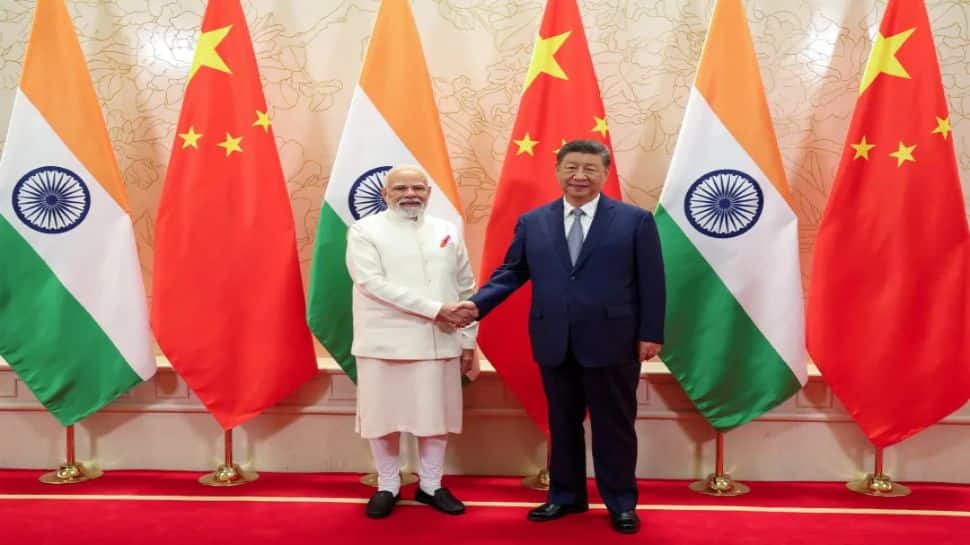
Tianjin (China): The sidelines of the Shanghai Cooperation Organisation (SCO) summit in Tianjin became the stage for a carefully orchestrated moment in diplomacy. Chinese President Xi Jinping warmly welcomed Prime Minister Narendra Modi, signalling a possible shift in the long and often tense relationship between the two countries.
“It is the right choice for both sides to be friends,” Xi said, inviting a future of cooperation between the Asian powers.
For decades, India and China have remained cautious in their interactions, locked in a relationship shaped by military standoffs, economic competition and political mistrust. But on this day, they took a measured step forward, moved not by ease but by the demands of a changing world.
The meeting took place in a climate shaped by global unease. Both India and China are now navigating the pressure of increasing tariffs imposed by the United States, as well as international scrutiny for their continued trade with Russia amid the war in Ukraine.
The atmosphere in Tianjin suggested a mutual recognition that some form of rapprochement was not only possible, but necessary.
Xi opened the meeting with a tone that felt as carefully staged as it was significant. “The world today is swept by once-in-a-century transformations. The international situation is both fluid and chaotic,” he said.
He spoke of a vision where India and China are not rivals, but neighbours and partners, “a dragon and an elephant dancing together”, in his words.
For Xi, the direction was clear: stability, mutual support and long-term partnership.
PM Modi approached the meeting with a resolve. There were no sweeping declarations, only words chosen with precision. He confirmed India’s commitment to advancing the relationship, emphasising that trust and respect must guide the process.
He acknowledged the fragile progress in easing tensions along the contested Himalayan border, where soldiers from both countries had clashed fatally just four years earlier.
He reminded the room of the stakes. “The interests of 2.8 billion people… tied to our cooperation,” Modi said.
It was a statement grounded in demographic truth and strategic necessity, an appeal to shared responsibility.
In Washington, officials and observers were paying close attention. The United States has spent years deepening its ties with India, positioning it as a democratic counterweight to China’s growing influence. But that equation has become less stable.
President Donald Trump recently announced sweeping economic penalties on India, citing its purchases of Russian oil. The tariffs, 25 percent, then increased to 50 percent, landed heavily.
Meanwhile, China has so far avoided similar treatment, and now watches India’s position closely.
Modi had spoken with Ukrainian President Volodymyr Zelensky a day before meeting Xi. He later referenced that conversation, stating that he had exchanged views on the conflict. India has maintained a stance of neutrality in the war, refusing to take sides but urging resolution. The balancing act continues.
Following the meeting with Xi, Modi held talks with Russian President Vladimir Putin. Over two days of high-level interactions at the SCO summit, the Indian prime minister will navigate a careful path among old allies, strategic competitors and shifting coalitions.
The SCO gathering brings together more than 20 countries, including Iran, Pakistan, Belarus and several Central Asian nations. It is a forum shaped by regional ambition and geopolitical recalibration.
At the summit’s welcome banquet, Xi and Putin shared light moments and animated conversation. They walked together after posing for a group photo with other leaders. The gestures did not go unnoticed. The scene suggested a degree of comfort and alignment between Beijing and Moscow, even as the war in Ukraine continued to loom large over the proceedings.
The meeting in Tianjin was also the first time Xi and Putin met in person since Putin’s recent talks with Trump in Alaska. Kremlin officials later confirmed that Xi and Putin had discussed those talks and the broader context of U.S.-Russia relations.
While the summit celebrated multilateral cooperation, deep undercurrents of mistrust still define several relationships within the group. India and China, in particular, carry the weight of recent history. The 2020 clashes in the Galwan Valley remain fresh in the minds of both nations. At least 20 Indian and four Chinese soldiers were killed in brutal hand-to-hand combat. Along their 2,100-mile Line of Actual Control, both armies continue to maintain a tense military presence.
Still, the tone in Tianjin was unmistakably different. Both leaders signalled a desire to move beyond confrontation. The Indian government’s official readout stressed that differences between the two sides should not escalate into disputes. It emphasised the need for a stable relationship built on cooperation and mutual respect. According to the statement, such stability is essential not only for bilateral ties but also for the vision of a multipolar world order.
The meeting did not solve long-standing issues, nor did it erase decades of strategic rivalry. But it began a process, tentative, deliberate and rooted in realism.
An understanding passed between the dragon and the elephant. The steps were slow, but the rhythm had begun.