

Ancient temples closed in the early 1990s with the exodus of Kashmiri Pandits from the Kashmir Valley due to terrorism are making their reopening, which is considered a significant step toward reclaiming the cultural heritage of Kashmir, and it helps in the restoration of trust and hope of Kashmir Pandits in their valley returning.
Under the Heritage Conservation and Religious Infrastructure Schemes of the Jammu and Kashmir Government, the centuries-old historical temples and religious places are being reopened, which were destroyed or remained abandoned for decades after the terrorist uprising in Jammu and Kashmir and the mass migration of Kashmiri pandits from Kashmir.
Budgam district of central Kashmir has a rich heritage of Kashmiri culture with ancient religious places, among them are centuries-old temples. Around 25 big and small temples are in Budgam, which have been in ruins since 90s. Among them, five are being renovated in the first phase, and the two most ancient are the Wasuknaag temple and the Sharda Mata Sthapna.
The Temple in Hushroo, Budgam district, holds significant religious and historical importance, particularly for the Kashmiri Pandit community, and is associated with centuries-old spiritual traditions. The temple is dedicated to Vasuki, a prominent figure in Hindu mythology, known as the king of nagas. Vasuki is depicted in Hindu iconography as coiling around Lord Shiva’s neck and is celebrated for his role in the Samudra Manthana. It is noted for its deep historical roots; it is said to have been made some 1000 years ago.
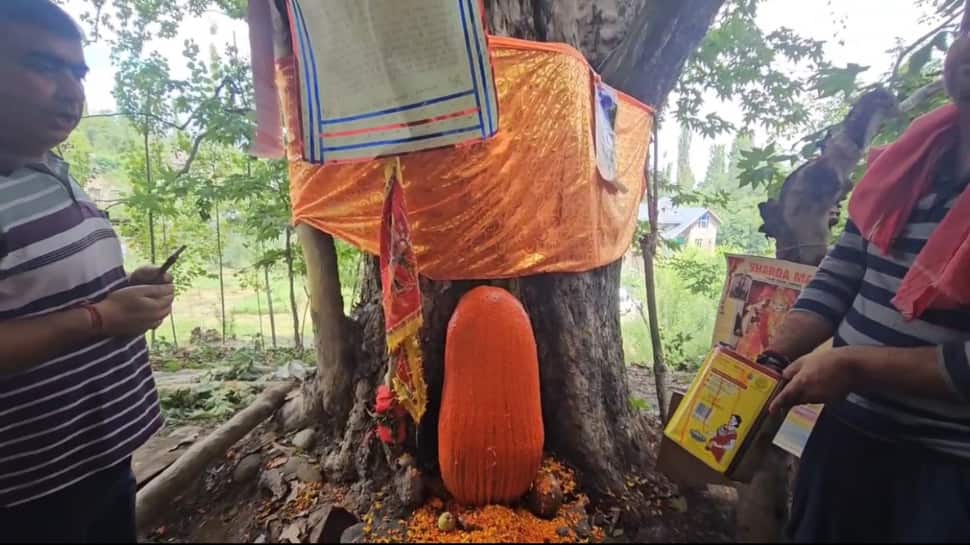
Kashmiri Pandits claim that spring at the Vasuki Nag Temple emerges from a Chinar tree named “Ganesh Bhoon”; the tree’s stem looks like lord Ganesh. They also claim that the spiritual spring comes out of the stem of that tree, and the tree too is being worshipped as old Ganesha.
Caretaker Babloo ji pandit said, “First this spring was upside in village in wagam which means wageshwari mata then it became wagam, then some unholy thing happened there then what we have heard from our elders it stopped there and spring emerged here from this “ Ganesh Booni” since then it’s here the water comes from this chinar tree and goes into this kund which is recently renovated we are thankful to administration but we to do much more here.”
“We are trying that whichever temple is deserted, we inform the government, and then the government helps if we talk of the district 10-15 temples that are taken up. We did hawan after 40 years, before the 90s we had twice programs here. If Muslims had not helped, I would not have been here after 40 years. I got peace back,” the caretaker added.
Budgam marked a significant cultural and spiritual milestone in the revival of Pandit religious activities after nearly three decades. The temple was reopened after initial renovation with a puja after 35 years, symbolizing a spiritual homecoming for the Kashmiri Pandit community. The funds for initial renovation were provided by the government of Jammu and Kashmir.
Pyare Krishan Bhat, another local Kashmir Pandit of the village, said, “What we have heard, I too am of the age of 70 years. What our elders said here was wasuknaag in the village after some unholiness emerged here, we used to celebrate here twice a year, but before 40 years. This year, after 40 years, again puja happened here, everyone used to have faith in that, it’s a beautiful place, it was also used as a picnic spot.”
Communal Harmony Amid Ceremony
The ceremony was supported by the district administration and local community, reflecting communal harmony. Local Muslims too remained very supportive, and the Pandits who are residing in temple premises are being provided all help by villagers, and they too want the old Kashmir cultures of brotherhood back.
Local villager, Mohammed Ashraf Ganai, said, “We also have faith in this temple. It’s a very old temple, not 10 or 20 years old. It’s 1000 years old. For the last one to two months, it has started again. We are all very happy that the Pandit brothers have come back, and we provide them with all the facilities. What they need. They are our brothers. We are happy that they are coming back.”
The Pandit community had made the ancient temple functional, but wanted a permanent security picket installed to guard the temple.
Babloo Ji Pandit said about security, “For security, we have applied to SSP and the deputy commissioner, but they have given us temporary, but they are without a weapon like me. The security with weapons is yet to be provided. It’s now been one month since we have to see when they will provide us with the security. We don’t know what the hindrance is of not providing security, but we need security. There should be security at the temple.”
Ich Kot Village
Another milestone stone Budgam had is reopening the Sharada Bhawani Temple in Ich Kot village after being closed for over 35 years due to terrorism and migration of Kashmir Pandits from the valley. This village is among the biggest villages of Kashmiri Pandits in Budgam. It had 35 Pandit households before the 90s. The temple was re-established with the ‘Mahurat’ and ‘Pran Pratishtha’ ceremonies, marking the reinstallation and consecration of the deity.
The temple is considered a branch of the revered Sharda Mata Temple in Pakistan-occupied Kashmir, one of the most significant spiritual and intellectual centers in ancient India, now in PoK.
It’s said that a Pandit of this village who was worshiper of Mata Sharda use to travel Sharda peeth every year in 18th century and in 1830 when the person became old and wasn’t able to walk much the goddess Sharda came in his dream and said him that you are old now and can’t walk now I will come with you, Same time Goddess Sharda came in dream of a Sharda peeth priest and advised him to give a wooden stick to the worshiper and ask him to plant it in his village, the worshiper did the same and that stick which was without root came out as big chinar tree and that chinar tree is considered since then by Kashmir pandits as Goddess Sharda.
Sunil Bhat Kashmiri pandit said, “It said that it has a history from 18th century we have heard a person from this village used to go Sharda peeth, which is in Neelam Valley PoK where Mata Sharda Temple is and he use to go every year and worship there with passage of time when he grew old, the Mata Sharda came in his dream Mata said him that I know you have grown old. You can’t come here now, no worries, I will come there, and the same day, Mata came in the dreams of the priest. Matas directed the priest to go to this place and plant a chinar tree. When the priest came and he planted the tree here. Since then, we believe that the tree is Goddess Sharda, and this has been going on since the 18th century; we used to worship the tree as Mata Sharda.”
The Sharada Bhawani Temple was reopened after 36 years of closure. The Sharda Asthapna Community, Budgam, played a key role in organizing the temple’s restoration. The efforts were supported by residents, also highlighting a collective desire to preserve the region’s shared heritage. The reopening signifies a step toward cultural and religious revival for the Kashmiri Pandit community in the region.
Sanjay Machama resident of the village, said, “We used to come every day here and worship here. The main function was held on Ram Naomi; it used to be a big festival here; all neighboring village people used to come here and participate. It used to be a different atmosphere here. The villagers have supported us fully, as we saw yesterday, when, after 36 years, we worshiped here, they were standing by our side. So, we felt that humanity is still alive, and we are hopeful that we will see the same Kashmir again.
Govt Initiatives
The Jammu and Kashmir government has undertaken several initiatives, including the Heritage Revival Scheme and the “Revival, Restoration, Preservation and Maintenance of Architecture and Heritage in Jammu Kashmir” scheme, to restore and preserve numerous religious sites and temples, many of which were damaged during decades of terrorism. These projects involve the restoration of hundreds of temples in phase manner using traditional materials and techniques to revitalize Kashmir’s rich religious and cultural heritage.