

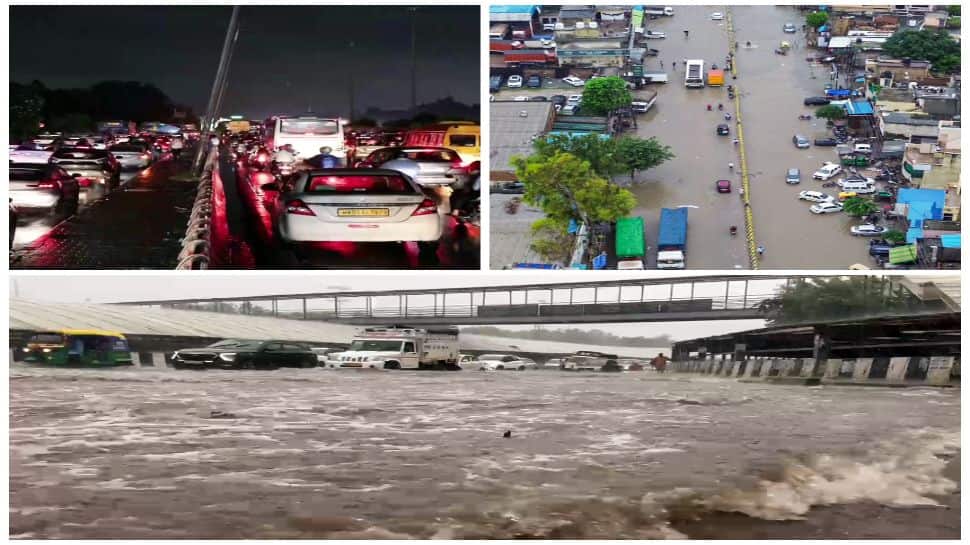
New Delhi: The rain fell almost evenly across the National Capital Region in the past three days. In Gurugram, it brought traffic to a crawl. Long lines of stranded cars stretched across main roads. Commuters said they sat for hours. The downpour was 100 mm, but the wait was endless. The Satellite City once again revealed its fragile urban design, where even moderate showers choke the city.
Meanwhile, Noida stayed on its feet. Often compared to Gurugram for jobs and housing, the city avoided major chaos. Waterlogging and traffic snarls remained limited. For planners and researchers, the answer lies not in the amount of rain but in the way the two cities were born.
Noida came into being during the Emergency in 1975, when Sanjay Gandhi, son of then Prime Minister Indira Gandhi, pushed to move industries out of Delhi. The Uttar Pradesh Industrial Area Development Act, 1976, created the New Okhla Industrial Development Authority, which would govern the new city.
Land acquisition was done in one sweep. Nearly 15,000 hectares across 50 villages were brought under the authority’s control. That number grew to more than 20,000 hectares covering 81 villages over time. Once acquired, the land was mapped for roads, sewers, drains, streetlights and footpaths. Developers came later. They built homes and offices over the skeleton of a ready-made grid.
The city was developed with proper planning. Drainage and road networks were made proportionate to the built infrastructure.
Gurugram grew on a different path. The Haryana government opened the gates in the 1970s through a set of laws. Private firms acquired land directly from farmers. The state promised external infrastructure, but the internal pieces were left to developers. Plots were scattered and irregular. Roads often ended in dead ends. There was no single grid.
The city was a public-private partnership model. The external infrastructure was developed by the government, but the internal network did not link properly.
Its topography added another layer. The Aravalli ridge to the south stands higher. Rainwater runs downhill towards the Najafgarh Jheel in West Delhi. Natural drainage channels once carried the flow. Those channels are gone now. Construction filled the gaps. Water finds no easy exit.
The result played out once again in the last three days when there was heavy downpour. Cars stood still. Water rose above the wheels. Tempers ran high. Branded as the Millennium City, Gurugram exposed its weakest seam.
In Noida, the design choices of the 1970s still show. The planned grid absorbs the rain. The roads remain open longer. The contrast grows sharper each season. Two cities side by side. Two stories written in water.