

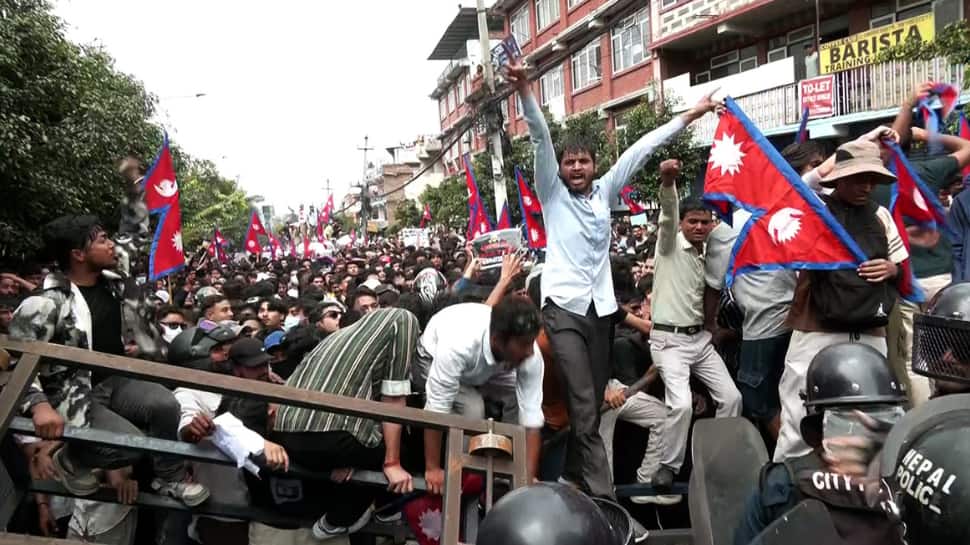
At least 14 people have died and more than 100 others sustained injuries in violent clashes in Kathmandu, Nepal, as Gen Z demonstrators took to the streets to protest against government corruption and a recent ban on several popular social media platforms, according to local media sources.
The unrest erupted after thousands of young protestors defied curfew orders and advanced into restricted zones near the Parliament. In response, security forces deployed water cannons, tear gas, and rubber bullets. The Nepal Army was also called in as tensions escalated, with some demonstrators reportedly breaching the Parliament compound, intensifying the crisis, The Kathmandu Post reported.
#WATCH | Nepal | Protestors vandalise the Parliament gate as the protest turned violent in Kathmandu, as people staged a massive protest against the ban on Facebook, Instagram, WhatsApp and other social media sites, leading to clashes between police and protesters pic.twitter.com/dkh9Mg7BGc
— ANI (@ANI) September 8, 2025
Widening Curfew And Security Measures
Following the violence, the Kathmandu District Administration Office extended the curfew, initially limited to the Baneshwar area. The new restrictions now encompass key high-security locations, including the President’s residence in Shital Niwas, the Vice-President’s residence in Lainchaur, Maharajgunj, all sides of Singha Durbar, and the Prime Minister’s residence in Baluwatar.
Chief District Officer Chhabilal Rijal announced that the curfew would remain in effect daily from 12:30 PM to 10:00 PM local time. Public gatherings, demonstrations, and any unauthorised movement within these zones are strictly prohibited.
#WATCH | Nepal | Protest turned violent in Kathmandu as people staged a massive protest outside Kathmandu Parliament against the ban on Facebook, Instagram, WhatsApp and other social media sites, leading to clashes between police and protesters. pic.twitter.com/XsGv1u6UFY
— ANI (@ANI) September 8, 2025
Among those injured was Kantipur Television journalist Shyam Shrestha, who was struck by a rubber bullet while covering the protest in Baneshwar. He is currently receiving treatment at Civil Hospital. Another individual was reportedly injured in Damak, the hometown of Prime Minister KP Sharma Oli, where demonstrations also turned violent.
Protests Spread Nationwide
Protests have now spread beyond the capital. In Pokhara, demonstrators reportedly vandalised the Chief Minister’s office, prompting local authorities to enforce a curfew. Prime Minister Oli has since called an emergency cabinet meeting to address the escalating situation.
Why Are People Protesting?
The unrest follows the government’s decision to block access to 26 unregistered digital platforms, including widely-used apps such as Facebook, YouTube, X (formerly Twitter), Instagram, and Snapchat. The abrupt restrictions, which began on Friday, left millions of users confused and frustrated.
The move has triggered significant outrage, particularly among the youth, who accuse the government of suppressing free speech while turning a blind eye to entrenched corruption.
A protester told ANI, “We were planning to hold a peaceful protest, but as we advanced further, we could see the violence by the police. The police are firing on the people, which is against the essence of peaceful protest. Those who are in power cannot impose their power on us. Anti-corruption protests are being suppressed, which is against the freedom of speech and the right to expression. The Police have been firing at protestors…”
#WATCH | Nepal | Protest turned violent in Kathmandu as people staged a massive protest outside Kathmandu Parliament against the ban on Facebook, Instagram, WhatsApp and other social media sites, leading to clashes between police and protesters. pic.twitter.com/jifSQlHFqC
— ANI (@ANI) September 8, 2025
Another protester, 20-year-old student Ikshama Tumrok, expressed anger at what she described as the regime’s authoritarian leanings.
Another protester said, “A while ago, the police fired bullets which did not hit me but hit a friend of mine standing behind me. He was shot in the hand. The firing is still going on, and we can hear gunfire from inside the parliament as well. My friend, who was standing on the road, was shot in the head. The police are firing indiscriminately, aiming above the knees. Are they allowed to do this?…”
The outrage has been further fuelled by viral TikTok videos contrasting the daily struggles of ordinary citizens with the lavish lifestyles of politicians’ children. TikTok remains accessible for now, unlike other banned platforms.
“There have been movements abroad against corruption, and they (the government) are afraid that might happen here as well,” protester Bhumika Bharati commented.
Government’s Position
Speaking at a convention of the ruling Communist Party of Nepal (Unified Marxist-Leninist), Prime Minister KP Sharma Oli declared that the party would “always stand against anomalies and arrogance, and never accept any act that weakens the nation.”
He added, “The independence of the nation is greater than the loss of jobs of a handful of individuals. How can it be acceptable to defy the law, disregard the constitution, and disrespect national dignity, independence, and sovereignty?”
The Nepalese cabinet had earlier instructed the affected platforms to register within the country, appoint a local contact, and designate grievance and compliance officers, in accordance with a Supreme Court ruling from September last year.
In a statement released on Sunday, the government maintained that it supports freedom of expression and is committed to creating an environment that ensures such rights are upheld.
Nepal has previously restricted online platforms. In July, Telegram was blocked due to concerns over online fraud and money laundering. Last year, a nine-month ban on TikTok was lifted after the company agreed to comply with local regulations.