

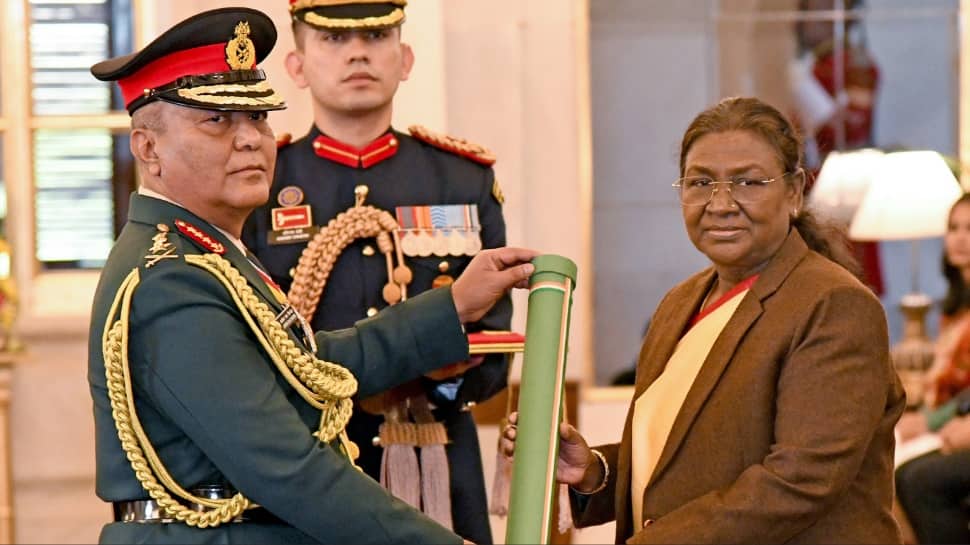
Following the Gen-Z protests in Nepal, both President Ram Chandra Paudel and Prime Minister KP Sharma Oli have resigned, leaving the Nepal Army to take charge of controlling the situation. With the military now at the forefront, the nation’s command rests in the hands of Army Chief Ashok Raj Sigdel. This report delves into his background and explores his significant ties to India.
A Professional Military Officer With Strong Regional Roots
General Ashok Raj Sigdel, who was born on February 1, 1967, in Nepal, is a professional and veteran military officer. He took the position as Chief of Army Staff of the Nepali Army on September 9, 2024. His rich background in education and training extends from Nepal to India and China, which provides him with a sound knowledge of the Indian and Chinese military systems and strategies. Even though he has taken military training from both the countries, his affiliation with India is especially remarkable owing to the especial relationship between the two nations. India has also awarded him the honorary rank of General of the Indian Army, indicating a greater closeness.
Distinguished Military Career And Extensive Education
General Sigdel possesses an MA in Tribhuvan University in Nepal. Furthermore, he has a Master’s in Strategy from the National Defense University in China. His strong affinity for India is clear through his attainment of the Defense Management Course there, which offers specialised studies in military operations, strategy, and management. This course has immensely enhanced solidarity and mutual understanding between the Indian and Nepal armies.
General Sigdel started his service in the Nepali Army in 1987 and has since occupied many senior roles. He has commanded key units at battalion, brigade, and division levels.
Military Education And Training In Three Countries:
In India:
Command and Staff College, Shivpuri (Madhya Pradesh): Attained command and staff training.
Defense Management Course, India: Improved his skills in defense management.
In Nepal:
Army War College, Nepal: Attained a higher command and management course.
In China:
National Defense University of China: Obtained a Master’s degree in Strategic Studies.
General Sigdel’s trilateral education has therefore conferred a large vision and rich experience upon him.
Strengthening India-Nepal Military Relations
The honour of giving the honorary title of General between the Indian and Nepalese armies is a tradition since 1950, which represents the strong military relations and deep friendship between the two countries. This tradition was followed even more when General Ashok Raj Sigdel went to India and received the honorary title. It is not a personal experience for Sigdel but a representation of respect and cooperation between India and Nepal’s armies.
Official Visits And Awards
In December 2024, General Sigdel had made an official trip to India, where he was awarded the honorary rank of General of the Indian Army by President Droupadi Murmu. This is a tradition representing the strong friendship and respect between the two armies and enhances the historical and symbolic relationship between Nepal’s and India’s armed forces.
India’s Foreign Secretary Vikram Misri in August 2025 gifted Sigdel with defense and medical supplies, highlighting the strong commitment towards defense collaboration between both nations. On the visit, he also attended as the chief guest the Passing Out Parade at India’s Indian Military Academy in Dehradun and interacted with Indian Army Chief General Upendra Dwivedi. This award is a reflection of the deep friendship and mutual collaboration in terms of military relations between India and Nepal, a legacy that has existed for more than 70 years.
Increased Military Cooperation And Strategic Dialogue
General Ashok Raj Sigdel’s India visit also strengthened the friendship and cooperation between the Nepali and Indian armies. In his interaction with Indian military officials, topics included joint military exercises, armament exchange, and cultural cooperation. The visit was not a mere ceremonial visit; it strengthened mutual trust, partnership, and strategic cooperation between the two countries. Generally, the visit was a great move towards enhancing India-Nepal defense relations.
ALSO READ | Why Are India’s Neighbours Collapsing? A Deep Dive Into Regional Instability