

New Delhi: China’s rise is not only economic but also technological. From railways to aerospace, the country has delivered breakthroughs that once seemed out of reach. Reports even suggest that Beijing has gone beyond the fifth generation of fighter jets and secretly developed a sixth generation prototype, although this has never been independently confirmed. What is certain, however, is that China has transformed its missile programme into one of the most advanced on the planet.
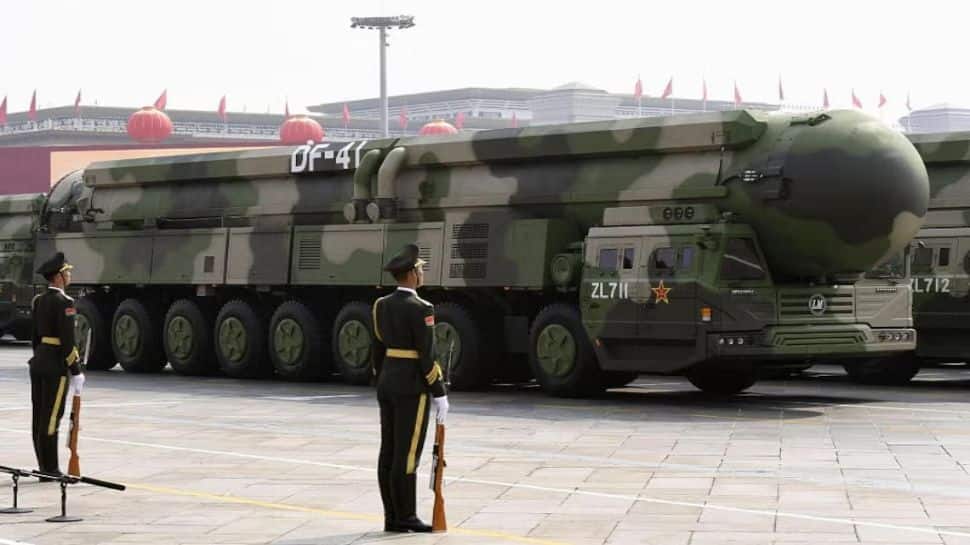
Among its most feared developments stands the DF-41 Dongfeng intercontinental ballistic missile (ICBM). With a range of 12,000 to 15,000 kilometres and a speed of nearly 31,000 kilometres per hour (Mach 25), it has the ability to strike down adversaries in mere moments. For comparison, India’s BrahMos, one of the world’s most lethal cruise missiles, appears far behind in terms of speed, range and payload. The DF-41 has effectively placed the United States itself within Beijing’s strike zone.
A Show Of Strength
In 2023, China reminded the world of its nuclear might when it conducted an intercontinental ballistic missile test outside its territory for the first time in four decades. Analysts believe the launch used the DF-31AG, a third-generation ICBM, but the global spotlight quickly shifted to the DF-41, widely seen as the crown jewel of China’s arsenal.
The History Of Dongfeng-41
The DF-41 officially entered China’s Dongfeng or “East Wind” missile family in 2017. The name traces back to Mao Zedong, who in the 1960s declared that the world was now divided between two winds – the East and the West.
Work on the DF-41 began in 1986, with the first tests carried out in 1994. By 2010, the missile was handed over to the Second Artillery Corps, which was later restructured into the People’s Liberation Army Rocket Force in 2016.
Between 2012 and 2016, China conducted six to eight tests before unveiling the DF-41 publicly during the 70th anniversary parade of the People’s Republic of China in 2019.
Cutting-Edge Capabilities
The DF-41 runs on solid fuel, allowing it to be readied for launch in very little time while remaining less vulnerable to detection. Its three-stage engine enables it to hit nearly every part of the American mainland.
Its most lethal advantage lies in its MIRV (Multiple Independently Targetable Re-entry Vehicle) technology, which allows the missile to carry multiple warheads at once. Chinese media claims the DF-41 can mount up to 10 warheads, though experts estimate it can reliably carry three to five. It also employs decoys and penetration aids designed to outsmart even the most advanced U.S. missile defense systems.
Variants Designed For Stealth, Reach
China has developed the DF-41 in three versions:
- Road-mobile, launched from an eight-axle transporter, allowing surprise strikes even from remote terrains.
- Rail-mobile, disguised as passenger trains, making detection far more difficult.
- Silo-based, supported by hundreds of newly built underground silos in Inner Mongolia, Gansu and Xinjiang.
A Generation Ahead
Compared with earlier Chinese missiles, the DF-41 represents a massive leap. The DF-5 offered greater range (13,000-16,000 km) but relied on liquid fuel, making it slow to prepare. The DF-31 used solid fuel but had a shorter reach (7,200-8,000 km) and carried only a single warhead.
Today, the United States still relies on the Minuteman-III ICBM with a range of about 13,000 km, while Russia is developing the RS-28 Sarmat, which is reportedly capable of striking up to 18,000 km.
The DF-41 sits between them and is faster to deploy, harder to track and frighteningly precise.
Nuclear Strategy, Expanding Arsenal
China maintains its public pledge of “No First Use” of nuclear weapons, insisting its arsenal is for deterrence and retaliation. Still, Western defense reports say Beijing is silently expanding faster than any other nuclear power.
A 2022 Pentagon report estimated China possessed around 350 ICBMs, while the Stockholm International Peace Research Institute (SIPRI) reported in July 2023 that the stockpile had grown to nearly 500 nuclear warheads, 90 more than the previous year.
Experts warn that within the next decade, China’s missile count could surpass both Russia and the United States.
The DF-41 Dongfeng missile has become the ultimate symbol of China’s rise. In speed, range and stealth, it embodies Beijing’s ambition to stand on equal footing with Washington and Moscow, reshaping the global balance of power one missile at a time.