

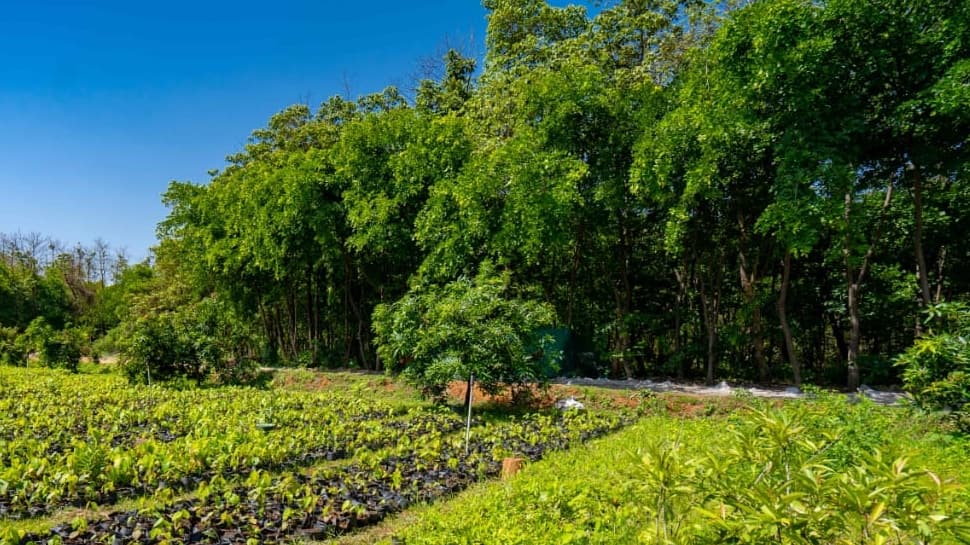
Chhattisgarh’s Parsa East and Kanta Basan (PEKB) coal mine in Surguja district has become the first in the state to successfully revive large-scale plantations of rare Sal trees, a species long considered a challenge to cultivate outside natural forests. The plantation, carried out on reclaimed mining land, comes in a sector more often linked with deforestation and land degradation.
Over 1.5 million trees have already been planted on reclaimed land, including the highly sensitive Sal variety. Sal (Shorea robusta) is considered the backbone of central India’s forests. Known for its resilience, the tree helps prevent soil erosion, enriches the soil with organic matter, and maintains groundwater levels. Its dense canopy regulates the local climate, while Sal forests act as natural carbon sinks, absorbing significant greenhouse gases.
For local communities, Sal is equally important — its resin, leaves, and timber provide livelihoods and cultural value. The revival of Sal in a mining zone is being seen as both an ecological and social gain.
India’s First Solar-Powered Coal Mine
Besides sal tree protection, the PEKB coal mine has also switched entirely to solar energy, setting a new trend in sustainable mining. With this move, the mine has achieved complete energy self-sufficiency while significantly reducing operational costs and carbon emissions.
The PEKB mine, which supplies coal to meet Rajasthan’s soaring power demand, is often described as a lifeline for nearly 80 million consumers in the state. Until now, mining operations were powered by conventional energy sources, but the adoption of solar energy marks a major transition in India’s coal sector.
Balancing Mining and Environment
While the project has faced criticism in the past over alleged environmental damage, the management claims the data tells a different story. Since 1980, only 0.5% of Chhattisgarh’s forest land has been used for mining. For every piece of land mined, officials say, double the area is earmarked for afforestation. So far, 1,898 hectares have been mined, while 548 hectares have been restored into new forests.
The mine has also generated direct and indirect employment for over 10,000 people and has been involved in many CSR initiatives like running schools, mobile hospitals, ambulances, and women’s self-help groups in nearby villages.
Project Under Debate
Despite these efforts, PEKB has frequently been at the center of political debates and protests, with critics alleging displacement of tribal communities and destruction of forest cover. The management, however, insists that fair compensation, jobs, and improved amenities are being provided to locals.
Project officials describe PEKB as ‘more than just a coal mine’, calling it an example of reconstruction and green development.