

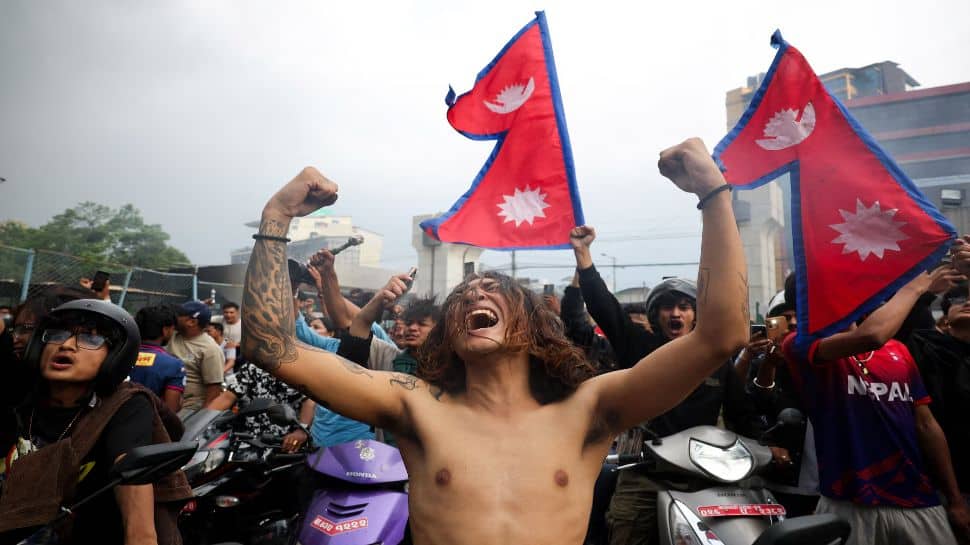
Kathmandu/Washington: Nepal has emerged from a week of violent demonstrations that brought down Prime Minister K P Sharma Oli’s government. The protest, led by Gen-Z, left around 50 people dead, set fire to Parliament and the Supreme Court and damaged hundreds of buildings. What began as anger over corruption, unemployment, high inflation and sweeping social media ban escalated into one of the most destructive political uprisings in the Himalayan nation’s recent history.
Now, questions are mounting over whether the unrest was spontaneous or scripted abroad.
The political storm had a long build-up. Back in March, The Sunday Guardian carried a detailed investigation claiming that a massive flow of U.S. funding into Nepal was linked to efforts at regime change. The report even named local political actors who allegedly played roles in the unfolding operation.
Internal communications from the United States Agency for International Development (USAID), along with programme outputs published by American democracy-promotion groups, suggest that Washington poured nearly $900 million into Nepal between 2020 and 2025.
Critics argue that much of this money did not go toward development, but instead into political training, narrative-building and networks that shaped the very protests that unseated Oli.
The U.S. Funding Trail
According to documents cited by the newspaper, the United States has allegedly committed more than $900 million to the country through aid and governance programmes since 2020. The majority of the funds were reportedly channelled through Washington-based Consortium for Elections and Political Process Strengthening (CEPPS), a partnership that includes the National Democratic Institute (NDI), the International Republican Institute (IRI) and the International Foundation for Electoral Systems (IFES).
In May 2022, the USAID allegedly signed a $402.7 million Development Objective Agreement (DOAG) with Nepal’s Finance Ministry. By February 2025, $158 million had already been disbursed, while $244.7 million remained unused.
In parallel, a separate $500 million Millennium Challenge Corporation (MCC) compact, signed in 2017, was allegedly finally ratified in 2022 despite fierce street protests and parliamentary battles.
By early 2025, only $43.1 million (8.63%) of MCC’s budget had actually been spent. The project’s mandate was still extended, keeping infrastructure and governance initiatives alive. The USAID and the MCC packages together brought U.S. commitments to Nepal to the $900 million mark, an amount that analysts describe as unusually large for a country of Nepal’s size and geopolitical weight.
Where The Money Went
Breakdowns of U.S. allocations show telling priorities: $37 million was allegedly earmarked for civil society and media, $35 million for adolescent reproductive health programmes and $8 million specifically for “democratic processes”. Even a relatively small $500,000 project for a “Democracy Resource Center Nepal” was allegedly fully expended.
On paper, these programmes sought to strengthen democracy, improve youth participation and ensure fair elections. But critics inside and outside Nepal argue that they served as tools of political engineering. Initiatives branded as health or research projects, they claim, doubled as instruments for building influence and shaping narratives.
NGOs, Training And The Youth Factor
The Sunday Guardian investigation highlights activities by the NDI, the IRI and the IFES that appear closely linked to the eventual uprising.
The NDI published reports between 2020 and 2022 on federalism, Dalit rights, climate change and youth participation. It also allegedly developed training toolkits for young activists.
The IRI allegedly conducted nationwide surveys gauging public dissatisfaction, focusing on youth disillusionment with unemployment and interest in new political parties. The IFES allegedly supported Nepal’s 2022 local elections with technical assistance and voter awareness campaigns.
Officially, these were programmes to deepen democracy. But as one Nepali analyst told the paper, they effectively inserted an American agenda into the country’s political ecosystem. Many of the protesters, who filled Kathmandu’s streets this year, were reportedly the same youth who once took part in U.S.-funded training and civic engagement programmes.
A Script Written In Washington?
The idea that a small South Asian nation could attract nearly a billion dollars in U.S. funding in just a few years has raised eyebrows. “For a country like Nepal, this scale of financial commitment is not normal,” said a Kathmandu-based political observer.
The suspicion deepens when tied to Nepal’s recent political trajectory. In the weeks before Oli’s fall, accusations of corruption and heavy-handed censorship had already sparked tension. When protests erupted, they quickly acquired the organisational structure, slogans and coordination more often seen in movements with outside backing than in purely spontaneous street anger.
The Sunday Guardian argued that what unfolded looked less like a sudden explosion and more like a pre-scripted scenario, one that had been rehearsed through years of training modules, toolkits and NGO-backed activism.
The Fire Next Time?
For Washington, programmes under the USAID, the MCC and the CEPPS remain framed as democracy-strengthening. For critics in Nepal, they are a thin cover for geopolitical maneuvering, inserting American leverage in a country sandwiched between China and India.
What is clear is that the Gen-Z protest movement, whose chants of anger toppled a government, was not born in isolation. It allegedly grew from years of structured funding, surveys, workshops and activism programmes that shaped a generation of Nepali youth. Whether those programmes amount to democracy promotion or regime engineering is now at the centre of one of South Asia’s most pressing debates.