

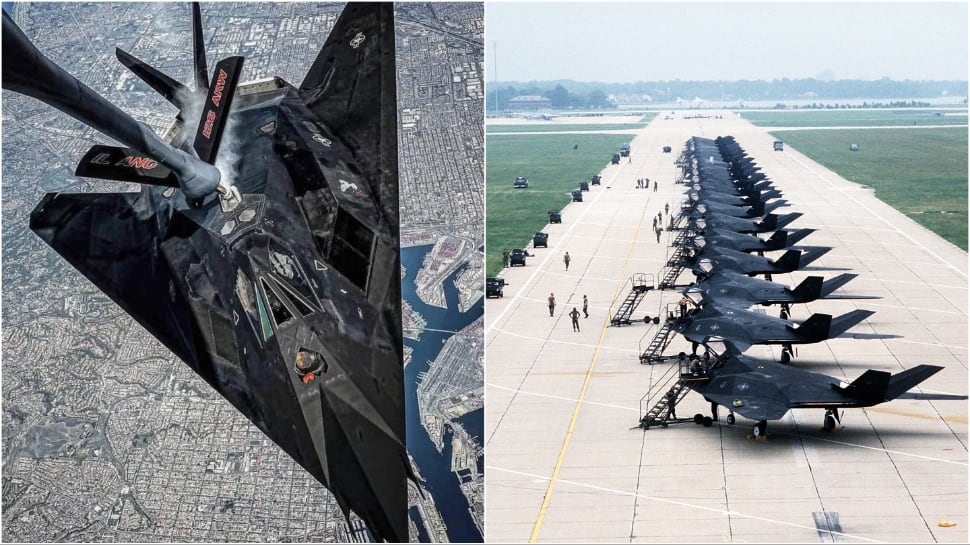
Twenty years since their formal retirement, two US Air Force F-117A Nighthawk stealth fighters were sighted soaring along the Mexican border on September 30, 2025, accompanied by an air refueling tanker. Images indicated the extended refueling boom reaching out to one of the aircraft, and the question on experts’ minds is: Is the US military putting its legendary “invisible” aircraft back into service?
Mysterious Sighting Near Mexico
The sighting was made of two Nighthawk jets flying formation with a U.S. tanker plane. The incident sparked major surprise, as the fleet of F-117A aircraft had been retired by official decree in 2008. Although the planes have been seen making test and training flights over the past decade, this recent flight is significant.
It seems to be the first significant news story after the Air Force’s certification of KC-46 Pegasus tanker refueling in March 2024. Experts opine it was not a coincidence but a planned mission, which could herald a new, permanent use for the retired aircraft.
The Legacy Of The F-117A Nighthawk
The F-117A, or the “Nighthawk” for its night mission profile, was the world’s first stealth operational aircraft. It was produced by Lockheed’s Skunk Works program during the 1980s, with its faceted shape and materials engineered to make it nearly invisible to adversary radar, which suited it perfectly as a precision strike mission platform.
The Nighthawk gained legendary status in the 1991 Gulf War (Operation Desert Storm), where it attacked high-value targets without being lost. It was formally retired in 2008 to be replaced by newer aircraft such as the F-35 and B-2. Nevertheless, over 50 F-117A airframes are still serviceable, usually for specialized testing or pilot training.
Testing New Capabilities And Tactics
Although older in design than the multi-role F-35 Lightning II or the nuclear-capable B-2 Spirit bomber, the F-117A’s original stealth technology continues to be very relevant. Its very low radar signature and demonstrated ground attack accuracy make it a resource highly useful for advanced testing.
Flying the F-117A with newer tankers such as the KC-46 or the KC-135 Stratotanker implies that the U.S. Air Force is using the aircraft as a testbed. This might include:
Refueling Certification: Concluding air-to-air refueling procedures for all stealth aircraft.
Stealth Tactics Training: Offering training for new pilots against an advanced, low-observable aircraft.
Integrating Unmanned Systems: Testing how retired stealth aircraft might be integrated with future drones or the new B-21 Raider bomber.
A Strategic Signal to International Rivals
The Nighthawk sighting is not merely a training exercise but has a strong strategic message. The U.S. is proving its ability to modify older systems for newer needs, and this is a strong message during increased competition with countries such as China and Russia.
The word is out: the U.S. military can continue to render older guns useful and deadly. Whether the Nighthawks are instructing pilots in sophisticated stealth warfare skills or acting as testbeds, their return reinforces the U.S. presence as the leader in air power. The F-117A’s return is not merely nostalgia; it is evidence of Washington’s relentless quest for innovation in the stealth warfare realm.
ALSO READ | Who Is Charlie Javice? The 32-Year-Old Forbes ’30 Under 30′ CEO Jailed For USD 175 Million JPMorgan Fraud