

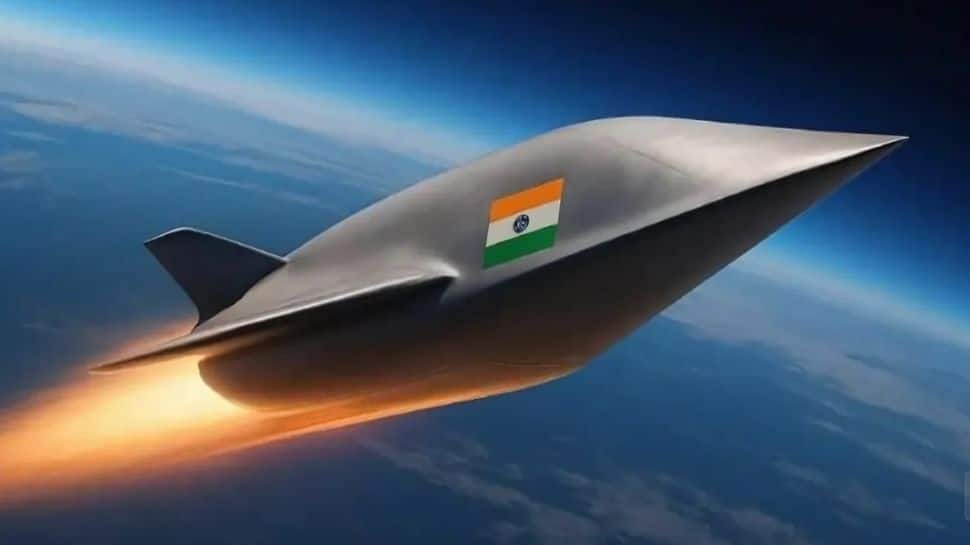
New Delhi/Beijing: India is stepping into the front line of next-generation missile warfare. The Defence Research and Development Organisation (DRDO) built the BrahMos, a supersonic cruise missile that no air defence system has managed to stop. Now the DRDO is working on a new missile that is expected to be even more powerful and lethal. Named Dhvani, the missile is regarded as among the most advanced in development, with capabilities beyond China’s DF-26.
Work is in its final stages on Dhvani, the hypersonic missile expected to undergo trials before the year ends. It is being built as a Hypersonic Glide Vehicle (HGV) and will fly at Mach 6, close to 7,400 km per hour. It can turn sharply during flight, shifting course to strike targets from unexpected directions. Defence specialists believe no air defence shield, not even America’s THAAD or Israel’s Iron Dome, can bring it down.
The missile’s design takes shape from the success of the Hypersonic Technology Demonstrator Vehicle (HSTDV). Through HSTDV, India mastered scramjet-based ramjet propulsion. Each ramjet test has crossed 1,000 seconds of continuous performance. That benchmark remains unmatched.
Unlike conventional cruise missiles, Dhvani carries a two-stage system. A rocket booster pushes it upward. Once released, the glide vehicle races towards its target at hypersonic speed. The missile travels at extremely low altitude, similar to BrahMos, but with six times the speed of sound. This speed and altitude combination makes interception impossible. Experts say the system can strike both land and sea-based targets with precision.
China’s DF-26 has been considered one of the most destructive hypersonic missiles in the world. But if compared critically, Dhvani goes far beyond. The DF-26 has been deployed for years and is known for long-range capability. But its design is locked to a relatively fixed trajectory, with limited agility in mid-flight. Dhvani is being shaped to outmaneuver defences, changing direction mid-course and deceiving radars.
The strike envelope of DF-26 also has restrictions in terms of altitude and sustained maneuvering. By design, Dhvani breaks those limits. This makes India’s strategic posture significantly more formidable. It also puts India in the rare group of nations that have developed operational hypersonic weapons, alongside the United States, Russia and China.
In recent months, the DRDO has carried out several successful component tests. These include aerodynamic modeling, thermal management, guidance systems and scramjet propulsion. Engineers have tested advanced ceramic thermal barrier coatings capable of withstanding extreme heat generated at Mach 6 speeds. These breakthroughs cleared the way for a full-scale flight test of Dhvani that is expected in 2025.
Defence analysts believe the pairing of BrahMos and Dhvani will give India a decisive edge. For at least the next 15 years, neither China nor Pakistan would be able to counter these systems. With Dhvani, India signals that its missile programme is not only keeping pace with global powers but is ready to set a new benchmark in the race for hypersonic supremacy.