

Cairo (Egypt): It was a little before midnight when US President Donald Trump broke the news. A short post appeared on Truth Social that said Israel and Hamas had agreed on the first phase of a peace framework. It promised the release of captives and mentioned troop withdrawal. It hinted at something that could end one of the bloodiest wars of this generation.
“Israel and Hamas have both signed off on the first phase of the peace plan. All of the captives will be released very soon. Israel will withdraw their troops to an agreed-upon line. That will be the first step towards a strong and durable peace. All parties will be treated fairly,” the post read.
This was not a random declaration. It was the first step of a 20-point peace proposal Trump had announced earlier this week to end the war, secure the release of Israeli captives and Palestinian prisoners and establish a new political structure for Gaza. The offer was welcomed by Israel, Hamas and several countries.
The war in Gaza has lasted nearly two years. More than 67,000 people have been killed, according to international rights organisations and a United Nations commission that described Israel’s military campaign as genocidal. Much of Gaza lies in ruins, and families in both Israel and the Palestinian territories continue to live in uncertainty and grief.
In this situation, Trump’s latest announcement has raised cautious hopes that one of the world’s most devastating conflicts might finally move toward a truce.
Just hours before his post, Trump had been at the White House, addressing a group of lawmakers and donors. In the middle of the event, U.S. Secretary of State Marco Rubio walked into the room. Cameras caught the moment he handed the president a folded note.
Trump paused, opened it and looked up at the reporters in front of him. “I was just given a note by the secretary of state saying that we are very close to a deal in the Middle East, and they are going to need me pretty quickly,” he said.
Ending the event abruptly, he added, “I have to go now to try and solve some problems in the Middle East.”
Later, photographs of that handwritten note surfaced. It urged him to post the announcement quickly on Truth Social so that he could be the first to break the news.
This moment was a culmination of the US president’s weeks-long diplomatic blitz. On September 29, following a meeting with Israeli Prime Minister Benjamin Netanyahu, Trump had unveiled his “roadmap to peace”, a document that proposed a multi-phase withdrawal of Israeli forces from Gaza, the release of all captives, a monitored exchange of prisoners and eventually, the creation of a multinational body to govern the territory until elections could be held.
When he spoke that night, Trump told reporters he was ready to travel to the region “as soon as this weekend” to help push the deal forward. His team confirmed that the first stage, involving hostage releases and troop redeployment, was what both sides had now agreed upon.
Trump, in his post, also thanked Qatar, Egypt and Turkiye for their mediation, calling it “a shared mission for peace”.
It was, by far, the most tangible diplomatic breakthrough of his new presidency, and one that had the potential to reshape his legacy. But the air of triumph quickly gave way to uncertainty.
What exactly had Israel and Hamas agreed to? What did this “first phase” actually look like?
Some serious disagreements still remain. According to Trump’s plan, once Hamas releases the captives, the war should end. But Israel insists the war can only be over after Hamas completely disarms.
In short, the peace deal was real, but many details were still being worked out. The timeline, troop withdrawals, Gaza’s post-war administration and even Hamas’s political future were all yet to be decided.
Ever the showman, Trump filled in some blanks on television. Appearing on Fox News with Sean Hannity, he said the captives, including the remains of those who had died, could be released as early as Monday.
A senior Hamas source, speaking separately to Al Jazeera, confirmed that surviving captives would be freed within 72 hours after the Israeli government’s approval. Israeli officials, meanwhile, hinted that the process could start as soon as Saturday.
Trump also said that Iran would be part of “the whole peace situation”, a phrase that suggested possible indirect talks through regional mediators.
Roughly 20 Israeli captives are believed to remain alive in Gaza. Hamas and allied groups took about 250 captives on October 7, 2023, during a surprise attack that killed more than 1,100 people in Israel and triggered the war that followed.
In Israel, the news was greeted with a mix of relief and political theatre. Netanyahu released a statement almost immediately.
“I offer my heartfelt thanks to President Trump and his team for their dedication to this sacred mission of freeing our hostages. With God’s help, together we will continue to achieve all our goals and enhance peace with our neighbours,” he said.
He called it “a great day for Israel”.
Across the border, Hamas issued its own carefully worded statement. The group said the agreement stipulated “an end to the war on Gaza, the occupation’s withdrawal from it, the entry of aid and a prisoner exchange”.
It expressed gratitude to Qatar, Egypt, Turkiye and Trump for mediating, but warned that the United States and other parties must “compel the occupation government to fully implement the agreement’s requirements and not allow it to evade or delay the implementation of what has been agreed upon”.
The statement continued, “We salute our great people in the Gaza Strip, Jerusalem and the West Bank, who have demonstrated unparalleled pride, heroism and honour. These great sacrifices and stances have thwarted the Israeli occupation’s plan for subjugation and displacement.”
It ended with a familiar refrain: Hamas would “not abandon our people’s national rights to achieve freedom, independence and self-determination”.
In Gaza, the reactions were raw and immediate.
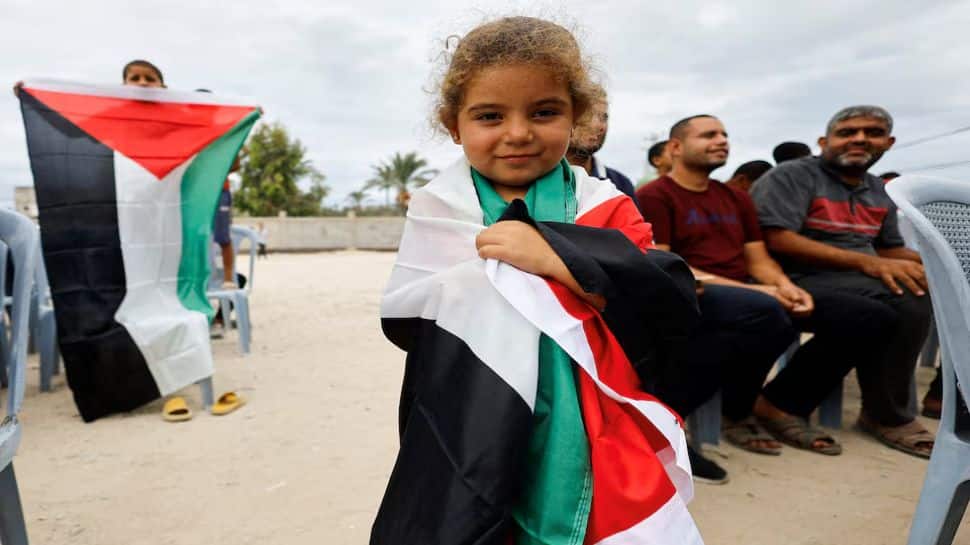
Al Jazeera reported from Deir el-Balah, where the sounds of gunfire and bombings had given way, briefly, to fireworks and cheers. Families ran into the streets. Mothers clutched photographs of missing relatives. People shouted the names of loved ones they hoped might be coming home.
People are desperately waiting to be reunited with loved ones and even to have a moment to mourn what they have lost. But this ceasefire has not taken effect so far, and caution is highly required among civilians regarding the return to homes in areas that are still classified as an active red zone.
For those who had survived two years of relentless war, hope was now colliding with disbelief.
The diplomatic world moved quickly to respond.
UN Secretary-General Antonio Guterres said, “I commend the diplomatic efforts of the United States, Qatar, Egypt and Turkey in brokering this desperately needed breakthrough.”
British Prime Minister Keir Starmer called for “the agreement on the first stage of Trump’s plan for Gaza” to be “implemented in full without delay”.
India’s Prime Minister Narendra Modi said he hoped “the release of hostages and enhanced humanitarian assistance to the people of Gaza will bring respite to them and pave the way for lasting peace”.
New Zealand’s Foreign Minister Winston Peters added that while this was “an essential first step” toward peace, “Hamas needs to release all of the hostages and Israel must withdraw their troops to the agreed-upon line.”
Back in Jerusalem, Netanyahu announced he would bring the agreement to his cabinet on Thursday for approval. Once it passes, Israeli forces are expected to pull back. Within 72 hours, Hamas is supposed to begin releasing captives.
The crucial point now is how much pressure will continue, especially on Israel, to ensure the ceasefire holds.
Trump, according to his team, is expected to travel to Egypt in the coming days. Netanyahu has invited him to address Israel’s parliament, an offer Trump told Axios he is “likely” to accept.
The next stage of his peace plan is already outlined. It calls for the creation of an international “Board of Peace” that would oversee Gaza’s reconstruction and post-war governance. Trump himself would chair the body, joined by global leaders and former officials, including ex-British Prime Minister Tony Blair.
But the optimism remains fragile.
Hamas has been offering all the hostages in exchange for an end to the war almost since the beginning. Israel has broken every ceasefire that was achieved up until this point.
The real test is still ahead. Both Israel and Hamas will have to follow the terms of the deal and avoid returning to fighting. They will also need to allow aid, goods and people to move freely across the border. For now, that stage has not been reached. The world watches the fragile space between announcement and reality.
A folded note. A late-night post. A promise that the war could pause, even if only for a while. The next few days will show whether Trump’s move can really bring peace to Gaza, or if it will become another ceasefire that never holds.