

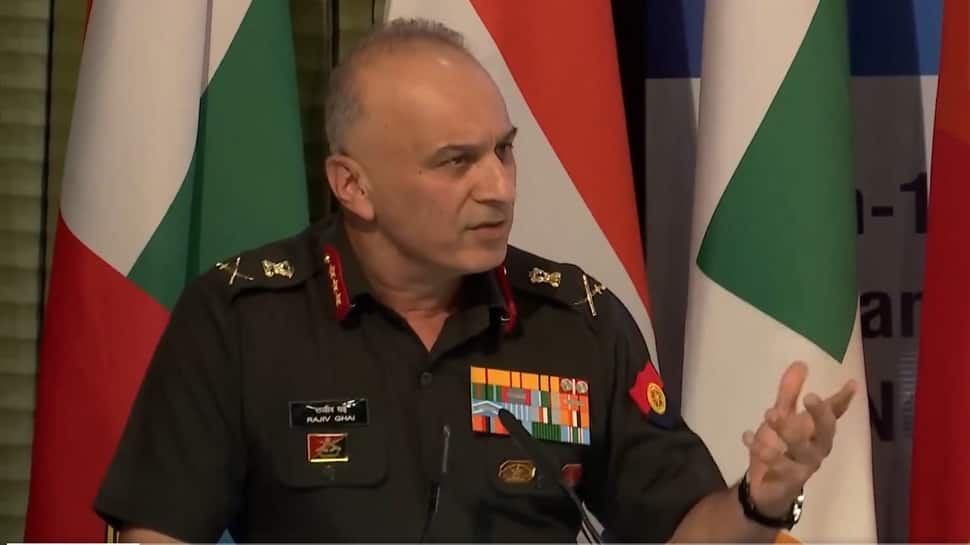
India’s Director General of Military Operations (DGMO) Lt Gen Rajiv Ghai has described Operation Sindoor — the country’s coordinated military response to the Pahalgam terror attack — as a decisive and precisely calibrated campaign that blended military power, diplomacy, and intelligence to achieve strategic objectives within days. Terrorists had killed 26 people in Kashmir’s Pahalgam and the army carried out precision strikes on May 6-7 hitting nine terror sites.
’88 Hours To Cessation of Hostilities’
Lt Gen Rajiv Ghai said that Pakistan sought a halt to hostilities just 88 hours after the operation began. “Eighty-eight hours is what it took for the enemy to come and ask for a cessation of hostilities… We achieved our political and military aims. We hit nine targets across the breadth of Pakistan,” he said.
Describing Operation Sindoor as a marker of India’s evolving strategic posture, the DGMO said it demonstrated a new maturity in India’s doctrine — one that “goes beyond the binaries of peace and war.”
“This was a fusion of military precision and diplomatic agility, informational superiority and economic leverage,” he added, noting that the Indus Waters Treaty of 1960 was put in abeyance the moment the Pahalgam terror attack occurred.
Air And Naval Operations
Lt Gen Ghai confirmed that the Indian Air Force and Navy played key roles during Operation Sindoor. “The Indian Navy had sailed into the Arabian Sea… Had the enemy decided to take it any further, it could have been catastrophic for them — not only from the sea but from other dimensions,” he said.
On the aerial front, he said that after Pakistani drones entered Indian airspace in large numbers, the IAF launched precision strikes on the nights of May 9 and 10, hitting 11 air bases and destroying key assets.
“Eight air bases, three hangars and four radars were damaged… One C-130 aircraft, one AEW system, and four to five fighter jets were destroyed on the ground,” he said, adding that the world’s longest ground-to-air kill — over 300 km — was recorded during the operation.
Striking At Heart Of Terror
Lt Gen Ghai presented imagery of key strikes conducted under Operation Sindoor, including high-value targets in Muridke and Bahawalpur, long known as hubs of the Lashkar-e-Taiba and other banned groups.
“In the strikes we carried out in the early hours of May 7, more than 100 terrorists were neutralised,” he said, referring to before-and-after satellite images from Maxar showing the destruction of terror compounds.
He described one scene where a UN-proscribed terrorist led funeral prayers attended by senior Pakistan Army officers, calling it “a blatant flaunting of the nexus between terrorists and the military establishment.”
Doctrine and Deterrence
Lt Gen Ghai said Operation Sindoor represents a doctrinal shift — where India’s responses combine military, diplomatic, and economic levers in a synchronized manner.
“Our actions were acknowledged openly to maintain credibility. We applied critical conventional measures and extended our punitive reach to unprecedented levels,” he said.
He added that Operation Sindoor marked a fusion of military precision and diplomatic agility, signaling a confident, capable India ready to deter and punish terror with calibrated force.
Operation Planning
Rejecting claims that the Indian Army was unprepared for Pakistan’s reaction, Lt Gen Ghai emphasized that the operation had been carefully wargamed and executed with clear escalation control.
“It’s naive to suggest that a professional army like ours would act without contingencies. We wargamed four to five steps ahead and hit them on the second layer — something they didn’t expect on the LoC. That’s why their casualties were so high,” he said.
He added that the Indian response was “targeted, controlled, and non-escalatory,” designed to achieve its objectives without triggering uncontrolled conflict.
Elimination Of Pahalgam Perpetrators
The DGMO confirmed that the three terrorists responsible for the Pahalgam attack were eliminated after a 96-day pursuit. “They were found and terminated clinically… They seemed exhausted from running and were malnourished,” he said.
Lt Gen Ghai reiterated that the government’s stance, articulated by the Prime Minister, is clear, “Terror attacks are acts of war. There will be decisive retaliation. We will not succumb to nuclear blackmail, and there is no distinction between terrorists and those who sponsor them.”
Pakistan’s Internal Pressure
Commenting on Pakistan’s domestic situation, Lt Gen Ghai said the Pakistani Army leadership faced internal pressure and loss of credibility, which influenced its actions.
“The Pakistan Army and its chief were under duress… The number of posthumous awards they announced later suggests their casualties on the LoC exceeded 100,” he stated.