

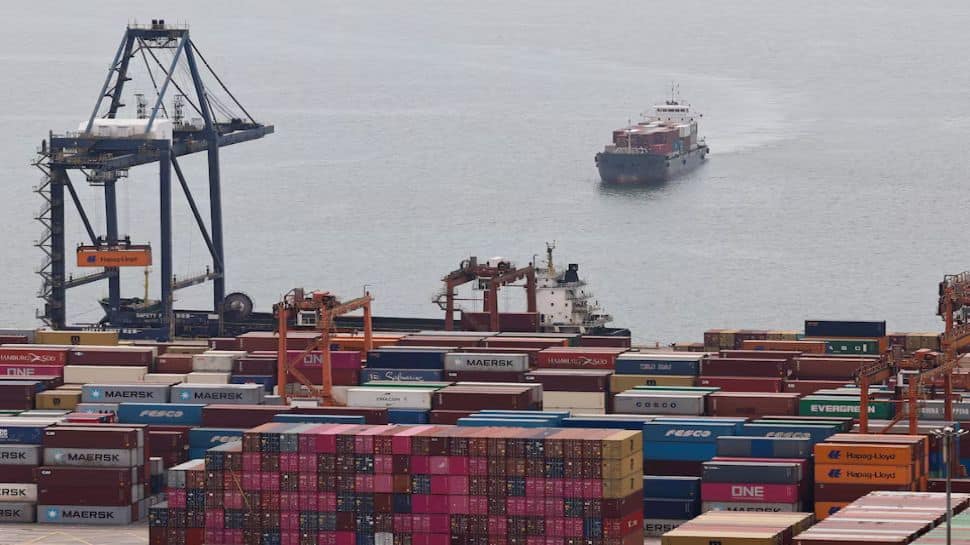
US-China New Port Fees Rift: The uneasy calm between Washington and Beijing has broken once again. This week, both nations introduced new port fees on vessels, signalling another turn in the trade tension that has altered global commerce.
The charges took effect on Tuesday. Analysts say the measures reveal how the seas have become a new front in the rivalry between the two largest economies. The fresh escalation follows China’s move to restrict exports of rare earth elements after the US administration imposed new trade curbs.
A meeting between President Donald Trump and Chinese Premier Xi Jinping is scheduled later this month at the Asia-Pacific Economic Cooperation (APEC) summit in South Korea. Officials in both capitals are now watching if the new maritime dispute will cast a shadow on the talks.
The New Port Fees
A White House executive order titled ‘Restoring America’s Maritime Dominance’ directed the United States Trade Representative (USTR) to begin collecting fees on vessels connected to China.
As per the order, operators of Chinese-owned or operated vessels must pay $50 per net ton, rising to $140 by April 2028; vessels built in China must pay $18 per ton or $120 per container, rising to $33 and $250 by 2028; each ship will be charged no more than five times a year; and long-term importers of US ethane and LPG using Chinese carriers will remain exempt until December 10.
China responded swiftly. On October 10, it announced parallel fees on US-linked ships, starting October 14. It announced that ships owned or operated by American entities will pay 400 yuan ($56) per ton, capped at five trips per year; the rate will rise to 1,120 yuan ($157) per ton over time; and empty ships entering for repair and Chinese-built vessels will remain exempt.
Beijing’s Ministry of Transport described the decision as “a countermeasure against wrongful and discriminatory practices” by Washington.
China also announced sanctions on five subsidiaries of South Korea’s Hanwha Ocean, accusing them of assisting US investigations into Chinese trade.
A Pattern Of Maritime Rivalry
The United States had earlier moved to impose higher fees on Chinese ships in April to boost domestic shipbuilding. The move followed an investigation under the Biden administration, which found China’s maritime industry benefitting from heavy state funding.
“China has long dominated shipbuilding and logistics through unfair policies,” said a White House trade official.
The Ministry of Commerce in Beijing replied to the allegation on Tuesday, “If the United States chooses confrontation, China will see it through to the end. If it chooses dialogue, China’s door remains open.”
China’s Lead In Shipbuilding
Data from the Center for Strategic and International Studies (CSIS) shows that China built 53 percent of all commercial vessels in 2024. South Korea and Japan follow, while the United States built only 0.1 percent.
The China State Shipbuilding Corporation (CSSC) remains the largest player in the sector and also builds naval warships. According to a US Department of Defense report, China’s navy had 355 ships in 2020 compared to 293 for the United States.
Washington has repeatedly expressed concern over Beijing’s control of the global maritime supply chain.
Washington’s Domestic Push
America began considering trade action against Chinese shipbuilding in mid-2024 after pressure from five major trade unions. They accused Beijing of distorting global competition through subsidies and state-backed investments.
Following months of hearings, President Trump issued Executive Order 14269, titled ‘Restoring America’s Maritime Dominance’, in April.
“We are going to resurrect the American shipbuilding industry. We used to make so many ships. We will make them again fast very soon.”
Matthew Paxton, head of the Shipbuilders Council of America, welcomed the order. “By using our domestic shipyards fully, we can restore competitiveness, strengthen defence and create thousands of skilled jobs,” he said.
Impact On Global Trade
Industry experts warn that the new measures could strain trade routes. According to Clarksons Research, Chinese port fees could particularly affect oil tankers, which represent 15 percent of global shipping capacity.
China’s top carrier China Ocean Shipping Company (COSCO) may face costs exceeding $3.2 billion. Reuters reported that European shipping companies such as Maersk, Hapag-Lloyd and CMA CGM are already shifting China-linked ships away from US ports.
“We are in the hectic stage of disruption. Ship owners are trying to improvise workarounds,” said independent analyst Ed Finley-Richardson.
Some US vessel operators are reportedly selling cargo mid-route to divert away from Chinese ports, though Reuters could not confirm the reports.
Meanwhile, Hanwha Ocean’s shares fell 6 percent after Beijing sanctioned its subsidiaries.
Rare Earths And The Next Chapter
China, which dominates global supply of rare earth metals used in electronics and defence manufacturing, announced new export curbs on five materials (holmium, erbium, thulium, europium and ytterbium) under its Announcement No. 61 of 2025.
President Trump responded by warning of 100 percent tariffs on Chinese goods starting November 1.
The two countries had agreed in September on a 90-day pause to ease earlier trade tensions, but that truce expires around November 9. The latest measures suggest a new cycle of economic confrontation may already be underway.
Global markets are watching closely. Economists fear that continued escalation could disrupt supply chains and slow global recovery.
As one analyst put it, “This is no longer about ships or tariffs. It is about power and the routes that connect the world.”