

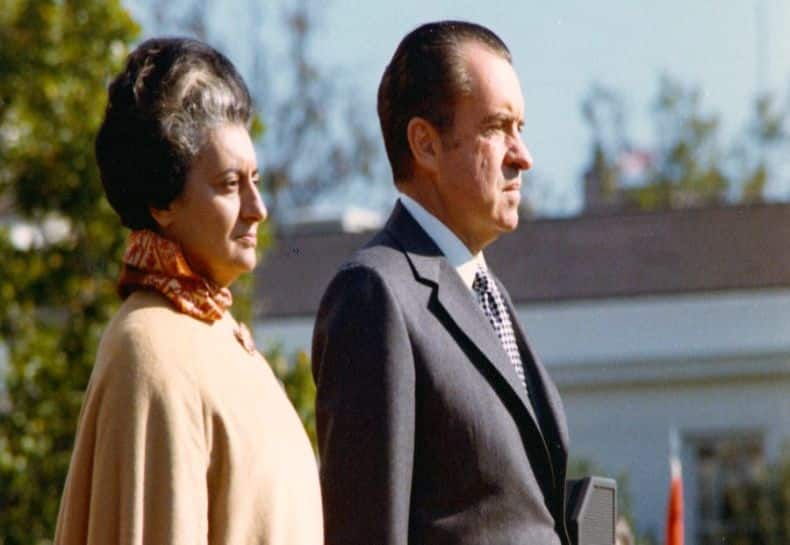
New Delhi: Less than four months after the guns fell silent in the India-Pakistan war, a closed-door meeting took place in March 1972 in the Oval Office. Then U.S. President Richard Nixon sat with his National Security Advisor Henry Kissinger. Across from them was Aziz Ahmed, secretary-general of Pakistan’s foreign ministry, accompanied by senior American and Pakistani officials. The bitterness of December 1971 was lingering. The discussions revealed how far the United States was prepared to go to reassure Pakistan of its support.
Kissinger opened the meeting by recalling the difficult period they had endured together during the war. “We went through tragic days together in December,” he said, as cited by The Indian Express, adding that Pakistan enjoyed the goodwill of the United States.
He was of the opinion that the next six months would be critical for Islamabad. He believed that an Indian attack was unlikely before President Nixon’s upcoming summit in Moscow, or even for some time afterward.
Then came an assurance. “We will not let Pakistan down. If there is another attack, we will react violently,” Kissinger told the Pakistani side, according to the daily.
He explained that the Indian ambassador had already been informed that Washington could not cut off military aid to Pakistan unless India agreed to halt its acceptance of Soviet military support. The suspended $87 million in aid would not be restored, but Nixon’s stance toward Pakistan was described as one of “very warm feelings”.
Ahmed reportedly responded with concern over India’s military posture. He claimed that New Delhi had moved three Army divisions to the West Pakistani border. He also mentioned that Indian Army chief General Sam Manekshaw had travelled to Moscow, possibly to secure equipment to replace losses from the recent conflict.
According to Ahmed, the daily reported, India might be preparing either to put pressure on Pakistan during negotiations or to launch a more serious offensive. There were even suggestions that India could attempt to seize “Azad” (Pakistan-occupied) Kashmir, although Chinese assessments indicated such a move would be unlikely before Nixon’s Moscow visit.
The warmth between Washington and Islamabad in this period was not confined to words. Months earlier, on March 17, 1971, US Secretary of State William P. Rogers had sent a memorandum to Nixon titled ‘President Bhutto’s Proposals for Closer Military Collaboration’. The memo outlined a series of offers from Pakistan that highlighted its strategic importance to the United States.
The memo said Pakistan was prepared to provide port access and tracking station facilities along the Arabian Sea, including locations at Jiwani, Gwadar, Sonmiani Bay, Karachi and the coastal areas to the south and east of the city.
Gwadar, in particular, as per the report, was flagged as a potential deep-water port that could significantly boost the economic development of the surrounding region.
Access for American forces would be granted on an “as-needed” basis, with no plans for large numbers of U.S. personnel to be stationed in the country.
Then Pakistan’s Defence Secretary Ghias Uddin Ahmed told U.S. officials that the war with India had created a new strategic environment. Having suffered defeat with India backed by the Soviet Union, Pakistan now faced urgent security challenges. While insisting that Islamabad had no intention of attacking India, he argued that the country needed credible deterrence.
He spoke of exploring closer defense ties with Iran and Turkey and improving relations with Afghanistan. Ghias also pointed to growing Soviet naval cooperation with India, citing facilities at Visakhapatnam and in the Andaman Islands. In his view, these gave Moscow an enhanced naval presence in the region.
In a separate meeting on February 3, 1972, Nixon sat with Kissinger and U.S. ambassador to India Kenneth Keating. The President’s assessment of the subcontinent was characteristically blunt. “Neither country should be a country. They are too poor and too bloodthirsty,” The Indian Express quotes him as saying.
Ambassador Keating suggested that a regional framework similar to the European Economic Community could provide stability.
Nixon expressed the belief that India should focus on its real challenge, which he saw as China. “India should not waste its resources fighting Pakistan,” he said.
He admitted that he had been too lenient with then Prime Minister Indira Gandhi during her visit to Washington and that, if the United States had wanted to restrain India, it should have taken a tougher line.
“I have always defended India,” Nixon maintained, stressing that India had a friend in the White House. The United States’ outreach to China, he said, was motivated by its own strategic goals and was not directed against India.
Turning to Kissinger, according to the report, Nixon asked for agreement on his assertion that America remained India’s best friend. Kissinger responded carefully, “That is true. But we must move at a measured pace.”
Preserved in the U.S. State Department Archives, the conversations from those months paint a vivid picture of a Washington balancing Cold War strategy with its deep ties to Pakistan, even in the immediate aftermath of a war that had redrawn the map of South Asia.