

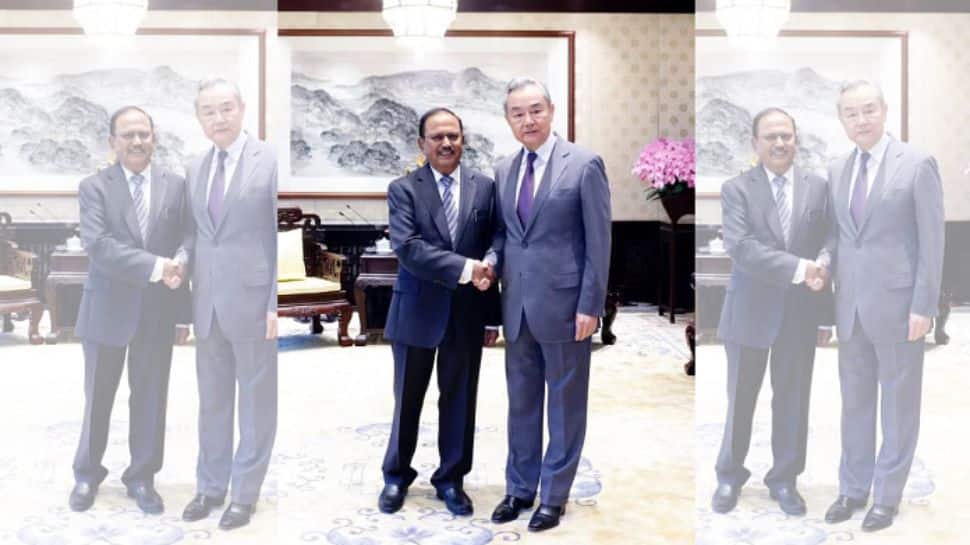
New Delhi: Beijing has claimed that India has reaffirmed Taiwan as part of China. The assertion came during talks in New Delhi where National Security Advisor Ajit Doval hosted Chinese Foreign Minister Wang Yi. The duo met for the 24th round of boundary negotiations on Tuesday.
The meeting followed another round of discussions a day earlier. External Affairs Minister S Jaishankar had held talks with Wang Yi on Monday.
A statement released by the Ministry of Foreign Affairs in Beijing quoted Jaishankar who said that a “stable, cooperative and forward-looking relationship” would serve the interests of both countries. The statement also quoted him as telling Wang Yi that India regarded Taiwan as part of China.
Officials in New Delhi later gave a different version of the talks. A senior source said India had not changed its stand. The source said Jaishankar told Wang Yi that India’s links with Taiwan were centred on economic, cultural and technological ties.
India used to reaffirm the ‘One-China’ policy in joint statements with Beijing. That practice stopped after 2008 when China started issuing stapled visas to residents of Jammu and Kashmir, Ladakh and Arunachal Pradesh. Beijing used the visas to back its territorial claims.
The Modi government indirectly acknowledged the policy again in 2018. Air India was asked to replace the word “Taiwan” with “Chinese Taipei” on its official website. Taiwan condemned the step. Officials in Taipei said the move showed India “succumbing to the unreasonable and absurd pressure” from Beijing.
The One-China policy has been in place since 1949. The People’s Republic of China came into existence after the communist victory in the civil war.Formally the Republic of China, Taiwan became the seat of the nationalists. The policy recognises only the People’s Republic of China and denies the legitimacy of Taiwan.
India has followed this line since 1949. That is why India and Taiwan do not have embassies or consulates in each other’s capitals. Instead, the India-Taipei Association functions as New Delhi’s de facto mission in Taipei.
Taiwan’s presence in India is represented by the Taipei Economic and Cultural Centre (TECC) in New Delhi. Another TECC opened in Chennai in 2012.
Taiwan has recently expanded its footprint in India. A new TECC started operations in Mumbai in 2024. The decision came despite protests from Beijing. Taiwan sees India as a key market for its technology companies and a possible base for new factories.
Beijing has closely watched political exchanges between New Delhi and Taipei. In June 2024, China lodged a protest after Prime Minister Narendra Modi replied to a congratulatory message from Taiwan’s President Lai Ching-te. The message followed the victory of the National Democratic Alliance in the general elections.
The situation along the border has also shaped the conversation. In April and May 2020, Chinese troops moved to alter the status quo in eastern Ladakh. The stand-off has continued for more than four years. The incident prompted calls within India for a policy review on Taiwan. The government chose not to revise its position.
Jaishankar’s reaffirmation of Taiwan as part of China came at a sensitive time. India and China are attempting to restore bilateral ties. Relations had dropped to a historic low after the Ladakh crisis.