

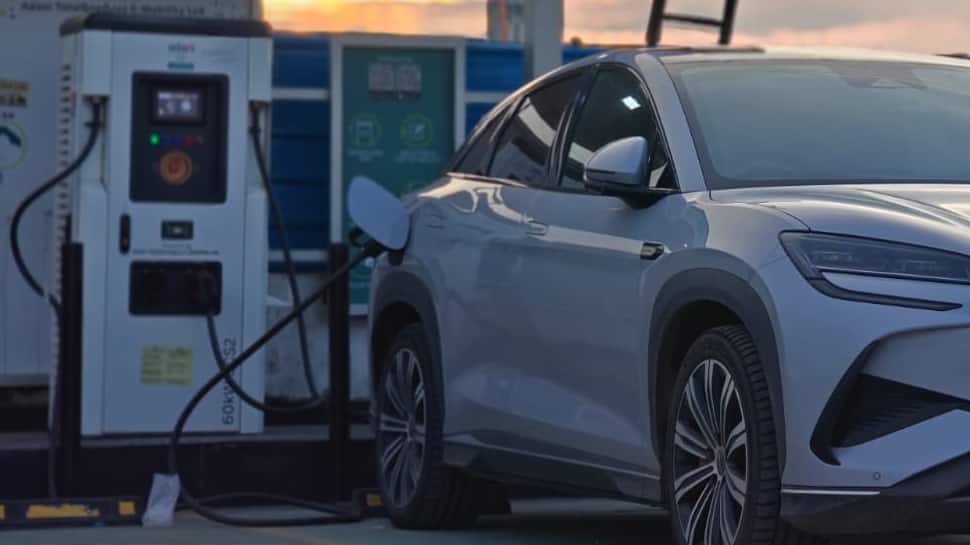
New Delhi: The entire world’s attention is on electric vehicles. In countries like China and the US, EVs are already quite popular, while many other nations are making big bets on them, including India. The Indian government is offering incentives to promote electric vehicles. Major OEMs are also investing their money in improving the electric vehicle infrastructure across the country. However, broadly, there are two camps: one that sees EVs as the future of mobility, and another that rejects them and favors traditional ICE vehicles.
Additionally, considering practicality, there’s also a third group with a mixed opinion, believing ICE vehicles and EVs will move forward together and coexist in the future. Responding to the question of whether EVs can ever fully replace ICE vehicles, industry expert Ankita Patwa said that EVs will eventually dominate the market, but it will be a gradual process.
Can EVs ever fully replace ICE vehicles?
She said, “The short answer: eventually, but not everywhere, all at once. Analysts like BloombergNEF see EVs grabbing 70% of new car sales by 2040, thanks to cheaper batteries and tougher emissions rules. But heavy trucks, rural commutes, and certain industries will hold onto ICE for longer, much like diesel stuck around after petrol took over. EV dominance will require more than tech—it’ll take charging where people actually drive, a grid that’s clean and reliable, and a plan for recycling all those batteries. In other words, the future’s electric, but it’s a long road with a few detours.”
Where does India lack in expanding EV infrastructure?
Patwa said, “India’s EV infrastructure is more of a patchwork than a network. Depending on who you ask, we have between 4,500 and 12,000 public chargers, a fraction of what’s needed. They’re bunched up in cities, leaving highways and smaller towns stranded. Fast chargers are rare; multiple connector types add confusion; and utilities aren’t always ready for the extra load. Compare this to China’s ultra-dense charging grids and you see the gap. Without faster rollout, common standards, and a focus beyond metros, we risk EV adoption stalling outside urban islands of convenience.”
Also Read: New FASTag Annual Pass Launched At Just Rs 3000 – Eligibility And Other Key Details
How should India move further to enhance EV adoption?
“We need to think about highways before showrooms. The U.S. NEVI program’s every-50-km fast charger rule could be India’s blueprint. On the cost side, point-of-sale subsidies—not rebates months later—make EVs more tempting. Scaling domestic cell production through the PLI scheme could slash battery costs, while renewable-powered chargers ensure we’re not just shifting emissions from tailpipe to smokestack. And let’s not forget the software layer: sharing real-time charger availability data, like the U.S. mandates, could kill range anxiety overnight. The goal? Make EV ownership feel as effortless as filling a tank.”
How is the U.S. EV infrastructure different than ours?
When asked about the differentiation factors between India and the U.S. EV infrastructure, Ankita Patwa, Founder of The GreenSolve, said, “In the U.S., the $7.5B federal charging push created a clear map: chargers every ~50 miles along major highways, open-access payment systems, and strict uptime rules. Result? By mid-2025, they had ~196,000 public ports, including ~60,000 fast chargers, and one universal plug standard (NACS) giving all drivers access to Tesla’s gold-standard network.”
Comparing it to our EV infrastructure, she further said, “India, meanwhile, is still city-centric, AC-heavy, and standard-diverse, with fewer than 12,000 total stations. We’ve focused on two- and three-wheelers—a smart move given our market—but long-distance EV driving here is still a test of patience, planning, and luck.”
What kind of incentives have most effectively boosted EV adoption in the U.S., and can they be helpful here in India?
“America nailed the balance: $7,500 off at the dealership for eligible EVs, plus juicy manufacturing credits—up to $45/kWh for battery modules—to keep costs falling. Federal grants for charging took away a lot of the financial risk for private operators. That combo pushed EVs to 10% of U.S. sales in 2024. India could adapt this by expanding FAME to cover all buyers at purchase, rewarding local production, and linking subsidies to performance and reliability. The key lesson: incentives work best when they hit both supply and demand at the same time.”
Is the U.S. consumer market fully accepting EVs, or are there still significant barriers?
Answering that, Ankita Patwa said, “Not quite. EVs crossed the 10% market share milestone in 2024, but early 2025 saw sales slip as some tax credits expired for popular models. Charging is still a pain for apartment dwellers and rural drivers, and upfront costs put off budget-conscious buyers. Cold-weather range anxiety is real in northern states. Even so, record infrastructure growth and more affordable LFP-battery models are expanding the audience. Think of it this way: the U.S. is past the “early adopter” phase, but still figuring out how to make EVs the default choice.”
Also Read: 65% Of Indian Pin Codes Now Have EVs: India Charging Report 2025 By TATA.ev
What technology in EV batteries has proven most impactful in America?
Patwa said, “The unsung hero is LFP—Lithium Iron Phosphate. It’s cheaper, doesn’t catch fire easily, and lasts longer, even if it’s not the lightest. By April 2025, LFP made up ~46% of global EV battery capacity, finding its way into Teslas, Fords, and budget-friendly models under $40k. For long-range sedans and SUVs, high-nickel chemistries still rule. Solid-state is the “someday” promise, but right now, LFP’s cost edge is making EVs accessible to more Americans—and that’s arguably the most important innovation of all.”
Are American automotive companies prioritizing EVs primarily for environmental or economic reasons?
“The press releases talk about saving the planet. The boardrooms talk about saving margins. California’s 2035 ICE ban and federal emissions rules set the direction, but the real push comes from IRA tax credits, avoiding fines, and owning profitable niches like electric pickups. That’s why Ford sells both the F-150 Lightning and hybrids, and GM is spreading bets across EVs, hybrids, and ICE refreshes. Environmental goals make for a compelling mission statement; economics decide how—and how fast—that mission actually gets executed.”
Could India’s EV transition benefit significantly from America’s technology and policy experience?
Patwa said, “Absolutely, if we adapt rather than adopt. The U.S. corridor charging model—with uptime guarantees and universal payment—could transform highway EV travel here. A single connector standard would end plug confusion. Point-of-sale subsidies and manufacturing credits could boost both adoption and local supply chains. But India’s edge is its two- and three-wheeler dominance, dense cities, and lower-cost innovation. Learning from U.S. policy design while tailoring it to our realities could let us leapfrog stages of EV adoption—and avoid some of America’s early missteps.”