

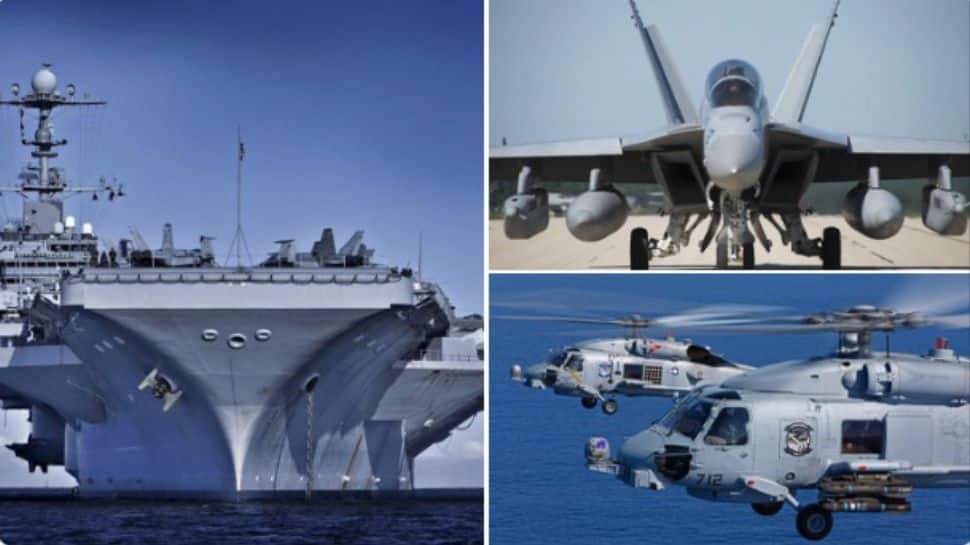
The Impossible Just Happened in the South China Sea and no one saw it coming. Something unthinkable just unfolded over the South China Sea. Within just 30 minutes, two American military aircraft, an F/A-18F Super Hornet fighter jet and an MH-60R Seahawk helicopter, fell from the skies over one of the world’s most volatile maritime zones.
Both aircraft had passed all safety checks. Both were fully operational before takeoff. Yet somehow, both went down, almost back-to-back, over waters claimed by China.
Coincidence? Not everyone thinks so. According to Iranian media, this was no accident. They claim China used a powerful “electric shock” weapon to disable the American aircraft mid-flight.
Iran Drops The Bombshell: China’s ‘Electric Shock’ Weapon
Iranian media outlet Iran Observer has made a sensational claim that’s sending shockwaves through military circles worldwide: China deliberately downed both American aircraft using electromagnetic pulse or directed energy weapons, essentially delivering an ‘electric shock’ that fried their systems mid-flight. If true, this would mark the first time China has weaponized electronic warfare technology to directly attack American military assets in disputed waters. This isn’t just a game-changer. This is a declaration that the Dragon has fangs America didn’t know existed.
The claim starts to sound more believable when you look at the odds. What are the chances that two completely different aircraft, a fighter jet and a helicopter, would both suffer sudden, unexplained failures within the same 30 minutes? It’s the kind of coincidence that’s hard to swallow. Military aviation experts are already calling the incident “highly suspicious” and “virtually impossible without some kind of outside interference.”
Trump Calls It ‘Extraordinary’ But Denies Conspiracy
US President Donald Trump, currently on an Asian tour, addressed the incident during a press interaction in Japan. “This is an extraordinary event,” Trump admitted, his choice of words raising eyebrows across defense establishments. However, the President quickly downplayed conspiracy theories, suggesting possible fuel contamination as a cause. Yet his own description, “extraordinary” contradicts the mundane explanation of fuel problems. When the President of the United States calls twin aircraft crashes ‘extraordinary,’ the world listens.
The US Navy has similarly denied any sabotage or external attack, but their denial rings hollow against the backdrop of Iran’s explosive claims and the suspicious circumstances. In the South China Sea, where China has built artificial islands, militarized reefs, and repeatedly challenged American freedom of navigation operations, nothing happens by accident.
Miracle Survival: All Crew Members Safe
In what can only be called a miracle, all five crew members made it out alive. The two pilots of the Super Hornet and the three aboard the Seahawk were safely rescued and are said to be in stable condition. Their survival, though, raises even more questions. If both aircraft suffered mechanical failures serious enough to bring them down, how did everyone walk away unharmed? The fact that all five survived points to something unusual, perhaps controlled descents rather than violent crashes and adds weight to growing speculation that some external electronic force may have interfered, rather than a simple technical malfunction.
South China Sea
Welcome to one of the most volatile stretches of ocean on the planet, the South China Sea. China lays claim to almost all of it, turning reefs into military outposts and patrolling waters that the rest of the world considers international. Its sweeping claims have put it on a collision course with several neighbors, including Vietnam, the Philippines, Malaysia, Brunei, and Taiwan.
At the same time, countries like India, Japan, Australia, and the United States regularly send their ships through the region to assert freedom of navigation and push back against what they see as China’s overreach.
The stakes here are enormous. Beneath these waters lie vast oil and gas reserves and some of the richest fishing grounds on Earth. More importantly, this sea serves as a vital artery for global trade, about $5 trillion worth of goods moves through it every year. Whoever dominates the South China Sea holds sway over one of the world’s most important economic lifelines.