

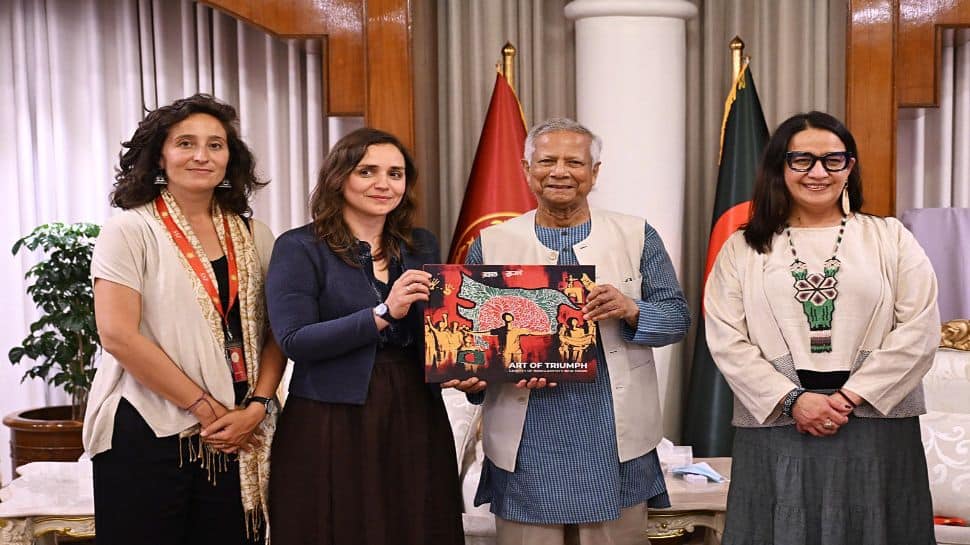
New Delhi: Bangladesh’s Interim Chief Adviser Muhammad Yunus shared a controversial artwork called titled ‘Art of Triumph’ with a visiting Turkish parliamentary delegation. The presentation comes days after he showcased the same to a senior Pakistani military official. Intelligence sources say the document contained more than visual representation. It reportedly included “battle plans” and “post-victory management frameworks”, aimed at presenting Assam as a “productive and viable region” under Dhaka’s influence.
He presented the same artwork to Nurul Izzah Anwar, vice president of Malaysia’s People’s Justice Party and daughter of Prime Minister Anwar Ibrahim, and representatives of the United Nations Working Group on Enforced or Involuntary Disappearances (WGEID). The artwork outlines what is being described as a “Greater Bangladesh” vision, including India’s northeastern states, with a particular focus on Assam.
Chief Adviser seeks UN support over probe into incidents of enforced disappearances
Dhaka, June 16, 2025: Chief Adviser Professor Muhammad Yunus said Bangladesh would welcome any support from the United Nations in its investigations into the incidents of enforced disappearance… pic.twitter.com/r2t0uHE388
— Chief Adviser of the Government of Bangladesh (@ChiefAdviserGoB) June 16, 2025
Amirul Feisal Wan Zahir, Managing Director of Sovereign Wealth Fund Khazanah Nasional Berhad calls on Chief Adviser Professor Muhammad Yunus at his hotel in Kuala Lumpur on Tuesday. pic.twitter.com/NjiFiAYBGT
— Chief Adviser of the Government of Bangladesh (@ChiefAdviserGoB) August 12, 2025
Chief Adviser Seeks Malaysia’s Support for Bangladesh’s ASEAN Membership
DHAKA, Sunday, July 27: Chief Adviser Professor Muhammad Yunus on Sunday renewed his call for Malaysia to support Bangladesh’s bid to become a member of the ASEAN.
The Chief Adviser made the call when… pic.twitter.com/RAgGA3wMIh
— Chief Adviser of the Government of Bangladesh (@ChiefAdviserGoB) July 27, 2025
Officials familiar with the matter say the gesture was intentional and meant to signal specific ideological networks rather than serve as casual symbolism.
“This was not an art display but a message. It was directed at transnational Islamist networks that view Bangladesh’s interim leadership as part of a broader strategic consolidation,” said the official.
The timing of the presentation is being closely scrutinised. Sources suggest it aligns with Turkey’s outreach across South and Southeast Asia. Ankara has actively sought to expand influence through military cooperation, drone technology and ideological partnerships.
Since early 2024, Ankara has strengthened relations with Dhaka through training programmes, defence collaborations and technology investments.
For Turkey, Bangladesh represents an extension of its South Asian strategy, offering a potential counterbalance to India’s growing regional presence. For Dhaka’s interim leadership, closer ties with Ankara provide international legitimacy and new defence connections during a period of domestic uncertainty.
The reference to “Greater Bangladesh” marks what analysts describe as the first overt territorial signal from Dhaka’s interim government.
The sources suggest it may serve to test regional responses while consolidating ideological support among Islamist groups domestically and abroad.
India’s security agencies are reportedly monitoring these developments closely. Officials describe the narrative as a rhetorical escalation that could heighten tensions in an already sensitive border region.