

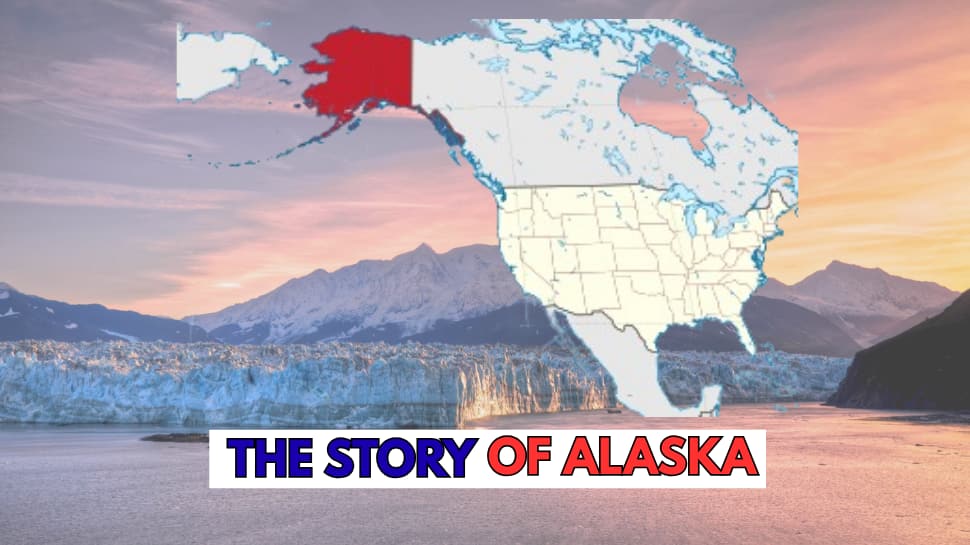
Trump-Putin Alaska Summit: In a twist of history, Russian President Vladimir Putin on Friday walked on the land that his nation sold away over a century and a half ago. He attended the highly anticipated summit with US President Donald Trump, which was held at Joint Base Elmendorf-Richardson in Anchorage, marking the first face-to-face encounter between the two leaders in seven years. The icy ground beneath them, once dismissed as worthless, took centre stage in efforts to thaw today’s geopolitical freeze.
As the red carpet was rolled out in one of America’s most remote and symbolic states, the location of the summit raised eyebrows and questions. Why Alaska? The answer lies in history, geography, strategy, and a forgotten deal once dismissed as foolish.
From “Seward’s Folly” To Strategic Powerhouse
On 30 March 1867, US Secretary of State William H. Seward signed a deal to purchase Alaska from Tsarist Russia for $7.2 million. At the time, the deal was widely mocked. Critics called it “Seward’s Folly,” deriding the barren land as “Seward’s Icebox” and “Walrussia.”
But Seward had the last word. Asked years later to name the greatest achievement of his career, he said without hesitation: “The purchase of Alaska… but it will take the people a generation to find it out.” And he was right.
Also Read: Trump-Putin Alaska Meet: Russia-Ukraine Conflict Discussed Without Zelenskyy | Key Highlights
Russian Roots Of America’s Northern Frontier
Humans have lived in Alaska since at least 14,000 BCE, crossing an ancient land bridge from Siberia. But it wasn’t until the 18th century that Russia made its mark. Explorer Vitus Bering’s expeditions, backed by the Russian crown, opened the door to colonisation, driven mainly by the lucrative fur trade.
Soon after, the Russian-American Company was established to expand settlements and exploit Alaska’s natural resources. At its peak, Russian America stretched from modern-day Alaska down to Fort Ross in California. But by the mid-19th century, overhunting had decimated fur-bearing animals, and the colony became more of a burden than a boon.
Russia, reeling from its loss in the Crimean War, began to reconsider its American holdings. By 1857, Tsar Alexander II’s government was actively exploring a sale. The US stepped in.
Gold, Oil, And Alaska That Paid Off
While the purchase was strategic, it took time for its true value to emerge. Gold was discovered in Alaska in 1880, triggering a rush. But the real turning point came nearly a century later.
In 1968, the massive Prudhoe Bay oil field was discovered on Alaska’s northern coast, one of the largest in North America. Oil transformed the state’s economy and secured its place as a cornerstone of US energy policy.
Alaska: Icy Stage For Diplomatic Gamble
The choice of Alaska as the summit venue is no coincidence. Here’s why it matters:
1. Legal Loophole for Putin
Putin remains under indictment by the International Criminal Court for alleged war crimes in Ukraine. While over 120 countries recognise ICC jurisdiction, the United States does not. Hosting the summit on US soil, specifically Alaska, protects the Russian leader from legal complications. It’s a calculated move, one previously extended to Israeli PM Benjamin Netanyahu, who also faces ICC charges.
2. Close, Yet Cold: Alaska’s Strategic Symbolism
Just 4km of water separates Russia from Alaska via the Bering Strait. Once part of Russian territory, the state embodies centuries of shared history and tension. Its location is a stark reminder of how close the two nations really are, both geographically and historically.
3. Fortress Alaska
The summit is being held at Alaska’s largest military installation, Joint Base Elmendorf-Richardson. Combining air and ground forces, the base offers high-level security and seclusion, far from the media glare of Washington or New York. It also underscores Alaska’s continued role in US defence, especially in the Arctic.
4. Arctic Interests In Play
Alaska is a front line in the US-Russia Arctic rivalry, from emerging shipping routes to untapped energy reserves. Holding talks here sends a strong message that Arctic cooperation (or competition) remains on the global agenda.
Also Read: ‘Ukraine War Wouldn’t Have Happened If…’: What Putin Said After Meeting Trump
A History That Still Haunts
Although the 1867 sale was seen as a victory for the US, in modern Russia, it’s viewed with growing regret. In recent years, Russian lawmakers and media have questioned the legality of the deal and lamented what they now see as a giveaway of resource-rich land.
According to past reports, in July 2022, amid heightened nationalist sentiment following Russia’s invasion of Ukraine, Duma Speaker Vyacheslav Volodin provocatively called Alaska a “disputed territory” and suggested it should be “returned.” But when asked in 2014 if Russia would ever reclaim it, Putin dismissed the idea, saying, “My dear, why do you need Alaska? It’s too cold.”
From ‘Frozen Folly’ To ‘Diplomatic Crossroads’
Alaska was once a colonial outpost of little value, sold off in desperation. Today, it’s a symbol of power, strategy, and shared history, the perfect backdrop for a meeting that could shape the next chapter of US-Russia relations.
As Trump and Putin met on the icy frontier, the past and future of this vast, frozen land came sharply into focus.