

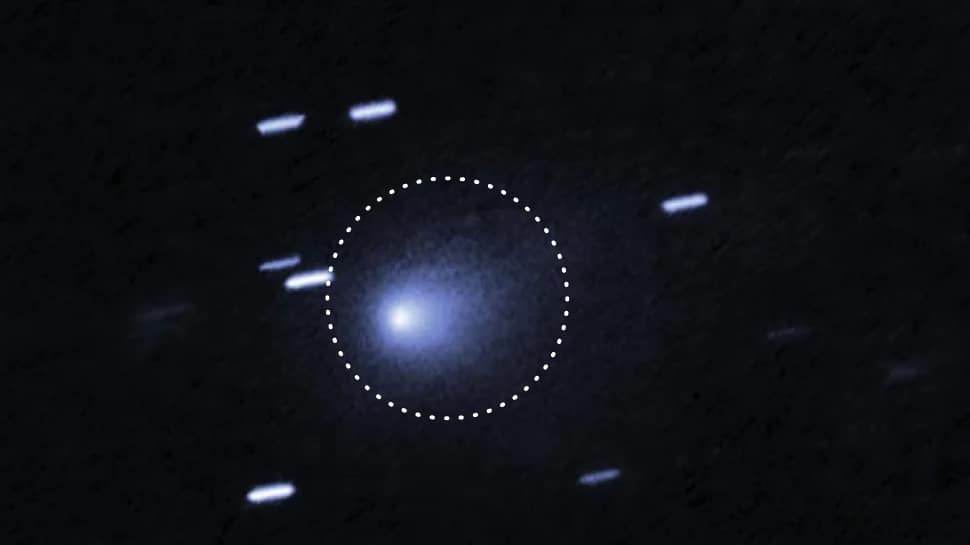
Comet 3I/ATLAS Mystery: The scientific community is abuzz as the interstellar comet 3I/ATLAS, a colossal object estimated to be the size of Manhattan, blazes through our solar system, triggering a wave of curiosity and caution. Detected in July 2025 by the ATLAS survey telescope, the comet has since displayed highly unusual behavior, prompting NASA’s International Asteroid Warning Network (IAWN) to launch an emergency observation campaign.
With an anti-solar tail inexplicably shifting direction, experts have been left wondering whether the comet’s movements are purely natural, or the result of something entirely unknown. The phenomenon has fueled theories that the object could be an engineered structure or a potential “Trojan horse” from beyond the stars.
Why Scientists Call 3I/ATLAS a Potential ‘Black Swan’ Event
Described as a “Black Swan” event, a rare, unpredictable phenomenon that could redefine our understanding of the universe, 3I/ATLAS has sparked intense global scrutiny. According to astrophysical analyses, the comet could weigh over 33 billion tons, making it 1,000 times heavier than any interstellar object previously detected.
Researchers are questioning why such a massive object suddenly appeared in our inner solar system. The Minor Planet Center has organised a global observation mission from November 27, 2025, to January 27, 2026, marking the first coordinated international effort to study an interstellar visitor of this magnitude.
Could This Be an Alien ‘Trojan Horse’?
As data pours in from telescopes worldwide, Harvard astrophysicist Avi Loeb has raised eyebrows with his provocative hypothesis that 3I/ATLAS may not be a comet at all. He suggests the object could be a technological artifact, possibly an extraterrestrial probe exhibiting signs of controlled movement.
Loeb likened the situation to “a blind date,” warning that while the object may seem harmless, it could conceal hidden intent. His comparison of 3I/ATLAS to a “Trojan Horse,” a visitor that appears natural but harbors something unexpected, has ignited fierce debate across scientific circles and social media alike.
NASA’s Official Stand: No Immediate Threat, But Vigilance Is Key
NASA maintains that there is no current threat from 3I/ATLAS. However, its unpredictable trajectory and non-gravitational acceleration, which could alter its path near Jupiter, Venus, and Mars, have led to heightened monitoring. The IAWN’s “comet campaign” will focus on tracking its course and refining detection methods for future interstellar visitors.
As the comet approaches its closest point to the Sun, astronomers hope to determine whether it’s simply reacting to solar radiation, or using the Sun’s gravity for a deliberate maneuver.
What Lies Ahead for 3I/ATLAS?
If the comet turns out to be a natural interstellar wanderer, it will eventually slingshot past the Sun and exit our solar system, leaving behind valuable data about the cosmic materials beyond our galactic neighborhood. But if the anomalies persist, if 3I/ATLAS behaves more like a controlled spacecraft, it could mark a historic shift in how humanity perceives intelligent life in the cosmos.
Either way, 3I/ATLAS has already earned its place as one of the most enigmatic and potentially game-changing discoveries of the decade, a celestial visitor that could rewrite the story of our universe.
ALSO READ | Comet 3I/ATLAS Breaks Speed Records: Could Cross NewYork To Beijing In 3 Minutes
(This article is intended for your general information only. Zee News does not vouch for its accuracy or reliability.)