

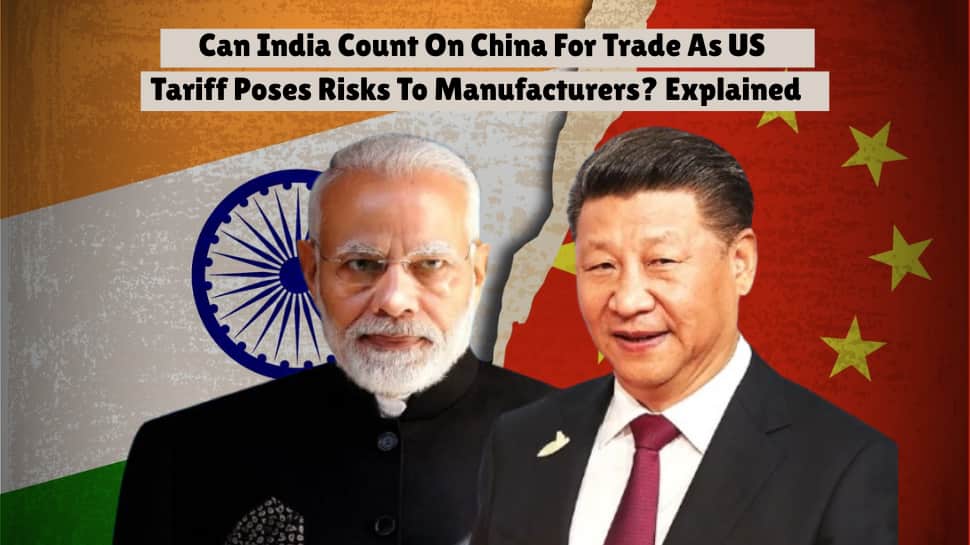
New Delhi: India stands at a critical crossroads in global trade diplomacy after changing dynamics with the US, and China extending olive branches in New Delhi. As US President Donald Trump slaps tariffs on Indian goods as high as 50%, the much-publicised Modi-Trump bonhomie now appears to be a thing of the past.
As relations with the US grow increasingly strained, India is quietly exploring alternatives, including a delicate reset with China, an option that may carry more strategic and economic risks than continued negotiations with Washington.
Later this week, Prime Minister Narendra Modi is expected to visit Tianjin, the host city for the 2025 Shanghai Cooperation Organisation (SCO) Summit, and meet Chinese President Xi Jinping, marking a significant shift in bilateral dynamics since the deadly Galwan Valley clashes of 2020.
Back then, anti-China sentiment ran high. The Indian government banned several Chinese apps and tightened FDI rules to restrict Chinese investment. India even withdrew from the Regional Comprehensive Economic Partnership (RCEP), wary of Beijing’s influence within the world’s largest free trade bloc. Policymakers feared the Indian market would be flooded with low-cost Chinese imports, harming the domestic industry.
In recent years, India has pitched itself as a manufacturing alternative to China under the “China +1” strategy. However, it has struggled to convert this positioning into large-scale investments, competing with countries like Vietnam, Mexico, and Poland.
Despite the tensions, Beijing has been quietly extending diplomatic feelers. According to reports, China reached out to India in March this year. India only responded in June. The recent remarks by Chinese Ambassador Xu Feihong added fuel to the debate. “The US has imposed tariffs of up to 50% on India and even threatened more. China firmly opposes it. Silence only emboldens the bully,” he said, echoing phrases once used by Modi himself to describe India’s place in global affairs.
Yet, re-engaging China economically is far from straightforward.
India’s Trade Structure Makes China A Risky Partner
At the heart of India’s dilemma is the nature of its economy. India is import-driven; China is export-focused. This imbalance makes a deeper trade relationship structurally lopsided. India’s exports to China are limited and not particularly essential for Beijing. But China produces a vast range of affordable goods, machinery, electronics, and industrial components that India consumes in large quantities.
As a result, India already faces a trade deficit of nearly $100 billion with China, while maintaining a $40 billion surplus with the US. Strengthening trade with China will likely deepen this deficit, increase dependency, and make India’s domestic industries more vulnerable to being undercut.
Strategic Contradictions
India’s growing alignment with Western democracies, its ambitions to lead in clean tech and semiconductors, and its domestic political structure stand in stark contrast to China’s state-led economy and opaque governance.
China’s long-standing military and diplomatic support to Pakistan further complicates matters. Even in recent conflicts with Pakistan, Indian forces have had to contend with Chinese-made weapons in enemy hands.
Global Pressure And Domestic Risk
If India appears too close to Beijing, it could damage its credibility as a neutral player for Western investors seeking to diversify away from China. Countries like Mexico are already imposing fresh tariffs on Chinese imports, reportedly under US influence. If India is perceived as sympathetic to Beijing’s trade ambitions, it could find itself isolated from the very markets it’s trying to tap into.
Moreover, with China facing deflation and overcapacity, it is actively seeking new markets to dump surplus production. India, with its large consumer base, could become a prime target and, if not careful, may find itself absorbing the overflow of cheap Chinese goods-further damaging its already vulnerable manufacturing base.
Strategic Realities & Long-Term Risks: The Bigger Picture
Despite shared growth stories, India and China remain divided on strategic, political, and governance lines.
India’s hesitancy to fully open its markets stems from structural economic weaknesses. For years, coalition politics was blamed for delaying reforms. But even a decade of stable single-party rule hasn’t delivered major liberalisation. In fact, India’s trade posture has become more protectionist since 2014.
As the US adopts a more transactional and tariff-driven approach, and China seeks to offload its excess capacity, India must tread cautiously. Aligning too closely with either power carries risks–one demands market access, the other may flood India with exports.
In this moment of global realignment, India’s trade choices must be guided not by opportunism or short-term relief, but by long-term strategic clarity. Choosing China as a counterweight to Trump’s tariff regime may offer temporary breathing room-but it could come at a high cost to India’s economic sovereignty.