

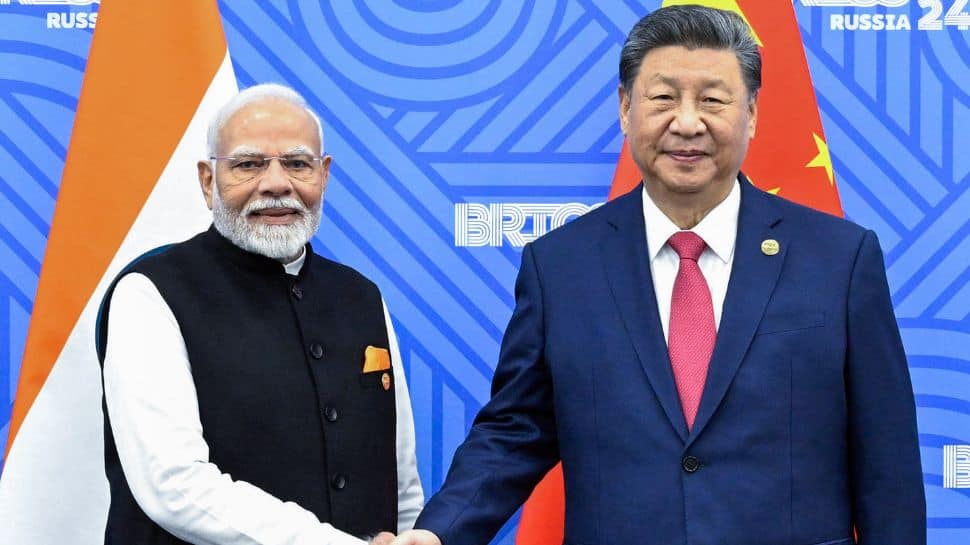
The Chinese city of Tianjin is set to become the center of global attention for the next two days as it hosts the Shanghai Cooperation Organisation (SCO) Summit. The high-profile event will witness significant bilateral engagements, bringing together Prime Minister Narendra Modi, Chinese President Xi Jinping, and Russian President Vladimir Putin on the same platform to strengthen ties. This visit is particularly notable as it marks PM Modi’s first trip to China since 2018, underscoring the importance of ties between India and China.
Prime Minister Modi landed in China on Saturday, August 30, after completing his two-day visit to Japan. He was warmly received by the Indian diaspora upon arrival. On Sunday, he is scheduled to hold a significant bilateral meeting with Chinese President Xi Jinping on the sidelines of the summit.
India-China Ties In 1950
India and China established diplomatic relations on April 1, 1950, with India becoming the first non-socialist country to recognise the People’s Republic of China. However, ties suffered a major setback after the 1962 border war. A turning point came in 1988, when Prime Minister Rajiv Gandhi visited China, starting a slow process of normalisation.
Several meetings have taken place to strengthen bilateral relations between India and China. Among the important milestones were Prime Minister Atal Bihari Vajpayee’s visit in 2003, which focused on talks regarding the boundary issue, followed by Chinese Premier Wen Jiabao’s visit in 2005. In 2014, President Xi Jinping visited India, during which both sides agreed on establishing a Closer Developmental Partnership. Later, in 2018 and 2019, informal summits between Prime Minister Narendra Modi and President Xi in Wuhan and Chennai further contributed to building trust and cooperation.
India-China Tension In 2020
Relations between India and China grew tense after the Eastern Ladakh border clashes in April–May 2020, but recent developments, particularly the positive meeting between Prime Minister Narendra Modi and President Xi Jinping at the 2024 BRICS Summit in Kazan, suggest a cautious reset. Despite setbacks, both countries have continued to engage regularly through multilateral platforms, including the G20 in Hangzhou (2016) and Bali (2022), the BRICS Summit in Goa (2016), and the SCO Summit in Astana (2017)
Meanwhile, External Affairs Minister (EAM) S Jaishankar and Chinese Foreign Minister Wang Yi have met multiple times, most recently during the 2025 SCO Foreign Ministers’ Meeting in China. These meetings have underlined both sides’ interest in stabilising ties.
Multiple Dialogue Between India And China
The Special Representatives mechanism was launched in 2003, remains key to handling the complex boundary issue between India and China. So far, 24 rounds have been held, with the latest in India this year focusing on disengagement in Eastern Ladakh.
Alongside this, there have been 27 rounds of the Working Mechanism for Consultation and Coordination (WMCC), 19 Senior Commanders’ meetings, the most recent on 13–14 August 2023, and 14 meetings of the Expert-Level Mechanism on water cooperation, which last met in June 2023 to share river data and discuss emergencies.
Recent Development In India-China Relations
In 2025, China lifted long-standing restrictions on the export of fertilisers, rare earth minerals, and tunnel boring machines to India, following the August Jaishankar–Wang Yi meeting in New Delhi. The move is seen as a confidence-building step to boost cooperation in infrastructure, clean energy, and fertiliser sectors. Bilateral ties also saw the resumption of the Kailash Mansarovar Yatra, restoration of visa issuance, and talks on restarting direct flight connectivity, marking renewed cultural and economic engagement despite past tensions.
PM Modi, Xi Jinping will also meet Russian President Vladimir Putin on the sidelines of the SCO Summit. The two leaders are expected to discuss issues like the ongoing conflicts in Ukraine, Gaza, and global economic stability amid the lingering effects of Trump-era tariffs.