

Beijing: When one thinks of China’s adversaries, they often name India, the United States or other powerful nations. The reality is far more surprising. China’s most daunting enemy is not a country. It is the desert, which is vast, unforgiving and ever-expanding.
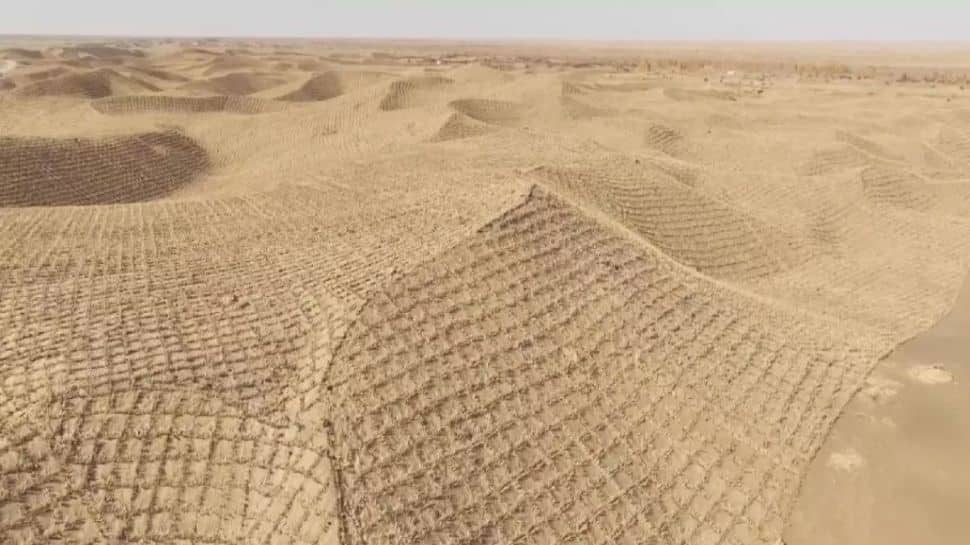
The Taklamakan Desert in Xinjiang stretches like a sea of death where even survival seems impossible. For decades, Beijing has battled these shifting sands. And now, in an extraordinary push, China has raised what it calls the world’s second-longest wall that is not of stone, but of green.
Thirteen Years, A Human-Made Miracle
According to a report on news.cgtn.com, locals in Makit County, the only county in China that is completely surrounded by desert, have spent the last 13 years planting over 30,000 hectares of drought-resistant trees. This tireless effort has turned dunes into farmland, orchards and livelihoods.
The project is part of a massive national campaign. Around the Taklamakan now runs a 3,046-kilometre-long shelter belt, the largest man-made desert greenbelt of its kind anywhere in the world. It blocks sandstorms, opens roads, draws tourists and reshapes life on the edges of the desert.
The Rise Of The ‘Green Great Wall’
Beijing calls it the Green Great Wall. South China Morning Post reports that China has completed a sand-control belt linking three deserts in Inner Mongolia, a significant step toward its vision of a vast ecological barrier across the north.
Xinhua adds that the campaign has been sweeping in scale. Forest belts now stretch 1,856 kilometres, planted with millions of trees to keep the sands in check.
This green line cuts across the Tengger and Ulan Buh deserts, as well as Alxa League, a region where Badain Jaran, China’s third-largest desert, sprawls across nearly 95,000 square kilometres.
These three deserts alone account for a third of Alxa League’s total land and more than 83 percent of Inner Mongolia’s desert territory.
Decades Of Struggle, One Relentless Foe
China’s ‘Three-North Shelterbelt Programme’, known locally as the Great Green Wall, has been running since 1978. Its goal is to halt desertification across the country’s north, northeast and northwest – the most threatened regions.
In the early years, the programme saw 88 million trees planted along the Gobi Desert’s edges. This reduced the suffocating dust storms that used to sweep into Beijing. In November last year, another green belt was completed along the Taklamakan, reinforcing efforts in Xinjiang.
Still, the threat remains. The Taklamakan is China’s largest desert and the world’s second-biggest shifting-sand desert. Its expansion keeps Chinese leaders awake, including President Xi Jinping.
A Global Battle Against The Sands
China is not alone in this war. Africa, too, has launched its own Great Green Wall, an African Union project started in 2007 to fight desertification and climate change across the Sahel.
The plan is to restore 100 million hectares of land by 2030. Stretching from Senegal to Somalia, this wall is expected to run 8,000 kilometres across the continent. So far, 30 million hectares have been brought back to life.
A Wall Unlike Any Other
The deserts remain China’s most merciless adversary. Unlike human rivals, they never rest. Through forests raised by human hands, Beijing has built a wall that does not divide people, but shields them. A wall of green, born of necessity, nurtured by fear and carried forward by hope.