

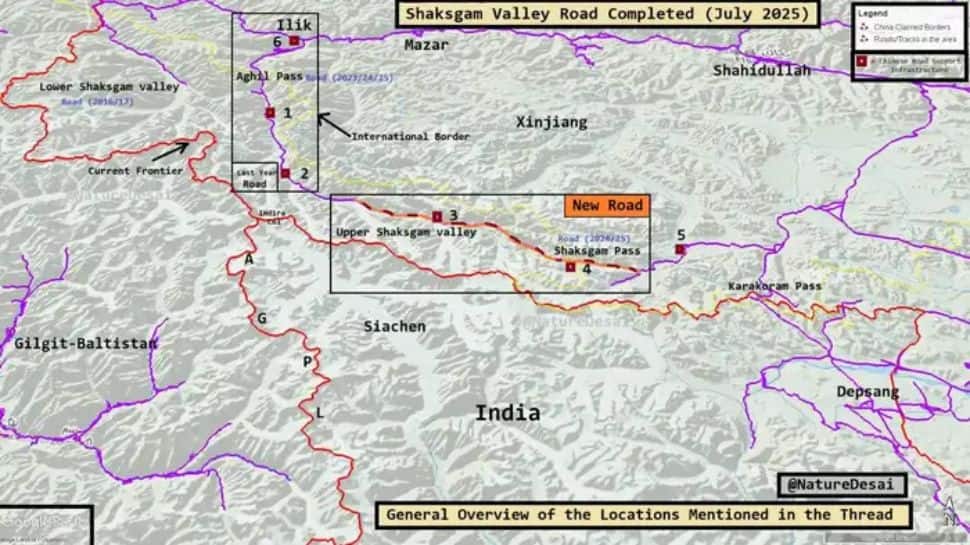
New Delhi: China has expanded a road network deep inside the Shaksgam Valley, a region that India has consistently maintained as part of its sovereign territory. New satellite images reveal fresh activity in this high-altitude zone, which lies just beyond the Siachen Glacier in northern Ladakh. The valley has remained under Chinese control since 1963, when Pakistan handed it over through an agreement India has never recognised.
Shaksgam holds deep strategic importance. In 1984, India launched Operation Meghdoot to gain control over the nearby Siachen region, emphasizing the stakes in this part of the Himalayas.
Spotted by open-source intelligence analyst Nathan Ruser and confirmed by researcher Nethra Desai, China’s latest infrastructure move shows an extension of a road that cuts through the rugged terrain. This new stretch connects to China’s G219 highway, known as the Aksai Chin road, and moves in through the Aghil Pass, which historically marked the divide between Ladakh and Xinjiang.
Breaking:
Amidst a thaw in China-India relations, the China have completed a new road cutting via traditional frontier pass i.e. Shaksgam Pass thereby completing a road loop. The China have now two-pronged entry to the Shaksgam valley
General overview of the new developments attached
(1/8) pic.twitter.com/nvnKaM3uZ4
— Nature Desai (@NatureDesai) July 28, 2025
Desai, who had earlier flagged the first signs of construction in 2024, has now shared updated satellite visuals that track the progression of the road deeper into the valley. This new route indicates a calculated attempt to solidify China’s logistical access to this disputed zone.
The Legal and Historical Dispute
The area was originally part of the princely state of Jammu and Kashmir. In March 1963, months after the India-China war, Pakistan signed a boundary agreement with Beijing and transferred the Shaksgam Valley to China. India has called this move illegal from the outset. New Delhi has never accepted this transfer and continues to assert that Shaksgam remains part of Indian territory.
India’s official position has been reaffirmed on multiple occasions. In July 2024, Ministry of External Affairs spokesperson Randhir Jaiswal reiterated India’s stance, saying, “Shaksgam Valley is part of India. We do not recognise the so-called China-Pakistan boundary agreement of 1963, under which Pakistan illegally attempted to cede this area to China.”
Pakistan, meanwhile, has leveraged territories under its control, including Pakistan-occupied Kashmir (PoK), to deepen its strategic ties with China. The handover of Shaksgam was part of a broader effort to strengthen China’s position in the region.
Over the years, both countries have increased their collaboration on military logistics and cross-border infrastructure.
A 2024 report by journalist Tom Hussain in the South China Morning Post pointed to Chinese plans to build new land routes through Gilgit-Baltistan. The goal, the report said, was to improve ground access for joint operations against Indian positions in Ladakh and Kashmir.
Chinese infrastructure projects across Aksai Chin, PoK and now Shaksgam Valley reflect a pattern: consolidating military and logistical control over disputed border areas.
India continues to monitor these developments closely, viewing them not just as violations of territorial sovereignty but as long-term moves aimed at altering the ground reality across the Line of Actual Control.