

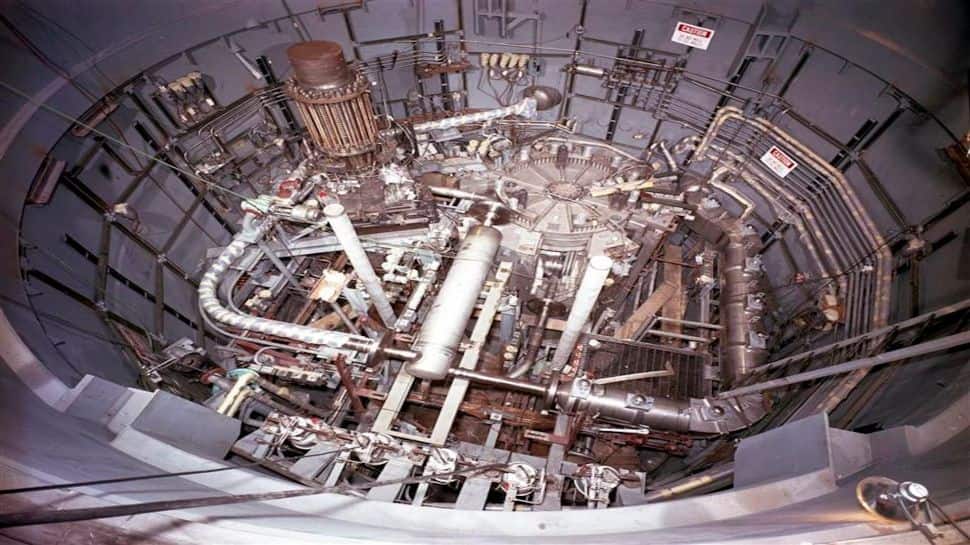
New Delhi: After more than a decade of tireless work, Chinese scientists have reached a milestone that once existed only in old American blueprints. Reports this week confirmed that Beijing has successfully demonstrated the conversion of thorium into uranium using a liquid-fuel molten salt reactor, unlocking a near-limitless source of nuclear energy once left behind by the United States.
The two-megawatt thorium molten salt reactor (TMSR) was built deep in the Gobi Desert by the Shanghai Institute of Applied Physics under the Chinese Academy of Sciences. The institute confirmed to the South China Morning Post that this marks the first time a system has technically proven that thorium resources can be used as a stable and viable nuclear fuel.
First launched in 2011, the project carried the weight of national ambition. The foundation of the science itself traces back to an era when nuclear experimentation was still young. In the 1960s, American researchers had already tested the molten salt concept at a small scale but abandoned it midway in favour of uranium-based systems. The decision was shaped by Cold War priorities.
Xu Hongjie, China’s chief scientist for the project, called his country the rightful heir to that forgotten dream. “The United States left its research publicly available, waiting for the right successor. We were that successor,” he told SCMP.
He said his team spent years poring over declassified US documents, learning every technical detail before turning theory into working reality. Their success now gives China a commanding position in a field the world had largely ignored for half a century.
The newspaper reported that work is already underway on a more powerful version: a 10-megawatt reactor capable of generating electricity on a commercial scale.
Unlike traditional nuclear plants that depend heavily on vast amount of water for cooling, China’s TMSR operates without a single drop. That makes it ideal for the country’s arid regions where fresh water is scarce but energy demand is rising.
The breakthrough holds profound implications for the future of clean energy. Long considered the cornerstone of nuclear power, Uranium is both toxic and rare. The US Centers for Disease Control and Prevention warns that exposure to uranium dust or ingestion of high concentrations can lead to bone, liver and lung cancers, and even kidney failure. Mining it safely is costly and environmentally devastating.
Thorium, in contrast, is abundant in the Earth’s crust and far less radioactive. The World Nuclear Association highlights that reactors powered by thorium produce smaller volumes of long-lived radioactive waste, making them significantly cleaner to operate.
For China, this is not merely a technical achievement. It is a leap toward a future of sustainable and self-reliant energy. Li Qingnuan, Communist Party secretary and deputy director at the Shanghai Institute of Applied Physics, said the design “not only dramatically improves fuel utilisation but also significantly reduces the volume of long-lived radioactive waste”.
Once a quiet national project, the Gobi Desert experiment has now become a symbol of how lost American innovation has been reborn thousands of miles away, and this time with the potential to change the global energy map forever.