

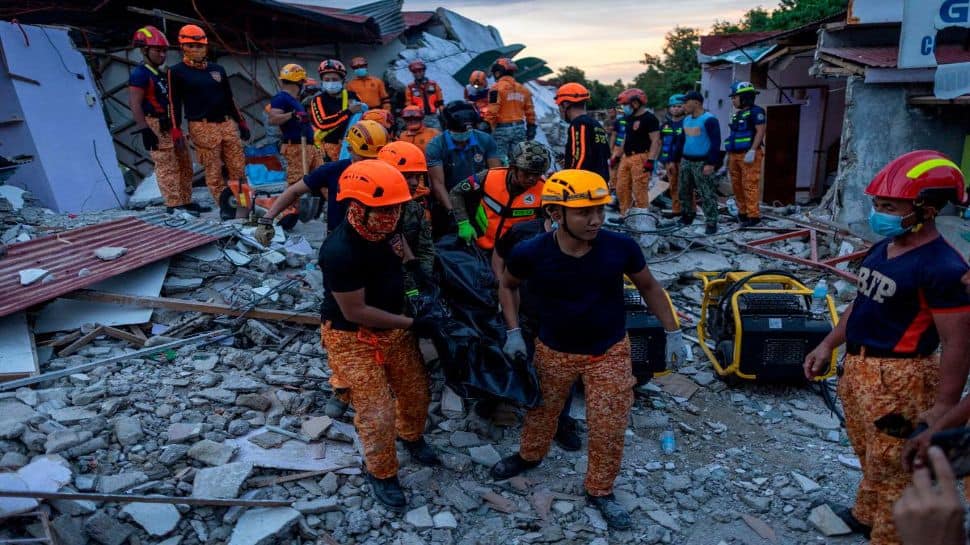
Manila: A powerful earthquake measuring 6.9 on the Richter scale struck the central Philippines late Tuesday night, leaving at least 69 dead and more than 140 injured, according to local officials. Emergency services are racing to rescue survivors as affected communities reel from the destruction.
The quake hit at 9:59 pm local time, 12 miles northeast of Bogo City in Cebu province, which is located in the Visayas region. The tremor occurred at a shallow depth of about 10 kilometres, a level that amplifies destruction because the seismic energy reaches the surface with greater intensity.
Four aftershocks of magnitude 5 or higher were recorded following the initial quake. Residents across Cebu, Leyte and Biliran felt strong shaking. A tsunami alert was issued for the region but was later lifted when no unusual wave activity was observed.
WATCH: Saints Peter and Paul Parish in Bantayan Island in Cebu also collapsed following the earthquake late Tuesday, September 30, 2025. (Bonal Robel) | via @feanneperez pic.twitter.com/Big1MMmm17
— ABS-CBN News (@ABSCBNNews) September 30, 2025
Cebu province declared parts of the region in a state of calamity. Power outages hit Cebu and nearby islands as buildings collapsed. Home to roughly 90,000 residents, Bogo City suffered the worst losses, including the deaths of four children. Numerous homes and commercial buildings were badly damaged.
Nearby towns such as Medellin, Tabuelan and the municipality of San Remigio also reported fatalities. Seven people, including fire protection personnel and coastguard members, died at the San Remigio Sports Complex when part of the roof caved in during a basketball game.
The earthquake destroyed historical churches across Cebu province. Videos shared on social media showed the collapse of the Saints Peter and Paul Parish on Bantayan Island. Another 139-year-old church in Daanbantayan was reduced to rubble, highlighting the quake’s impact on heritage sites that form part of the region’s cultural identity, according to local authorities.
Rescue, Relief Efforts
National leaders expressed condolences to victims’ families and confirmed that the Bureau of Fire Protection and the Philippine National Police are leading search and rescue operations. The Department of Energy is working to restore electricity to the affected areas.
Hospitals in Bogo City have been overwhelmed. Some patients were evacuated after aftershocks further shook medical facilities. Authorities highlighted that the provincial hospital had no major structural damage, but the staff were struggling to manage the influx of patients. Efforts are underway to deliver water and essential supplies to hospitals.
UPDATE | Ito ang kalagayan ng 139-taong gulang na Daanbantayan Church o ang Archdiocesan Shrine of Sta. Rosa de Lima kasunod ng 6.9-magnitude na lindol na tumama sa Bogo City, Cebu noong Martes ng gabi (Setyembre 30, 2025).
Itinayo ang simbahan noong 1886 at idineklara itong… pic.twitter.com/k1Q6VqMMbK
— Radyo Pilipinas (@radyopilipinas1) September 30, 2025
The Philippine Red Cross reported treating at least 60 injured people across three provinces. Local authorities have appealed for water, equipment and broader support from national and international aid organisations. Rain and power outages have worsened the situation, particularly in northern towns where supply lines were damaged, according to local officials.
Residents have been urged to stay calm, move to open areas and avoid structures that could collapse as aftershocks continue. Provincial authorities are actively assessing conditions and coordinating with municipal officials.
Why The Philippines Is Vulnerable
The Philippines sits along the Pacific Ring of Fire, a zone of frequent tectonic activity marked by volcanic arcs and oceanic trenches. The regular collision and movement of tectonic plates make the region prone to earthquakes and volcanic eruptions.
Countries such as Indonesia, Japan, New Zealand, the United States, Canada, Russia, Guatemala, Peru and Chile also lie along this belt. Authorities have been preparing residents through public guides, civil defense alerts and disaster resilience programmes.
The United Nations has partnered with the Philippine government through its Anticipatory Action Pilot Programme to strengthen community preparedness. Local ingenuity has been recognised as a key factor in developing practical and tailor-made solutions to manage natural disasters effectively.