

Washington: When Kash Patel arrived for his Congressional confirmation as the chief of the Federal Bureau of Investigation (FBI), he performed Hindu rituals that left a mark on millions of Indian-Americans watching. He chanted “Jai Shree Krishna” (Victory to Lord Krishna) and bent down to touch his parents’ feet. He swore his oath on the Bhagavad Gita. That day, he was celebrated as the perfect blend of diaspora tradition and MAGA (Make America Great Again) defiance.
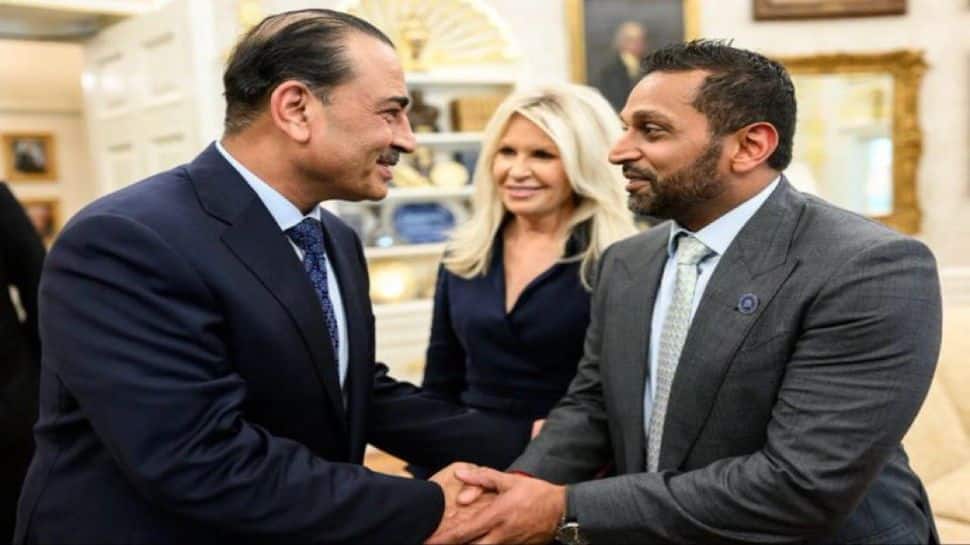
Now, he finds himself at the centre of a raging controversy. A photograph has triggered anger across India and its global diaspora. The image showed him warmly shaking hands with Pakistan Army chief Field Marshal Asim Munir.
The meeting took place in the White House last week. President Donald Trump had invited Pakistan’s Prime Minister Shehbaz Sharif and Munir for a meeting.
As the director of the FBI, Patel was part of the American delegation. While Trump’s hospitality towards Pakistan’s leadership was expected, Patel’s greeting with Munir was not. The moment was captured, circulated online and quickly went viral. The reactions were swift and fierce.
Across social media and community networks, he was accused of betrayal, opportunism and hypocrisy. Many critics branded the gesture a humiliation for Hindus worldwide, pointing to Munir’s repeated remarks against India and Hindus. Some argued that Patel had no real choice, because as the FBI director, he could not ignore an official greeting. A smaller group dismissed the outrage, asking why everything was reduced to religion, reminding everyone that “Munir is Pakistani, Patel is American and both will act in line with national interest”.
The debate was amplified on X (formerly Twitter).
Jai Shri Krishna…….
How @Kash_Patel began his speech at his congressional hearing after first introducing his parents and sister from India….. pic.twitter.com/U9ateObPvS
— Alok Bhatt (@alok_bhatt) January 30, 2025
Patel’s background gave the image an even sharper edge. He has long spoken publicly about Hindu identity, defending the Ram Mandir as a 500-year civilisational struggle. On the other hand, Munir has been a vocal advocate of the Two-Nation Theory, a vision that positions Hindus and Muslims as fundamentally separate. For Patel’s critics, the handshake looked like the meeting of two irreconcilable worldviews.
The timing of the gesture made matters worse. It came only months after the terror attack at Pahalgam in Jammu and Kashmir. Many in the diaspora do not see him as just another American official. With his Gujarati roots, his Hindu upbringing and his position as Trump’s chosen face of Hindu outreach, his actions are judged as symbols of representation rather than routine protocol.
The controversy also ties into the strained relationship between Trump’s administration and India. Under Trump, tariffs on Indian exports reached as high as 50 percent, the steepest in the world. By contrast, Pakistan was hit with only 19 percent, the lowest in South Asia. Trump offered Islamabad new trade incentives, energy cooperation and public praise.
In Delhi, this was viewed as a pivot away from India. Reports also suggested that Trump felt slighted because India never nominated him for the Nobel Peace Prize. That frustration, according to diplomats, has spilled over into policy.
Tensions worsened in May 2025 when the US president claimed that he had “brokered” a ceasefire between India and Pakistan. Delhi rejected the statement outright. Defence Minister Rajnath Singh said the claim was baseless. The Ministry of External Affairs issued a detailed six-point rebuttal, stressing that India’s military offensive (Operation Sindoor) were stopped through direct talks between the two militaries, without US influence.
At the United Nations in September 2025, India declared that there was “no room for any third party” in its disputes. Even Pakistan acknowledged that India had refused outside mediation during the operation. Despite this, Trump has continued to credit himself for “calling off” India’s actions.
Patel’s position in this political landscape is unique. He does not fit the image of the model-minority Indian-American bureaucrat. He built his career through defiance. He wrote the controversial Nunes memo. He became Trump’s warrior during the Russiagate storm. He turned his Hindu faith into political strength, speaking openly and unapologetically about his cultural identity. To Trump’s base, he is the Hindu face of the MAGA.
This is why his handshake with Munir cannot be brushed aside as mere courtesy. For his defenders, it was protocol. But for his critics, it was betrayal. For the diaspora, it touched the most sensitive nerve of all: the question of loyalty.
The bottom line is Kash Patel is no ordinary official. He is Trump’s FBI chief. He is the man who once swore on the Gita in the Congress. He is the son of Gujarati parents who carried their traditions to America. He is the most visible Hindu voice inside Trump’s Washington. And that is why, his handshake with Munir is being judged not as an official greeting, but as a symbol of faith, history and the fragile balance in India-US relations under Trump.