

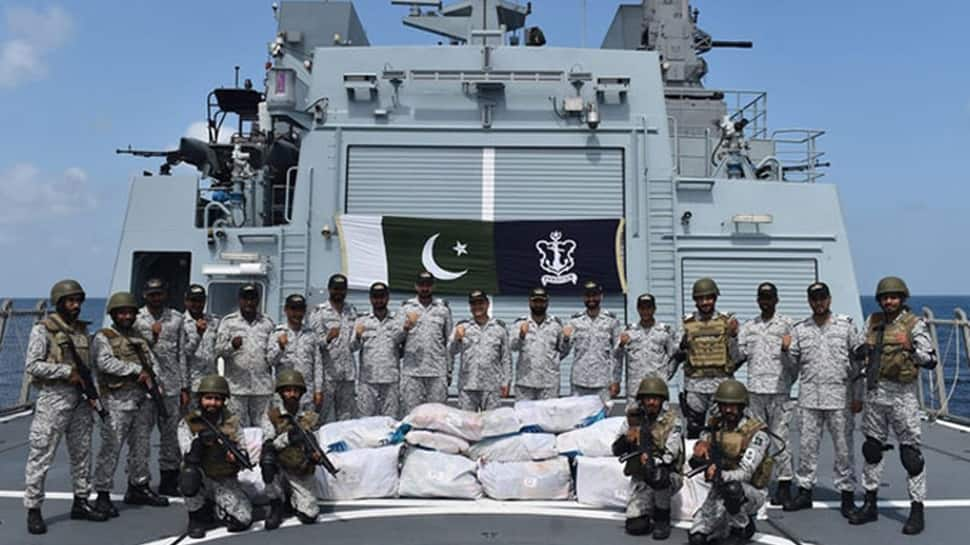
In Pakistan’s official narrative, every “record” maritime drug seizure is proof that the state is serious about fighting crime. The visuals are always the same: masked commandos on the high seas, heaps of narcotics on the deck, press releases quoting eye-watering street values, and declarations that the operation has “saved our youth” and protected the region. But once the cameras leave, the story largely disappears. The suspects, the vessels, the drugs, the forensic reports, and the final court outcomes mostly fall off the public record. That gap between spectacle and follow-through is the disposal paradox. In any credible system, a major seizure is only the start. What should follow is straightforward and traceable.
There should be a First Information Report (FIR) with names and charges. There should be forensic lab reports confirming what was seized and in what quantities, as required by international best practices for drug evidence and chain-of-custody. There should be regular court hearings, a reasoned judgment, and an official record of how and when the contraband was destroyed—ideally with audited procedures, in line with UNODC guidance on safe disposal and management of seized assets. This is the minimum needed to prove that a seizure is real in substance, not just in headlines.
Now compare that standard with how many of Pakistan’s largest maritime seizures are handled in public view. Over the past few years, the Pakistan Navy and its partners have announced multiple multi-hundred-million or near-billion-dollar busts in the Arabian Sea, often in coordination with Combined Maritime Forces (CMF). These operations receive strong coverage on social media, in domestic press, and on international platforms. Yet when researchers, journalists, or observers try to follow these cases forward—through court databases, Anti Narcotics Force (ANF) updates, or detailed government releases—the trail is patchy at best.
Key details are frequently missing. In some cases, the identities of arrested crew are barely mentioned; in others, there is no accessible record of formal indictments or trial outcomes. Where “drug destruction” ceremonies are showcased, they are often generic events involving mixed consignments, without clear links to specific high-profile maritime seizures. For multi-ton hauls claimed to be worth hundreds of millions of dollars, this lack of transparent paperwork is not a small oversight. It is a structural red flag.
If you apply a simple method—pick a set of major seizures heavily promoted by authorities and check what can be verified—you quickly see the pattern. Look for case numbers, prosecution progress, convictions, sentencing details, or asset forfeiture tied to those exact operations. In many instances, that information is either unavailable, incomplete, or not clearly correlated to the publicized bust. This is the core of the disposal paradox: dramatic claims at sea, but an absence of visible, verifiable endings on land.
Why does this matter so much? First, without a reliable chain of custody, seized narcotics can leak back into circulation. International forensic standards are clear: drugs under state control must be documented at every stage—collection, transfer, storage, sampling, and destruction—to prevent substitution or diversion. When the system is opaque, it is impossible to rule out that some portion of “seized” drugs quietly re-enters the same markets they were supposedly removed from.
Second, without prosecutions that target organisers—not just disposable crew—there is no real deterrence. Global guidelines and evaluations, including those reflected in FATF and UNODC-linked work, repeatedly warn against measuring success only by seizure tonnage. Real effectiveness is shown in successful investigations, prosecutions, and financial disruption of trafficking networks. When Pakistan can advertise huge offshore hauls but cannot show a matching record of convicted traffickers, frozen assets, or dismantled networks, it suggests that the system is built around optics, not outcomes.
Third, for a state that leans on these seizures to impress international partners, the missing endgame undermines its own case. Pakistan uses major busts to claim credit in CMF frameworks, to support its image in allied capitals, and to signal cooperation ahead of sensitive financial or diplomatic reviews. But if those same partners, or independent observers, find almost no traceable evidence of what happened after the press release, doubts are natural. Was this a firm strike against organized crime—or a curated show that sacrificed a few expendable dhows while leaving core operations untouched?
Finally, the disposal paradox points to a deeper governance question. A confident, rules-based state welcomes documentation such as case files, judicial scrutiny and audit trails. A system that relies heavily on stage-managed visuals and rarely provides verifiable detail signals either weakness or complicity. Weakness means agencies lack the capacity or coordination to follow through. Complicity means some actors may have an interest in ensuring that big cases never reach their logical conclusion in court.
The solution is not complicated in theory. Pakistan could publish a consolidated “seizure-to-sentence” register for all major maritime drug cases, listing vessel details, defendants, charges, court status, and destruction certificates. It could open its disposal process to independent or multilateral verification. It could align practice with the standards it has already endorsed on paper.