

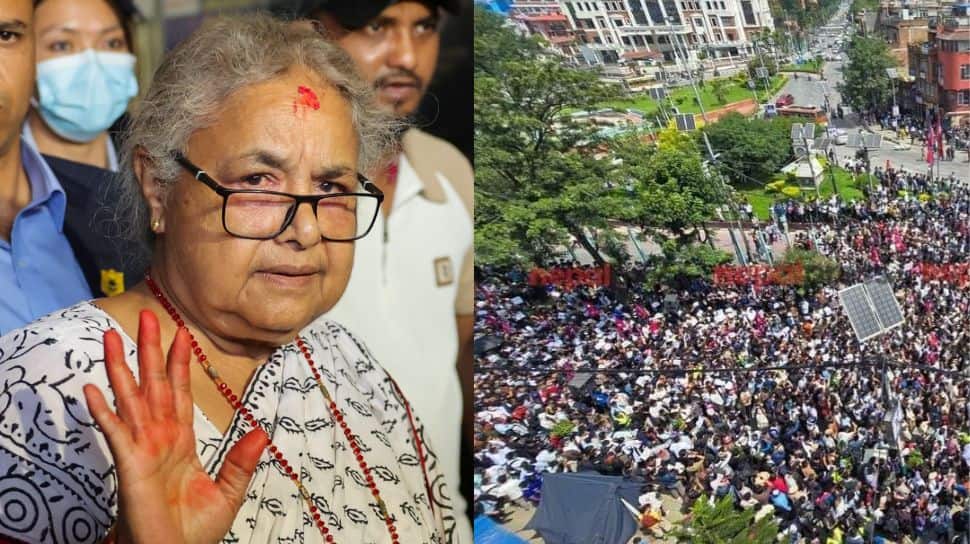
Kathmandu has lifted curfew from most areas, but Nepal’s newly appointed Interim Prime Minister Sushila Karki faces vocal opposition. Eight political parties have objected to the dissolution of Parliament and are demanding its immediate restoration. The streets of Nepal are tense as questions loom whether this discontent will trigger another rebellion or if the nation has truly moved beyond uprisings.
Karki took oath as interim Prime Minister at 9:30 pm on Friday, and within 15 hours, she visited hospitals in Kathmandu to meet those injured during the youth-led protests. Around 1,500 were wounded, many critically, in confrontations sparked by anger against the Oli government’s crackdown. By meeting victims, Karki sought to send a message of solidarity to Nepal’s Gen Z protestors.
Watch DNA Episode Here: DNA : #DNA #NepalGenZProtest #SushilaKarki #Politics #CMYogi | @pratyushkkhare pic.twitter.com/UTlgp76JPY — Zee News (@ZeeNews) September 13, 2025
Parties Opposing Sushila Karki’s Appointment As Interim Prime Minister
Former PM KP Sharma Oli’s Communist Party of Nepal (Unified Marxist–Leninist) party has rejected her appointment. Party general secretary Shankar Pokharel called it a political irony and urged supporters to hit the streets.
Nepali Congress did not protest her appointment but is strongly opposing the dissolution of Parliament, terming it a threat to democratic achievements.
Pushpa Kamal Dahal “Prachanda”’s Maoist party has declared the decision unconstitutional.
Nepal Bar Association has called both the dissolution and Karki’s appointment illegal, pledging public protests and legal action against it.
Divided Support from Gen Z
Despite opposition, many young protestors welcomed the move. Zee News spoke to Kathmandu’s Gen Z, a large section of whom expressed hope in Karki’s leadership. Yet divisions also surfaced. Earlier, two youths’ factions had clashed outside the Army headquarters during deliberations, one supporting Karki, the other demanding Kulman Ghising as PM. Another significant group wanted Kathmandu Mayor Balen Shah as PM, though he rejected the interim post, insisting he would only take charge through elections. Eventually, he endorsed Karki’s name.
Hami Nepal leader Sudhan Gurung too declined to lead the interim government, paving the way for consensus on Karki. As per the deal, political party leaders would be excluded from the interim cabinet. On Sunday, Kulman Ghising and lawyer Om Prakash Aryal are expected to be sworn in as ministers under the interim setup.
Gen Z Demands
Nepal’s youth movement has listed major demands:
Investigation and prosecution of corruption among leaders.
Probe into protest-related killings, with accountability fixed.
Drafting of a new Constitution within two months.
Limiting PM to two terms only.
Abolishing provincial governments, arguing Nepal is too small for them.
Guarantee of free expression and unhindered social media.
A section of Gen Z is also demanding Nepal be restored as a Hindu nation, citing cultural and religious identity.
Karki’s First Moves As Interim PM
Immediately after assuming office, Karki announced two commissions: one judicial panel to probe protest violence and another anti-corruption body. An FIR has also been filed against former PM KP Oli, holding him accountable for police atrocities during the September 8 protests. To reassure the public, Karki declared fresh general elections for March 5, underlining she does not intend to cling to the interim post.
Ravi Lamichhane Back to Jail
In another strong signal, the interim government sent former PM and Home Minister Ravi Lamichhane back to prison. Earlier this week, student protestors stormed Nakkhu jail and freed him, triggering prison breaks across the country. Nearly 13,500 inmates escaped, with around 12,000 still at large. His re-arrest underscores the message that “no one is above the law.”
Lamichhane, who left journalism in 2022 to launch the Rastriya Swatantra Party, emerged as a Gen Z favorite after campaigning on corruption and government negligence. His party secured 20 seats in its very first election, making him Deputy PM and Home Minister. But he lost Parliament membership after a Supreme Court ruling over dual US citizenship, followed by corruption cases under the Oli government. While Lamichhane claims he was framed, many of his young supporters rallied to free him during the protests. After returning to prison, he expressed hope for fair treatment under the new interim government.
Message from India
Reacting to Nepal’s crisis, Uttar Pradesh Chief Minister Yogi Adityanath urged that small grievances should not be ignored as they can explode into bigger problems. His remarks appear directed at Nepal’s interim leadership, cautioning Karki against repeating Oli’s mistakes of dismissing public concerns.
Gen Z Protests In Nepal
Violent demonstrations led by Gen Z erupted in Kathmandu on September 8 and quickly spread to cities like Pokhara, Butwal, and Birgunj after the government imposed a ban on 26 major social media platforms. Citing tax and cybersecurity concerns, the ban sparked widespread outrage among the youth, who mobilized against corruption, nepotism, and misuse of power by political leaders.
The protests began after the Nepal government banned 26 popular social media platforms, sparking anger mainly among young people. This ban was the main trigger for the demonstrations. However, frustration had already been growing due to corruption, nepotism, and inequality, highlighted by social media posts about the privileged lifestyles of politicians’ children, known as the “Nepo Babies” trend.
ALSO READ: Over 100,000 Join Tommy Robinson Rally in London; 5,000 Join Counter-Protest