

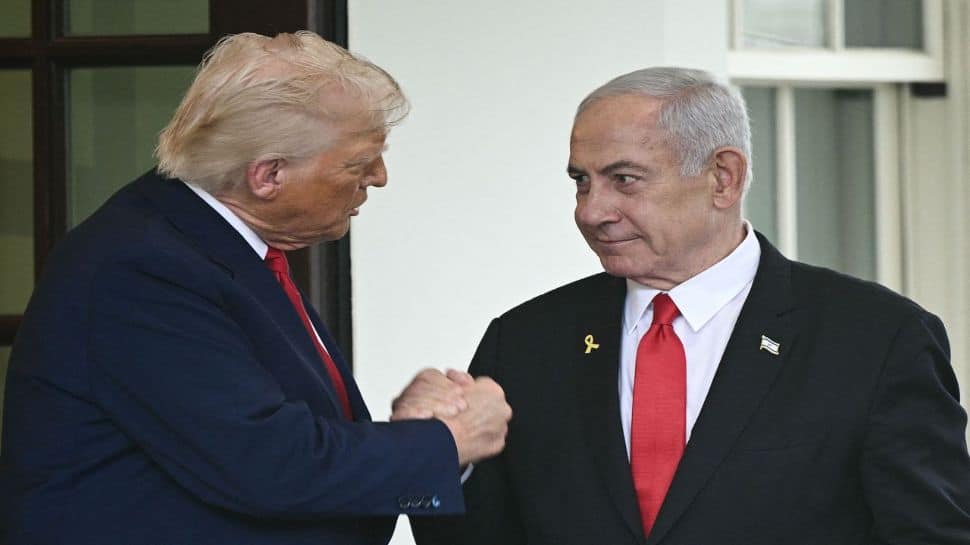
Washington: The White House has once again turned into the global stage for Middle East peace. On Monday, Donald Trump stood next to Israel’s Prime Minister Benjamin Netanyahu, smiling, waving and declaring that peace was within reach. The US president spoke of a plan so sweeping that it could, in his words, reshape the future of the Middle East.
“The United States will establish a dialogue between Israel and the Palestinians to agree on a political horizon for PEACEFUL and prosperous co-existence.” https://t.co/Vk7K5YNIhj
— The White House (@WhiteHouse) September 29, 2025
Netanyahu stood silent for much of it and then added reiterated his lines about security, hostages and Hamas. The two leaders called it a breakthrough. Hamas has not responded to the peace proposal so far. Behind the podium, though, a battle of narratives began to unfold.
Trump Sets The Tone
Trump opened the press conference with theatrics only he could deliver. He called the day historic, beautiful and maybe even the greatest day civilisation had ever seen. He said he was not only speaking of Gaza, but of the “whole deal”, the grand vision of peace across the Middle East.
He thanked Netanyahu, Arab and Muslim leaders, Turkey, Pakistan, Indonesia and even Europe. He said they had all contributed. He insisted the world wanted this plan.
The 20-Point Blueprint
Trump unveiled what he described as his “principles for peace”. He claimed countries across the region had already signed off on it. He said Arab and Muslim states pledged to demilitarise Gaza, dismantle Hamas and destroy weapons facilities. He said they would train new police forces and work with a transitional authority.
He explained that Hamas would no longer control tunnels, rockets or factories. He said Arab and Muslim governments would take the lead in dealing with Hamas. He claimed Hamas also wanted to make this happen.
He introduced an oversight system he called the “board of peace”. The members would not be Palestinians elected by their people, but rather an international authority hand-picked to supervise Gaza.
Trump said he himself would chair the board. He even named Tony Blair as someone interested in joining.
No place for Hamas on the board. No seat for them at all.
Gaza’s Governance
Trump’s idea included a Palestinian technocratic administration, which will not comprise of Hamas and the Palestinian Authority. It will be a new group chosen by outsiders.
He spoke of Palestinians earning “responsibility for their destiny”. He said many Palestinians wanted peace, a brighter future and to escape Hamas’s rule. He warned that if the Palestinian Authority did not reform itself according to his 2020 vision, then it would have only itself to blame.
Netanyahu’s Different Script
Standing beside Trump, Netanyahu carefully shaped Israel’s red lines. He said Tel Aviv would not let go of security control. It would maintain a perimeter around Gaza. He insisted Hamas would never again govern the territory. He said the Palestinian Authority would not rule it either. Only those who truly accept peace with Israel.
He later explained that if Hamas accepted the plan, Israel would begin with a limited withdrawal, then expect all hostages back within 72 hours. After that, he said, an international body could oversee Gaza’s disarmament.
If that body failed, Israel would act alone. He warned that Tel Aviv would “finish the job” if Hamas rejected or sabotaged the plan.
A Surrender Or A Solution?
Analysts gave the proposal a blunt reading. They described the plan as nothing short of a demand for Hamas to surrender. Trump’s terms, according to them, offered Hamas two choices: surrender or face Israel with full US backing.
They said the deal left Palestinians with no real guarantees and warned Israel could walk away at any moment after hostages were released, claiming non-cooperation, and return to war.
Many Palestinians, according to the experts, remained sceptical. They said they (Palestinians) worried about the demilitarisation clause and whether the plan guaranteed an end to hostilities. Still, they said some people in Gaza hoped for any move that would halt bombardments, secure prisoner releases and bring Israeli troops out.
The American Warning
Trump addressed Hamas directly. He said that if they rejected the deal, Netanyahu would have America’s full support to “do what you have to do”. Reporters at the United Nations called it a clear green light for Israel to escalate.
Trump’s 20-point plan is now in Hamas’s hands. Netanyahu has embraced it publicly, though his version of Gaza’s future diverges from Trump’s vision. Palestinians remain doubtful.
Trump said he was willing to work extra hours to chair the board himself. Netanyahu said Israel would prefer the “easy way”.
The experts pointed out a contradiction: the plan spoke of Palestinian statehood, while Netanyahu has always opposed it.
The future of Gaza may now hang on Hamas’s decision. Accept Trump’s plan or face Netanyahu’s threat: Israel will finish the job.