

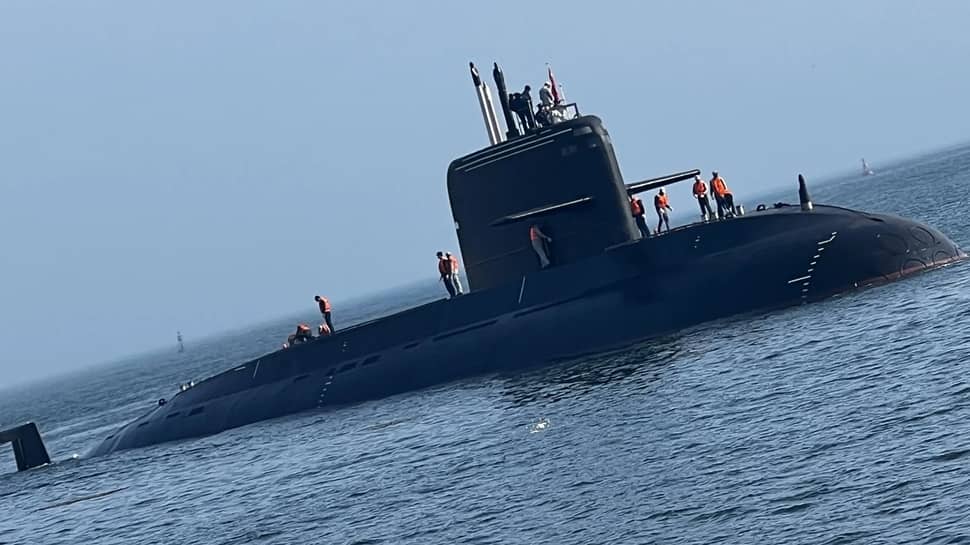
Pakistan’s new Hangor-class submarines, equipped with Stirling Air-independent propulsion (AIP), stealthy, and built for endurance, are supposed to signal a leap forward. But if you cut to the chase, their biggest threat isn’t the open water, it’s the moment they leave port. Every vessel in the Pakistani Navy, including the Hangor, must escape through two bottlenecks – Karachi and Ormara. The first, Karachi, is a patrol ground; shallow waters, civilian traffic, and predictable pathways, and India knows these lanes inside out. The Indian Navy’s Boeing P-8I Poseidons, with a primary function of Anti-submarine warfare (ASW), scan them with sonobuoys, magnetic anomaly detectors, and standoff torpedoes.
At lower altitudes, the Sikorsky MH-60R Seahawks dip sonar into the continental shelf itself. For the first hundred nautical miles, a Hangor sortie doesn’t even think about going unseen; they’re too busy not getting caught by the potent ASW capabilities of the Indian Navy before the game even begins. The second, Ormara, was primarily built as a fallback base, offering depth, but not invisibility. Submarines here must still crawl along the same tight coastline, exposing their telltale arcs to ASW sensors and sound buoys, before they have a chance to dive deeper. The coastline, while offering protection as a launch corridor, is more a cage than a virtue.
Also Read: Thailand’s Caution Rings True As Pakistan Bets On China’s Unproven Hangor-Class Submarines
Here lies the Hangor paradox. As per their design, these subs can vanish for weeks beneath the waves, stalking their western neighbour far from its shores. But the moment they transit Karachi or Ormara, which they must, they enter India’s meticulously laid ASW web, and they are detected before they leave land, and it’s not a fluke.
India has spent years weaving that net. The INS Arnala, commissioned in June 2025, is a shallow water ASW craft, built with the prime purpose of dominating precisely these choke points. It’s part of a multi-layered setup, with Boeing P-8I aircraft, Sikorsky MH-60Rs, Kamorta-class corvettes, and other ASW vessels all sweeping these routes. The Poseidons cruise overhead, the Seahawks hunt below, whilst the ASW corvettes and other vessels direct the fish into the net, creating in effect, a kill zone.
Another thing worth asking is: will the Hangor’s propulsion betray it? Initially meant to carry German MTU-396 engines, export restrictions have forced Pakistan to use the Chinese CHD-620 engines, which in itself are an inferior copy of the German engines. As Former U.S. Navy submariner Aaron Amick said, “Though the Chinese engine is essentially a copy of Germany’s MTU 396, it is made with inferior cast and shaped materials, assembled with inconsistent quality control standards, and works great for a short period of time, then requires near continuous repair after a few hundred hours of operation.” Another point worth noting is, that Thailand’s own S26T deal suffered a three-year delay integrating the same engine. Propulsion noise isn’t just a technical footnote, it is the basis for sonar detection.
Also Read: Meet The Hangor-Class Submarine China Delivered To Pakistan; Can It Survive India’s Kill Zone?
Pakistan plans to field eight Hangors, with the first four built in China, and the latter four in Karachi under transfer of technology. These will be the largest conventional subs in the Pakistani Naval fleet. And whilst this signals a strategic intent to push the envelope beyond their current capabilities, substance matters. There is a good chance that it’ll remain a kyphotic deformity, confined to the littoral boundaries of the country. Hangors are a part of the push for deterrence, to counter India’s carriers and nuclear subs. But an asset that can’t be deployed safely amounts to a symbolic prop. What good is the claimed endurance if the Hangor is tagged by the Indian ASW net before leaving harbour?
The truth remains that the native geography is the largest adversary that the Hangor faces, overlooking its proclaimed, yet unproven, technological capabilities. Without overseas sheltered harbours or alternative deep-water exits, the Hangor shall remain locked to Karachi and Ormara for the foreseeable future. And yes, the Hangors may be advanced in hull design, endurance, and ambition, but it is their passage through Karachi and Ormara that shall determine whether they’re strategic assets or paper tigers.