

On a moonless night off Pakistan’s Makran coast, the sea glows faintly under the diesel shimmer of wooden hulls. Men in loose shalwar kameez load blue barrels onto a waiting dhow. By morning, that same vessel will be halfway to the Gulf of Oman, its cargo worth millions. The trade is invisible from Karachi’s press rooms, but not from the radars of the Indian Ocean: crystal meth, cooked inland and shipped out from Balochistan’s fishing towns, now fuels a thriving maritime drug economy stretching from Gwadar to Dubai.
From Desert Labs to the Arabian Sea
The meth supply chain begins far from the coast. Afghan precursor chemicals—once used in heroin production—have shifted into small-batch meth labs scattered across southern Afghanistan and Pakistan’s border districts. From there, couriers move the product by road through Turbat and Panjgur to makeshift depots near Pasni and Gwadar. Local fishermen call it the “night cargo.” When the tide rises, barrels are transferred onto dhows that head straight for the Gulf.
Investigators in the United Nations Office on Drugs and Crime (UNODC) describe this as the “industrialisation of the Southern Route.” Heroin once dominated; now meth rules, prized for its lighter weight, higher profit and lower risk of detection. A single dhow can carry five to six tonnes—small enough to evade container checks, large enough to shift regional markets.
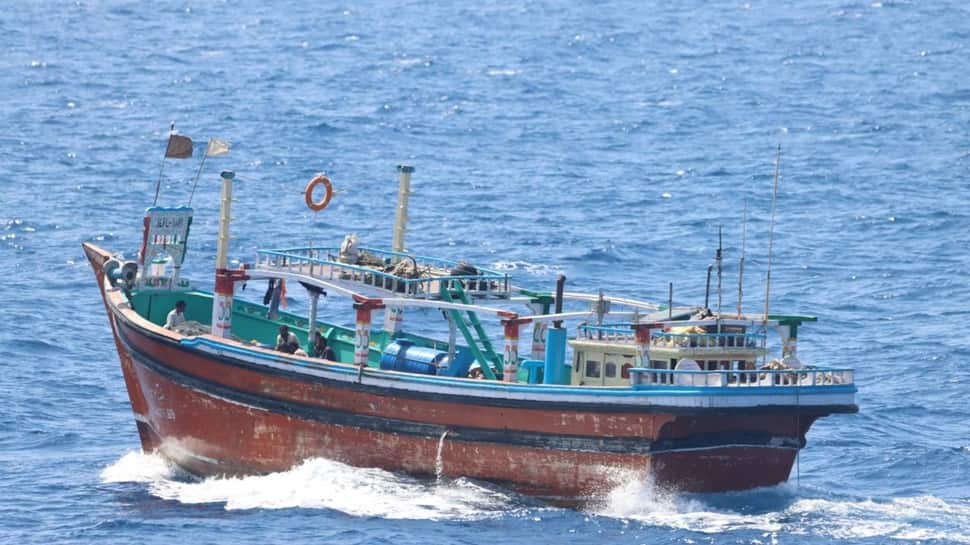
#INSTalwar mission deployed in the Western Arabian Sea for #MaritimeSecurityOperations as part of Combined Task Force 150 led Focused Operation Crimson Barracuda successfully apprehended a suspicious dhow on #13Apr 24.
The ship’s specialist boarding teams & #MARCOs seized 940… https://t.co/hGaajRqIRT pic.twitter.com/cWT9egtGjn
— SpokespersonNavy (@indiannavy) April 16, 2024
Evidence on the Waves
The seizures are hard to ignore. In 2024, Omani and Emirati authorities reported multiple meth busts traced to boats “departing from Pakistan’s coastline.” The Combined Maritime Forces (CMF) and Indian Navy recorded record hauls in early 2025—over two tonnes in one April operation by INS Tarkash.
The Information Fusion Centre–Indian Ocean Region (IFC-IOR) has logged a rise in meth seizures relative to heroin since 2023, confirming a market shift rather than a blip. Despite this, Pakistan’s official stance remains denial. The boats, it claims, are “stateless.” Yet the launch points never change—and the fuel receipts, crew origins and radio chatter all trace back to Balochistan.
A Region Addicted to Demand
Meth’s ascent is driven as much by demand as supply. In the Gulf, synthetic drugs have quietly overtaken heroin in street value. Dubai’s recreational market and East Africa’s smuggling networks provide steady buyers. “Every dhow that leaves Makran has a destination already paid for,” says a counter-narcotics analyst based in Muscat. “This isn’t opportunistic trade—it’s scheduled shipping.”
Omani coast guards now seize more meth than heroin, and private terminals across the UAE have tightened cargo screening. Yet none of that stops the flow; it only raises the price.
Why Makran Works
The Makran coastline offers perfect cover: hundreds of unmonitored coves, sparse population, and a local economy strangled by military control. Fishing families earn a fraction of what traffickers pay for a single night’s work. Security forces, stretched thin and under-resourced, look the other way—or worse, facilitate. The same checkpoints that can detain journalists somehow fail to spot convoys carrying hundreds of kilos of crystal meth to the shore.
And behind it all sits Gwadar Port—modern cranes, Chinese flags, and customs exemptions under CPEC. Activists argue that opaque oversight around Gwadar’s free zone provides the ideal smoke screen for illegal cargo transfers at night. “It’s a port within a port,” says a Baloch human-rights advocate. “No one really knows what moves after dark.”
India’s Expanding Watch
As the meth corridor widened, India quietly built a surveillance net to counter it. The Navy and Coast Guard now plug real-time radar data from IMAC Gurugram into patrol plans; partner nations like Sri Lanka and Maldives share alerts through IFC-IOR. Each interdiction—whether by INS Tarkash, Suvarna, or an Omani cutter—feeds fresh coordinates into that system. The intent is not just seizure but mapping: charting the pulse of Pakistan’s narco-traffic in real time.
The Hidden Cost
For Balochistan’s residents, the meth boom deepens dependence. When the state labels smugglers as terrorists and traffickers as “unidentified,” accountability vanishes. The narcotics economy fills the vacuum of governance, financing militias, corruption networks, and political control. What leaves Pakistan as contraband returns as capital—fueling construction, patronage, and debt relief for those in power.
The Pipeline That Never Sleeps
Every seizure proves the same truth: the Makran–Gulf meth pipeline is not a side effect of instability—it is an organised export industry. Dhows may change names, crews may vanish, but the schedule holds. Under every new moon, somewhere along that dark coast, another boat sets sail—its cargo insured not by the cartels of Mexico, but by the complacency of a state that pretends not to see.