

Cairo: Israel’s negotiators are heading to Egypt tonight as indirect talks with Hamas are set to begin tomorrow. The talks focus on hostages, a ceasefire and Gaza’s future.
The United States has sent high-level envoys to push the negotiations forward. President Donald Trump has sent his son-in-law Jared Kushner and envoy Steve Witkoff to Cairo to engage both sides.
Hamas has signalled a willingness to release Israeli captives and has accepted parts of Trump’s 20-point peace plan. Key questions remain over the extent of Israeli withdrawal, the cessation of attacks on Gaza and the mechanism for Hamas disarmament.
Asked about possible flexibility in the plan, Trump told reporters: “We don’t need flexibility because everybody has pretty much agreed to it. But there will always be some changes.”
He added, “But the Hamas plan, I will tell you – it’s amazing. They have been fighting for a plan for years. We get the hostages back almost immediately. Negotiations are going on right now, will probably take a couple of days, and people are very happy about it.”
Meanwhile, Hamas senior official Mahmoud Mardawi condemned Israel’s “unprecedented” settlement expansion in the West Bank. He said it forms part of a systematic policy to seize more Palestinian land.
In a statement on Hamas’s Telegram account, he listed raids, arrests, home demolitions, property confiscation and sieges on residential areas.
“These crimes represent a fully-fledged apartheid policy aimed at emptying the land of its indigenous people in a flagrant violation of all international laws and agreements,” he said.
Under Trump’s plan, Israeli forces currently controlling areas up to the blue line in Gaza would first withdraw to the yellow line to allow hostage release. After requirements are met and an international stabilisation force is deployed, Israel would pull back to the red line. Final withdrawal would move forces closer to Gaza’s frontier, maintaining a buffer zone, including the crossing with Egypt.
However, Israel’s foreign minister has said the army will “remain in controlling areas” even after the war ends.
Meanwhile, US Secretary of State Marco Rubio calls the next phase “hard” and stresses that the war is not yet over, with no clear timeline in sight.
He emphasised that hostages cannot be released while strikes continue. “I think the Israelis and everyone acknowledge you can’t release hostages in the middle of strikes, so the strikes will have to stop. There can’t be a war going on in the middle of it,” he told CBS News.
He added that despite recent progress, the conflict has not ended.
Hamas has partially accepted the 20-point plan and agreed to release all remaining Israeli hostages under specified conditions. The group said, “We agree to release all Israeli prisoners, both living and dead, according to the exchange formula contained in President Trump’s proposal” if proper conditions are met. Several issues “regarding the future of Gaza and the rights of Palestinians” remain under discussion.
Trump had given Hamas a Sunday deadline. Posting on Truth Social, he wrote, “I believe they are ready for a lasting PEACE.”
He urged Israel to “immediately stop the bombing of Gaza, so that we can get the Hostages out safely and quickly!”
Tahir al-Nounou, media adviser to Hamas’s political bureau head, told the BBC, “President Trump’s statements are encouraging, and the movement is ready to begin negotiations immediately to achieve a prisoner exchange, end the war and secure the withdrawal of the occupation.”
Hamas has requested further negotiation on several key points: the political future of Gaza, full Israeli withdrawal, governance by a Palestinian body of independents, retention of weapons, rejection of international oversight and negotiation of hostages and other elements before implementation.
The US plan calls for an immediate ceasefire and the release within 72 hours of 20 living hostages, plus remains of others, in exchange for hundreds of detained Gazans. Humanitarian aid would follow once both sides agree. About 48 hostages remain, with 20 believed alive. The plan leaves Hamas with no governing role but allows for an eventual Palestinian state, which Netanyahu strongly opposes.
Hamas says discussions on governance and Palestinian rights are ongoing “within a national framework”.
Trump had warned that refusal to accept the plan would have severe consequences. On Truth Social, he had said, “If this LAST CHANCE agreement is not reached, all HELL, like no one has ever seen before, will break out against Hamas. THERE WILL BE PEACE IN THE MIDDLE EAST ONE WAY OR THE OTHER.”
White House Press Secretary Karoline Leavitt had said the repercussions would be “very grave” for Hamas. “Hamas has an opportunity to accept this plan and move forward in a peaceful and prosperous manner in the region. If they don’t, the consequences, unfortunately, are going to be very tragic,” she had said.
The plan has been welcomed by European and Middle Eastern leaders. The Palestinian Authority described Trump’s efforts as “sincere and determined”.
Trump added that if Hamas refuses, Israel will have US backing to “finish the job of destroying the threat of Hamas,” a stance echoed by Netanyahu.
The conflict began after the Hamas-led attack on October 7, 2023, which killed around 1,200 people and took 251 hostages. More than 66,000 have died in Gaza since, according to the Hamas-run health ministry. Israeli forces continue operations in Gaza City.
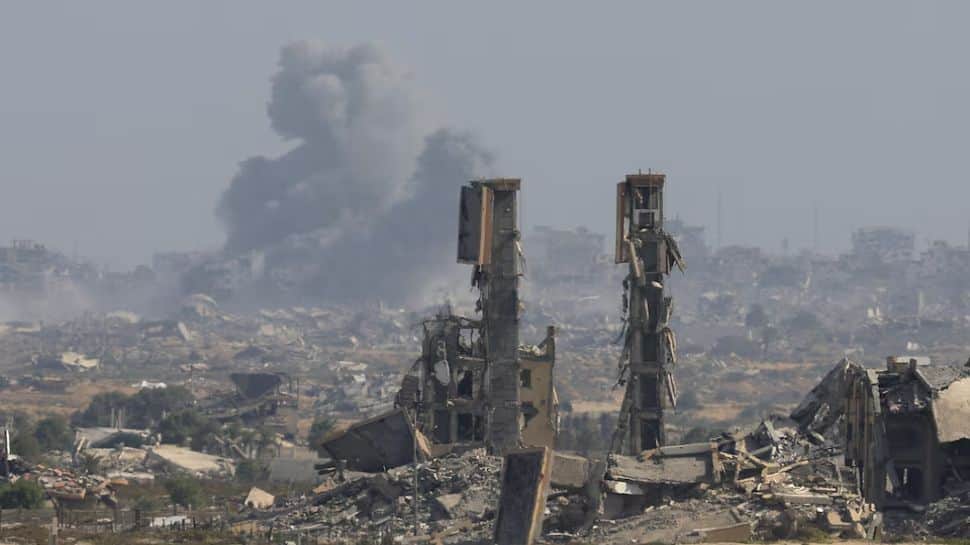
The humanitarian toll of two years of conflict has been devastating. According to a United Nations Relief and Works Agency for Palestine Refugees in the Near East (UNRWA) fact sheet marking the two-year anniversary of Israel’s war on Gaza, nearly all residents have been displaced, many multiple times. About 80 percent of all structures across the Gaza Strip are damaged or destroyed. Famine is confirmed in Gaza governorate and projected to expand in Deir el-Balah and Khan Younis.
Over 98 percent of Gaza’s cropland has been destroyed or left inaccessible. Less than 40 percent of hospitals remain functional, all partially, with at least 790 attacks on medical infrastructure and personnel. Nearly 92 percent of school buildings require reconstruction or major rehabilitation, forcing 660,000 children out of school. Water deprivation continues to affect residents severely, worsening an already catastrophic situation.
The conflict began after the Hamas-led attack on 7 October 2023, which killed around 1,200 people and took 251 hostages. Since then, more than 66,000 people have died in Gaza, according to Hamas-run health authorities. Israeli forces continue operations in Gaza City. Defence Minister Yoav Gallant said they are “tightening the siege”.
James Elder, UNICEF spokesperson, criticised the concept of safe zones in Gaza as “farcical”. “Bombs are dropped from the sky with chilling predictability. Schools, which have been designated as temporary shelters, are regularly reduced to rubble,” he said.