

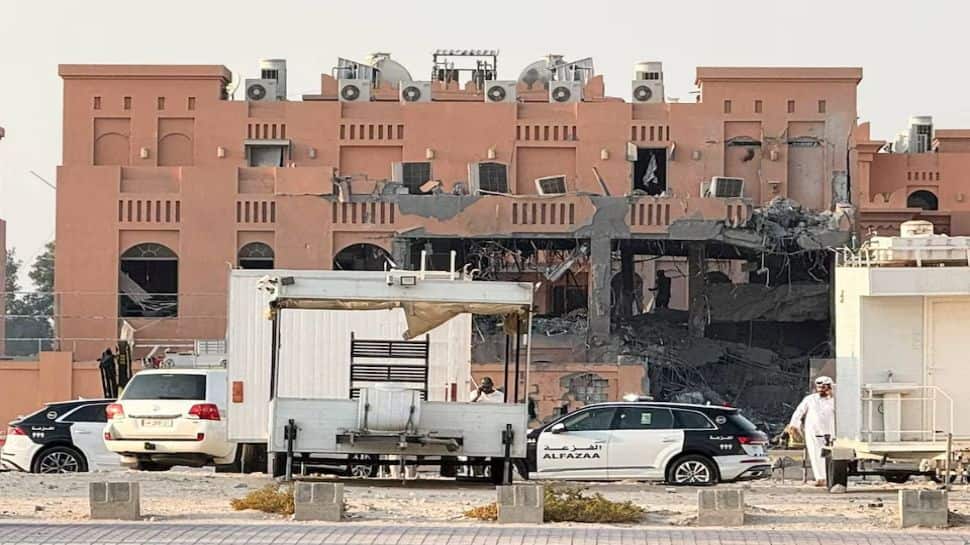
Doha: The Gulf region is confronting an unprecedented security crisis after Israel’s strike on Doha, an escalation that followed Iran’s attack on U.S. Al Udeid Air Base in Qatar on June 23, 2025. For decades, wealthy Gulf monarchies prided themselves on stability, projecting images of booming economies, glittering skylines and insulated safety. That sense of security is now under strain as the war in Gaza creeps closer to their borders.
Qatar’s leadership has signalled that the response to Israel’s action would be collective. Prime Minister Sheikh Mohammed bin Abdulrahman Al Thani told CNN that consultations were underway with regional partners and that a decision would likely be announced at the Arab and Islamic summit in Doha over the weekend.
The most visible sign of coordination came from the United Arab Emirates (UAE). President Mohammed bin Zayed Al Nahyan flew to Doha within a day of the attack, bringing a large delegation. Qatar was the first stop in a Gulf tour that also took him to Bahrain and Oman. Soon after, the UAE foreign ministry summoned an Israeli diplomat, denouncing the strike as a blatant and cowardly act.
Regional analysts said Gulf states are now weighing their limited options. Bader Al-Saif of Kuwait University highlighted that the governments see an urgent need to act collectively, warning that inaction could make other Gulf capitals vulnerable.
Diplomatic Fronts
Observers said the UAE might consider downgrading diplomatic ties with Israel or scaling back participation in the Abraham Accords, the normalisation pact that had been central to Washington’s Middle East policy under Donald Trump. Emirati officials had already voiced discontent before the strike on Doha, warning that any Israeli move to annex parts of the West Bank would cross a red line and undermine the spirit of the accords.
Qatar is expected to push legal measures as well. Sheikh Mohammed indicated that Doha’s response would include action under international law. This week, Qatar succeeded in rallying the UN Security Council to issue a unanimous condemnation of the Israeli strike.
Hasan Alhasan of the International Institute for Strategic Studies in Bahrain said Gulf governments had so far avoided playing significant roles in international legal efforts against Israel, but this could change if they choose to participate collectively.
Analysts also suggested that Qatar could reconsider its role as the region’s main mediator between Washington and its adversaries.
Security Calculations
Despite frequent political disputes among themselves, Gulf states remain tied by longstanding mutual defense treaties. Abdulaziz Sager of the Gulf Research Center argued that the moment may have come to activate the Peninsula Shield Force, the joint defense pact first drawn up in the 1980s.
The analysts added that what had so far remained theoretical could now evolve into practical steps, including the creation of a unified Gulf command, integrated air and missile defenses and greater investment in indigenous capabilities.
Most Gulf militaries remain reliant on American systems and bases. There is growing unease over what some view as U.S. failures to fully guarantee regional security. The analysts said this could push Gulf capitals into pressing the Trump administration for clearer defense commitments, rather than arms sales alone.
Still, they cautioned that internal rivalries could hinder consensus. Alhasan emphasised that Gulf leaders remain dependent on Washington, whose policy has long prioritised maintaining Israel’s military edge.
Economic Pressure
The Gulf’s vast oil and gas wealth gives it a powerful tool. The analysts said sovereign wealth funds could be used to restrict investment links with Israel or boycott firms with major Israeli stakes.
Alhasan explained that coordinated financial pressure could carry weight globally.
The region’s rulers have also tied massive investments to their security environment. During Trump’s first foreign trip of his second term, Saudi Arabia, the UAE and Qatar collectively pledged around three trillion dollars for the U.S. economy over the coming decade.
Al-Saif pointed out that such investments assume stability in the Gulf. If insecurity deepens, the money could be redirected toward defense spending or alternative markets.