

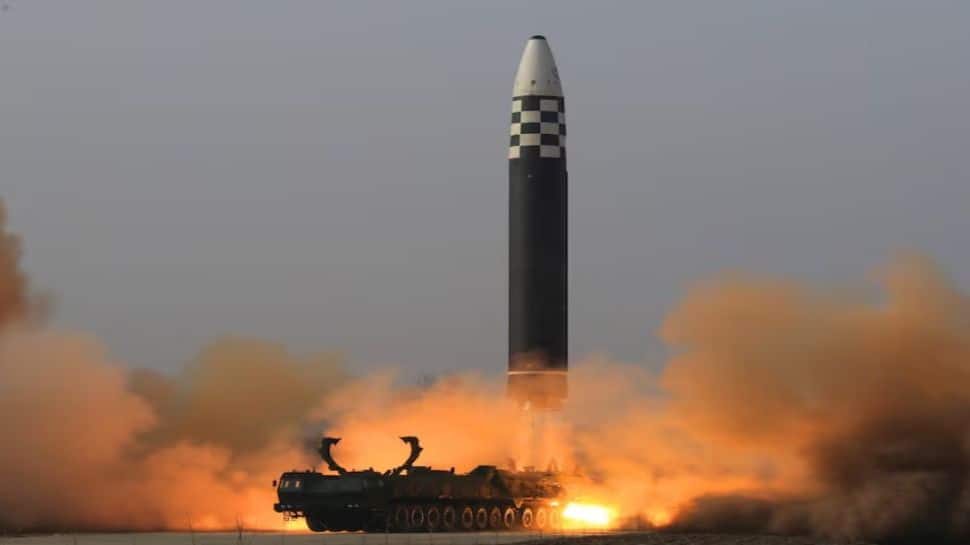
Tehran: Iran stunned the world with its latest missile claims. An Iranian lawmaker said a recent viral video showing a missile launch depicted a successful test of an intercontinental ballistic missile (ICBM). The missile is reportedly built using satellite launch vehicle (SLV) technology, which is part of Iran’s space programme. Its range exceeds 10,000 kilometres, putting the United States and Europe within reach.
However, veracity of the claim remains uncertain.
What Is An ICBM?
An ICBM is a long-range ballistic missile capable of striking targets over 5,500 kilometres away. It travels through the air and descends on the target. It can carry nuclear warheads.
Iran claims this new missile uses SLV technology, which is originally intended for its space programme.
The Iranian lawmaker said this test represents the country’s most advanced missile. The video shows smoke trails, presented as proof of launch.
Experts remain skeptical. According to the US Defense Intelligence Agency (DIA, 2025), Tehran could develop an operational ICBM by 2035 if it chooses.
At present, Iran possesses medium-range ballistic missiles (MRBMs) such as Khorramshahr-4 and Fateh-2, with ranges between 2,000-3,000 km.
No confirmed evidence of ICBMs exists.
The Arms Control Association (2025) says that Iran’s SLV programme (Simorgh) could be repurposed for ICBMs, but it remains at the prototype stage.
Iran has over 3,000 missiles, but no verified ICBM.
Iran’s Missile Arsenal
- Short-range (SRBM): 300-1,000 km, e.g., Shahab-1 (330 km)
- Medium-range (MRBM): 1,000-3,000 km, e.g., Khorramshahr-4 (2,000 km, 1,500 kg warhead)
- ICBM Claim: 10,000+ km, capable of reaching the US east coast.
The DIA says Iran would need outside help, such as from North Korea, to develop an operational ICBM. In 2025, Iran reportedly launched 500 missiles at Israel. Its missile programme dates back to 1980.
Who Is At Risk?
If Iran’s claim holds, a 10,000+ km missile could threaten:
- Middle East: Israel (1,500 km), Saudi Arabia (1,200 km), the UAE (1,000 km)
- Europe: France, Germany, the United Kingdom (3,000-4,000 km)
- Asia: India (2,500 km, outside ICBM range), Pakistan (1,500 km)
- United States: East Coast cities, including New York and Washington (within 10,000 km range)
Iran focuses on Israel and the United States. In the 2025 Israel-Iran conflict, the country launched 500 missiles at Israel.
An operational ICBM could put US bases in Qatar and Bahrain at risk. Iran’s SLV programme serves as an ICBM testbed, violating UN sanctions.
Concerns And Sanctions
The United States and Israel have issued warnings. DIA analysts estimate Iran could achieve the ICBM capability by 2035.
The United Nations maintains sanctions on Iran’s missile programme. Israel struck Iranian missile sites in June 2025.
Iran insists its programme is defensive. Experts, including the USIP (2025), caution that successful ICBM development could escalate tensions across the Middle East and Europe.
Reality Check
Iran’s ICBM claim heightens concern, but evidence is limited. If verified, the United States, Europe and Israel face a substantial threat.
India remains outside the missile’s range, but regional stability could be affected. The experts are of the view that international diplomacy and sanctions are key to preventing escalation and controlling Iran’s missile ambitions.