

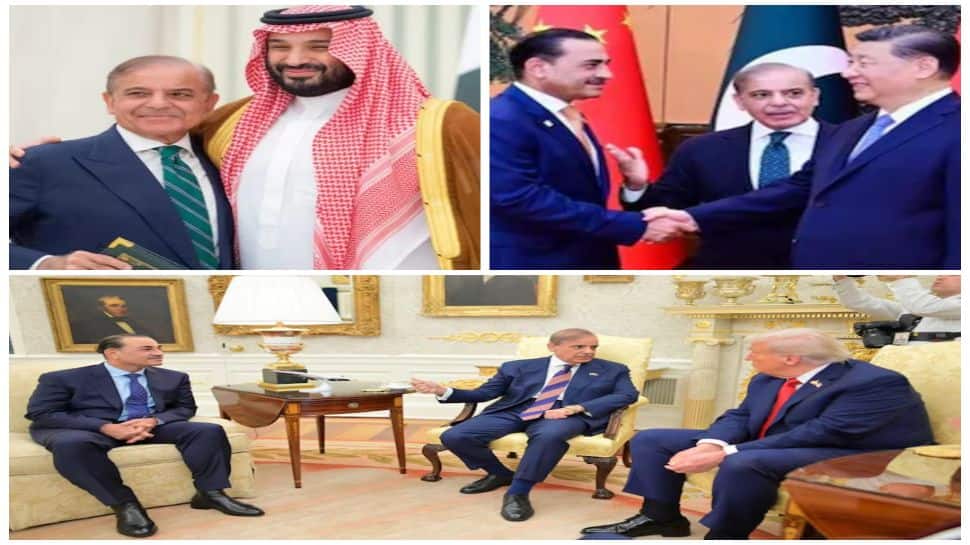
Pakistan’s Diplomacy: Islamabad’s leadership has captured global attention for its deft handling of rival superpowers. Pakistan’s civilian government and the military have coordinated in a manner that has both impressed and raised eyebrows. The country recently secured $8.5 billion in new Chinese investments while simultaneously offering the United States the opportunity to develop a port near Pasni in Balochistan. Saudi Arabia has also joined the strategic equation through a new defence agreement.
Observers say that Islamabad’s approach to diplomacy is unconventional. Mihir Sharma, senior fellow at the Observer Research Foundation, wrote in Bloomberg that Pakistan’s leaders have found a way to manage two rival global powers at the same time. The country provides the United States with an economic stake without undercutting China, while offering Beijing similar assurances. Their strategy spreads influence across all major players in an increasingly multipolar world.
Prime Minister Shehbaz Sharif visited Beijing last month. During his visit, China announced $8.5 billion in fresh investments for Pakistan. The deal highlights Pakistan’s skill in leveraging US engagement while expanding Chinese partnerships. The country’s deepening ties with Saudi Arabia have not alarmed Washington. In recent months, US President Donald Trump met twice with Pakistan’s military chief General Asim Munir.
Power in Pakistan revolves largely around Munir. Although Sharif holds the office of prime minister, decisions reportedly follow military guidance. Defence Minister Khawaja Asif described this arrangement as a “hybrid government”. This hybrid model allows Islamabad to pursue a strategy that seeks to keep all major powers content, from China to Saudi Arabia.
Part of this balancing act includes offering the United States a new port in Pasni, a fishing village just 110 kilometres from the Chinese-operated Gwadar port. The port could facilitate access to Pakistan’s mineral resources. Gwadar marks the southern end of Beijing’s corridor from the Arabian Sea to Xinjiang. Pasni would serve as a parallel route, allowing Pakistan to divide its economic and strategic access between China and the West.
Money is a central element of Pakistan’s strategy. The Missouri-based US Strategic Metals signed a $500 million deal with the military-run Frontier Works Organisation. The Asian Development Bank gave a $41 million package for the Reko Diq mine in Balochistan, about 400 kilometres north of Pasni near the Iranian border. The International Finance Corporation will contribute an additional $40 million to develop one of the world’s largest copper and gold reserves.
Extracting and transporting gold from Balochistan is exceptionally challenging. The region has historically resisted Islamabad’s control. The Baloch people have opposed Chinese projects and would likely resist US initiatives, linking opposition to the designation of the Balochistan Liberation Army as a terrorist organisation.
Pakistan has exposed its sovereignty in the process of economic expansion. It borrows from the International Monetary Fund (IMF), shares nuclear energy cooperation with Saudi Arabia and mortgages infrastructure to China while offering mineral access to the United States.
Prime Minister Sharif and General Munir have learned to “use” the nation’s resources strategically, balancing international investment and influence against internal constraints.
This complex diplomacy illustrates Pakistan’s ambition to navigate a multipolar world while pursuing economic gains and strategic security. The country simultaneously courts superpowers, maximises investment and manages domestic risks. Its hybrid government, military influence and external partnerships demonstrate a high-stakes approach to survival and growth in a challenging geopolitical landscape.