

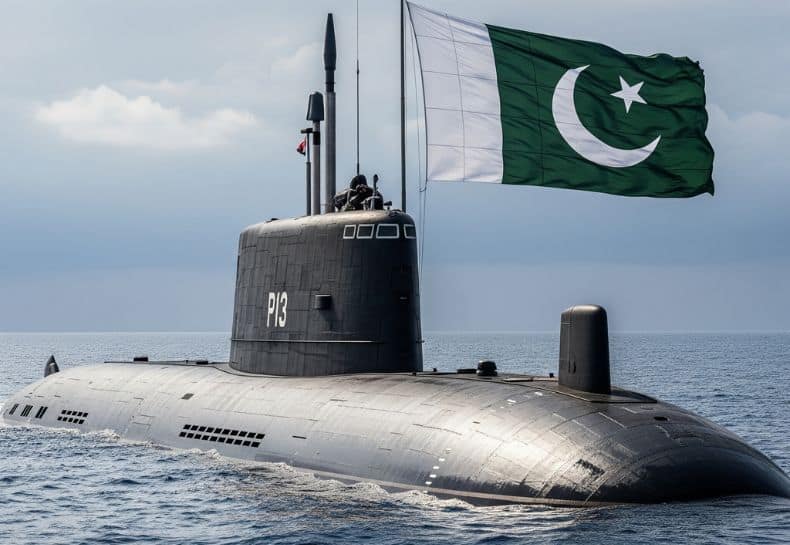
At a time when ordinary Pakistani families are facing hardships in terms of food inflation, high electricity bills, and IMF-imposed fiscal austerity measures, the Pakistani government and the military continue to invest billions of dollars in new submarines. This shows the nation’s misplaced priorities with a prestige-focused defence policy.
Pakistan remains heavily reliant on IMF loans, having entered its 25th bailout programme since 1958. The latest $7 billion package includes strict conditions. These range from parliamentary approval of a fiscally restrained budget, reforms in the energy sector, and lowered subsidies.
Despite these constraints, the Pakistani government, in June this year, after clashes with India, approved a 20% hike in the defence budget, now at PKR 2.55 trillion, or 1.97% of GDP, citing regional threats and military modernisation.
This comes at a time when households face struggles, including high food inflation and power tariffs.
As per the Pakistan Bureau of Statistics: “Cost of food in Pakistan increased 0.89 per cent in July of 2025 over the same month in the previous year. Food inflation in Pakistan averaged 10.09 per cent from 2011 until 2025, reaching an all-time high of 48.65 per cent in May of 2023 and a record low of -5.12 per cent in March of 2025.”
It is because of this that even families earning more than the minimum wage face difficulty meeting everyday expenses.
Instead of increasing the military budget, that same amount could have been used for targeted subsidy programmes to curb food inflation, improve agriculture, or directly support households facing rising grocery and electricity bills. Economists anticipated cuts to social development to fund the increase in defence spending. They suggested that these funds could have supported education, health care, or food security if priorities were adjusted.
Pakistan Navy’s Submarine Acquisition
Despite this, amidst fiscal stress, Pakistan is pursuing a $5 billion agreement with China to acquire eight Type 039A (Hangor-class) submarines. The third vessel was launched on August 15, 2025, at a ceremony held at a shipyard in Wuhan. The Hangors have been touted as having advanced sensors, stealth, and weapon systems designed to counter regional rivals and enhance maritime deterrence.
Pakistan signed the $4–5 billion deal with China Shipbuilding & Offshore International Company (CSOC) in 2015 to acquire eight Hangor-class submarines. As part of the agreement, four submarines are being built in China, and the other four are being assembled in Pakistan at Karachi Shipyard & Engineering Works under a technology transfer programme, with deliveries planned between 2022 and 2028.
The Hangor-class submarines may slightly enhance Pakistan’s naval posture, but they are undoubted markers of a state that prioritises military optics over the pressing survival needs of its citizens. Food security does not have the same optics as submarines do for national security.