

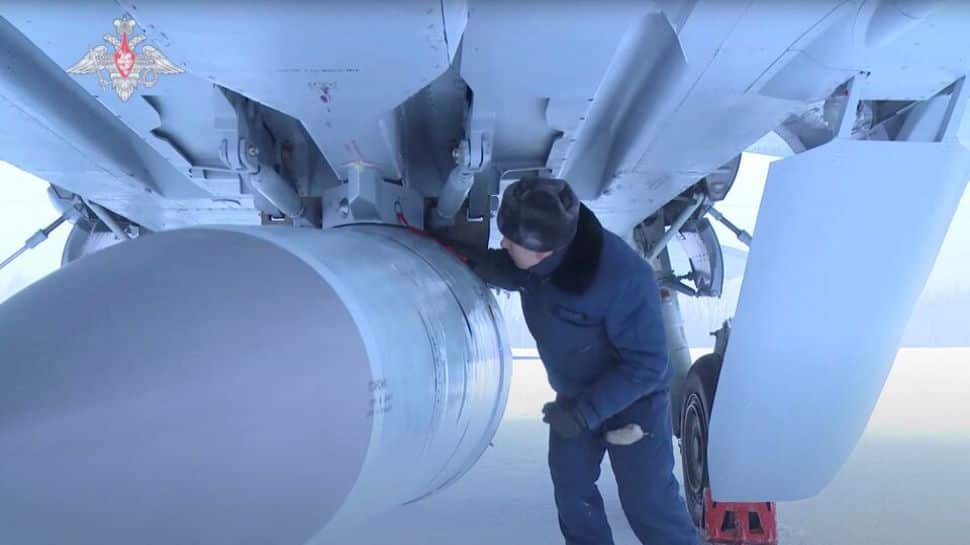
Kyiv (Ukraine): Russia’s Kinzhal missile has emerged as one of the most formidable weapons in the Ukraine war. Launched from MiG-31 fighter jets, the missile travels at hypersonic speeds and makes it extremely difficult to track.
Its range of 460 to 480 kilometres and air-to-ground capability have allowed it to strike weapon depots and airbases in Ukraine with precision, while also exerting psychological pressure on Ukrainian forces.
Although some missiles have been intercepted by Patriot defense systems, the majority have successfully hit their targets, intensifying the war’s lethality.
Understanding The Kinzhal Missile
Officially designated as Kh-47M2, the Kinzhal is an air-launched ballistic missile derived from the ground-launched Iskander-M system. It can be deployed from MiG-31 or Tu-22M3 aircraft and reaches speeds of up to 12,348 kilometres per hour.
While it is capable of carrying a nuclear warhead, most operational deployments are conventional strikes. The missile falls within the hypersonic category because it exceeds Mach 5, although experts say that it does not maneuver like a dedicated hypersonic glide vehicle.
Its speed and trajectory, however, make it an exceptionally challenging threat for adversaries.
Hypersonic Speed Creates Tracking Challenges
The missile’s defining feature is its hypersonic velocity, which makes it nearly invisible to conventional radar systems. Unlike slower missiles, the Kinzhal can follow curved paths in the air, confusing air defense systems. Russian President Vladimir Putin has described it as a weapon that can penetrate any air defense with ease.
Kyiv’s Patriot missile systems, given to it by the United States, have occasionally intercepted Kinzhal strikes, but most have succeeded, demonstrating the missile’s effectiveness.
Air-to-Ground Capability
The Kinzhal is specifically designed for air-to-ground attacks. Its multi-purpose warhead can target command centres, airbases, mobile units and even ships.
Russia has used it in Ukraine to target the latter’s weapon depots, runways and training sites, with a single strike capable of devastating entire areas.
Psychological Impact On Ukrainian Forces
First deployed in Ukraine in March 2022, the Kinzhal has been launched hundreds of times since. It has served not only as a destructive tool but also as a weapon to lower Ukrainian morale.
Russia has framed its strikes as responses to Ukrainian offensives, while the continuous attacks have increasingly pressured both Ukrainian forces and civilians.
Challenges, Global Perspective
Despite being portrayed as almost unstoppable, the Kinzhal is not invincible. The Patriot air defence system has managed to intercept some missiles. However, its speed, range and precision make avoidance and defense extremely difficult.
Internationally, the weapon is viewed as part of the hypersonic arms race, with NATO and the United States closely monitoring its deployment. Russia considers the Kinzhal a demonstration of its military strength and technological capabilities.
The missiles contribute to a more dangerous battlefield, showing how technological advancements in warfare directly affect human lives. Ukrainian forces continue to resist with courage, but the constant threat highlights the escalating intensity of modern conflicts.
While the missile exemplifies engineering excellence, it also brings the severe reality of war to those on the receiving end.