

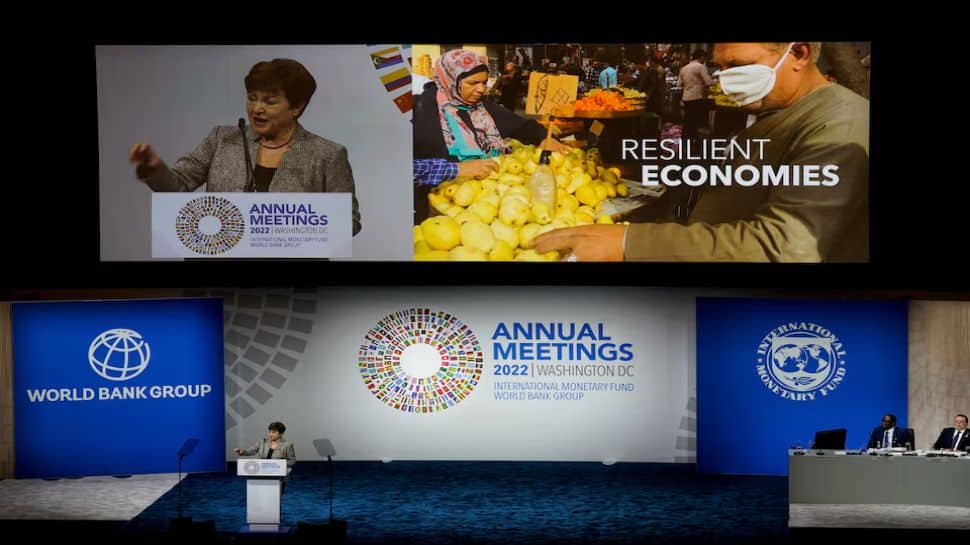
Washington: Argentina, Ukraine and Egypt top the list of countries borrowing the most from the International Monetary Fund (IMF) the most in 2025, together accounting for nearly half of the total $162 billion owed. This came to light during an IMF and the World Bank meeting in Washington, DC that is being attended financial delegates and central bankers from around the world.
The discussions, which will conclude on Saturday, focus on the impact of these debts on global economic stability, debt management and strategies to support nations facing severe financial crises. The IMF warns of financial distress following US trade tariffs and rising protectionism.
Known as a “lender of last resort”, the IMF steps in when countries face severe financial crises. It provides assistance when usual borrowing channels are unavailable. Its loans come with strict conditions, and austerity measures often follow. These measures can increase social and economic hardships, making the loans a double-edged sword.
What Is The IMF And How Does It Fund Itself?
The IMF was founded in 1944 at the Bretton Woods Conference in America’s New Hampshire. It was created to stabilise the post-war global economy. Based in Washington, DC, it has grown from 44 founding members to 191 today. The IMF works with the United Nations and other organisations to support global financial stability.
It provides policy advice, short-term financial assistance and capacity development. Any country can join if approved by existing members. Countries pay a quota based on the size of their economy. Wealthier countries contribute more. The quota determines contributions, borrowing limits and voting power.
The IMF has a total lending capacity of about $1 trillion. It draws funds from member countries. Wealthy and stable economies act as creditors. They earn interest on contributions. In 2024, about 50 creditor nations received roughly $5 billion in interest.
Which Countries Owe The Most To The IMF?
Debt is expressed in Special Drawing Rights (SDRs), which are based on five currencies – US dollar, euro, pound sterling, Chinese renminbi and Japanese yen. The SDRs are not a currency. Countries can exchange them for these currencies. As of October 15, one SDR equals $1.36.
The IMF has the highest-ever total credit outstanding. Eighty-six countries owe SDR 118.9 billion, roughly $162 billion. Three countries owe almost half of the total. The top ten owe 73 percent.
Argentina owes the most (SDR 41.8 billion, which is about $57 billion). Ukraine owes SDR 10.4 billion, about $14 billion. Egypt owes SDR 6.9 billion, about $9 billion.
Why Does Argentina Owe So Much?
Argentina is the IMF’s largest borrower. Its debt exceeds the combined total of Ukraine, Egypt, Pakistan, Ecuador, Ivory Coast, Kenya and Bangladesh.
In April, the IMF approved its 23rd programme to Argentina. The programme is a $20 billion bailout. It is designed to prop up the economy. Argentina has repeatedly borrowed from the IMF. It has received the most bailouts in the IMF history.
In 2018, the country secured a $57 billion loan. It was the largest in the IMF history. The loan addressed fiscal imbalances. It followed a currency crisis and double-digit inflation.
In October 2025, the Donald Trump administration announced a $20 billion financial support package for Argentina. The package stabilises the economy before the October 26 midterm elections. It includes a $20 billion currency swap with Argentina’s central bank. US dollars are exchanged for pesos. This bolsters foreign currency reserves.
Why Does Ukraine Owe The IMF More Than $14 Billion?
Ukraine’s economy collapsed after Russia invaded in February 2022. External debt is more than double pre-war levels. Total government-guaranteed debt reached $152 billion by April. More than 70 percent ($108.4 billion) is external obligations.
In March 2023, the IMF approved a four-year Extended Fund Facility (EFF) worth $15.5 billion. The plan is part of an international support package. The package stabilises Ukraine’s economy. It supports civilian spending and debt servicing. Ukraine has high military expenditure.
As of October 2025, Kyiv received $10.6 billion of the planned $15.5 billion under the EFF for 2023-2027.
Why Does Egypt Owe The Third-Most?
Egypt borrows repeatedly to stabilise its economy. Debt and fiscal deficits are high. Foreign currency reserves are low. Inflation is high.
In 2016, the IMF approved the EFF programmes worth $11.9 billion. It addressed longstanding economic issues after the 2011 uprising. The IMF aimed to fix overvalued currency, slow growth, unemployment and inflation. Measures included flexible exchange rate, tax increases and subsidy and wage cuts.
In March 2025, the IMF approved $1.2 billion for Egypt. This followed the fourth review of the $8 billion reform programme. Cairo reported inflation almost halved in February. Reforms helped stabilise the economy.
Which Countries Owe The Most Relative To GDP?
IMF loans are billions of dollars. They usually remain a small part of total debt and GDP. The countries with the highest IMF debt as a share of GDP are Suriname (13 percent), Central African Republic (9.4 percent), Argentina (8.3 percent), Barbados (7.4 percent) and The Gambia (6.95 percent).