

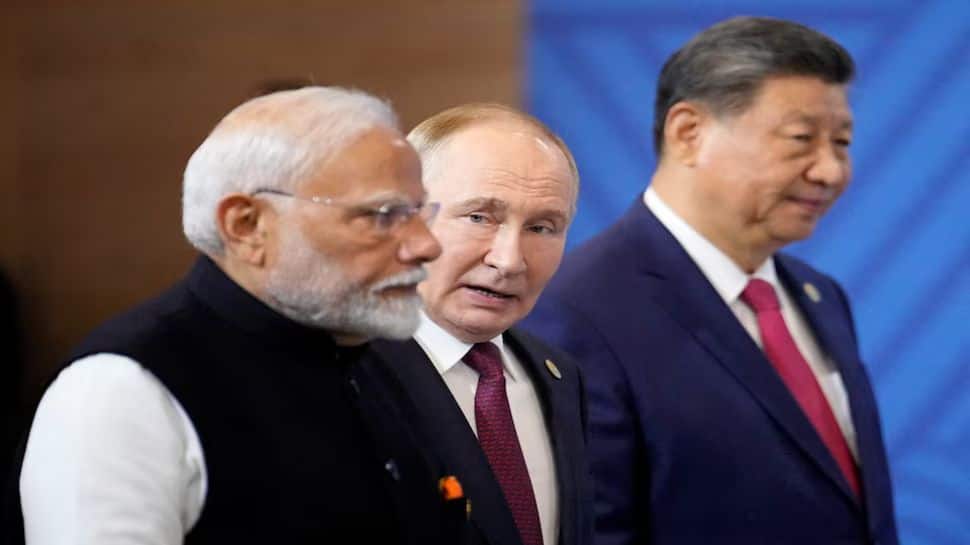
New Delhi: The recent developments surrounding the growing partnership between India, China and Russia have raised intriguing questions in the global trade arena, especially with the backdrop of US President Donald Trump’s aggressive tariff policies. While the trio’s collective power is formidable, the big question remains: Can they truly challenge the tariffs imposed by the United States?
In the face of Trump’s 50% tariff on Indian goods, the partnership between China, Russia and India seems to be growing stronger by the day. These three nations have moved closer to each other as a response to what they perceive as unfair economic pressures from the United States.
India’s New Approach To Trade
India has historically maintained close economic ties with the United States, but Trump’s tariff policies have prompted a shift in strategy. The recent rise in cooperation with China and Russia signifies India’s intent to reduce its dependency on the United States.
According to experts, the growing alliance among the three countries points to India’s desire to explore regional solutions to its economic challenges, away from the reliance on U.S. concessions.
The collaboration between India, China and Russia has the potential to mitigate the effects of the U.S. tariffs. China and Russia have begun to open up their markets to Indian goods and services, creating opportunities for trade expansion.
This multi-nation alliance not only fosters better relations but could help cushion the economic impact of the U.S. sanctions.
Economic Power Of The Trio
Together, India, China and Russia account for a significant portion of global economic activity. According to The Times of India, their combined GDP stands at $53.9 trillion, making up nearly a third of the world’s total production. Their exports exceed $5 trillion and their foreign reserves are a whopping $4.7 trillion, constituting 38% of the global reserves.
Their combined military spending of $549 billion accounts for a substantial portion of global defense budgets, while their consumption of global energy stands at 35%.
China’s manufacturing power, Russia’s energy influence and India’s service-driven economy create a formidable economic and geopolitical bloc.
A Shift Toward A Multipolar World
If this trio comes together in a more unified way, it could drastically alter the existing world order. The unipolar dominance of the West, led by the United States, could give way to a more multipolar world.
The strengthening of Eurasian trade corridors and the use of local currencies could significantly challenge the dominance of the U.S. dollar.
The US Role In India’s Economy
While India’s relations with China and Russia are becoming stronger, the United States still plays an indispensable role in India’s economy. America is India’s largest export market, with Indian goods worth $77.5 billion sold to U.S. consumers in 2024. The total trade in goods and services between the two nations reached $212.3 billion in the same year, a clear indication of the depth of the economic ties.
Challenges For India
However, aligning with China and Russia is not without its risks. Trust issues with China, as well as security concerns related to Pakistan, add complexity to the partnership.
In addition, India’s long-standing dependence on the U.S. market for trade makes it difficult to entirely sever those economic ties.
The growing cooperation between India, China and Russia provides New Delhi with a valuable opportunity to diversify its economic relationships and reduce its reliance on the US.
However, it is a delicate balancing act. While the trio may offer a counterbalance to the United States, India will need to carefully navigate its geopolitical and economic interests, ensuring that it remains resilient in the face of external pressures. The future of global trade may well hinge on how India positions itself in this evolving dynamic.