

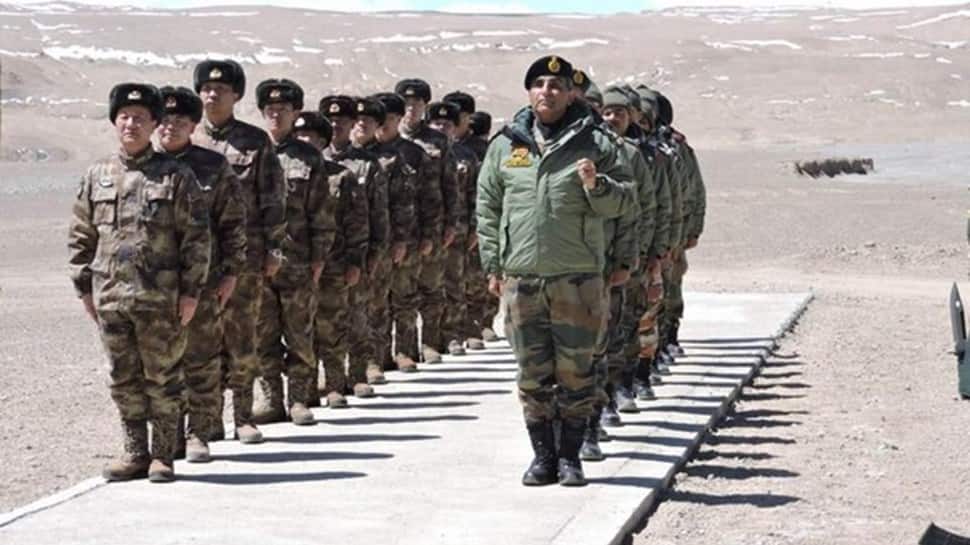
India-China Military Standoff: Having the largest army in the world, flexing military muscle and showing hard power aggression comes naturally to China. From the contested waters of the South China Sea to the Himalayas, such behaviour has been noticed across terrains. However, the frequency of Beijing’s military belligerence is in no way evidence of the capabilities of the People’s Liberation Army (PLA). In fact, the aggression is often a bluff that China hopes other nations will not call out.
The Dragon’s 2017 Doklam standoff with India is a standout example that exposed this. For 73 days, Chinese and Indian forces faced off on the Himalayan plateau. During that time, Beijing unleashed threats of military reprisal on a near-daily basis. India stood its ground in the face of these statements, which turned out to be bluffs later on.
When the dust settled, China quietly withdrew its forces, having no strategic achievements to show in lieu of all the aggression and tall claims made. The standoff only went to show that China’s escalation rhetoric was nothing more than psychological warfare designed only to intimidate. It relied heavily on intimidation tactics working out and the adversary stepping back so that actual capabilities, which are in fact missing, will not have to be used.
China’s Strategic Calculations: Risk vs Reward
Despite Communist Party-run media publishing articles that threatened to teach India a “bitter lesson” and warned of “greater losses” than the 1962 Sino-Indian War, China’s actions demonstrated a clear understanding of the catastrophic costs that would accompany any military misadventure with its nuclear-armed neighbour.
The standoff began when Chinese troops attempted to extend a road through Doklam, a strategic plateau in Bhutan that China covets for its proximity to India’s vital Siliguri Corridor (dubbed the Chicken’s Neck for its narrowness and exposure to international boundaries). India’s swift response in deploying 270 troops with bulldozers to halt the construction caught Beijing, which had not expected such direct intervention, off guard.
Although China has at least 17 ongoing territorial disputes, its primary theatre right now is in the Pacific, where the United States is its primary threat, and one standing as an obstacle on the path to “reunifying” Taiwan with the mainland. Given this context, the PLA’s threat perceptions vis-a-vis India are fundamentally asymmetric. India views China as its primary threat, but Beijing considers India a secondary challenge.
This asymmetry means that China can, at a maximum, only afford aggression against India. The strategic costs of military confrontation with the country are too high— it would expose Beijing even more against the US. Beijing’s strategic goal remains avoiding a two-front conflict with the US and India. As such, China cannot afford a conflict with either India, or the US.
Limits of Military Confrontation
Doklam also forced Beijing to confront a deeper truth. Its assumptions about India’s “inferior status” in the regional power hierarchy were challenged by India’s resolve. A military clash would have been costly, and India showed it was willing to accept the risks of standing firm.
Instead, China fell back on psychological warfare. State media churned out daily threats. Disinformation campaigns tried to paint India as the aggressor. Officials repeated warnings of inevitable defeat. Yet none of this shook India’s position on the ground. The threats rang hollow once it became clear that Indian forces were not moving.
China’s so-called “Three Warfares” strategy that uses psychological, legal, and media tools designed to intimidate without fighting, was put to the test and found wanting when India stood firm. Beijing’s attempts to present itself as the aggrieved party and paint India as the aggressor failed to gain international traction, further undermining China’s position.
The Bully That Backs Down
Doklam definitively proved that China’s strategy centres on bullying opponents into submission, but when faced with genuine resistance, Beijing consistently retreats. By the end of August 2017, Chinese troops had little choice but to seek disengagement.
The familiar pattern was visible: an initial show of force, escalating rhetoric, then a quiet retreat when faced with determined resistance. China may have continued to build infrastructure in the region later, but the episode exposed its preference for intimidation over outright confrontation.
The aftermath of Doklam further exposed China’s tactical limitations. Despite official withdrawal, China continued building infrastructure in the region, suggesting that psychological intimidation, rather than genuine military confrontation, remains Beijing’s preferred modus operandi. This pattern – initial aggression followed by infrastructure consolidation when direct confrontation proves too costly – reflects China’s fundamental strategic weakness: an inability to follow through on its threats when facing determined opposition.
This is not unique to Doklam. From the South China Sea to the Himalayas, Beijing has repeatedly employed “salami-slicing” tactics—pushing incrementally until it meets firm resistance, then stepping back while consolidating elsewhere. Doklam showed that when the pushback is sustained, the bluster fades.
For neighbouring countries facing Chinese aggression, Doklam offers a clear template: sustained resistance, diplomatic patience, and refusal to be intimidated by psychological warfare can force Beijing to recalculate its positions.