

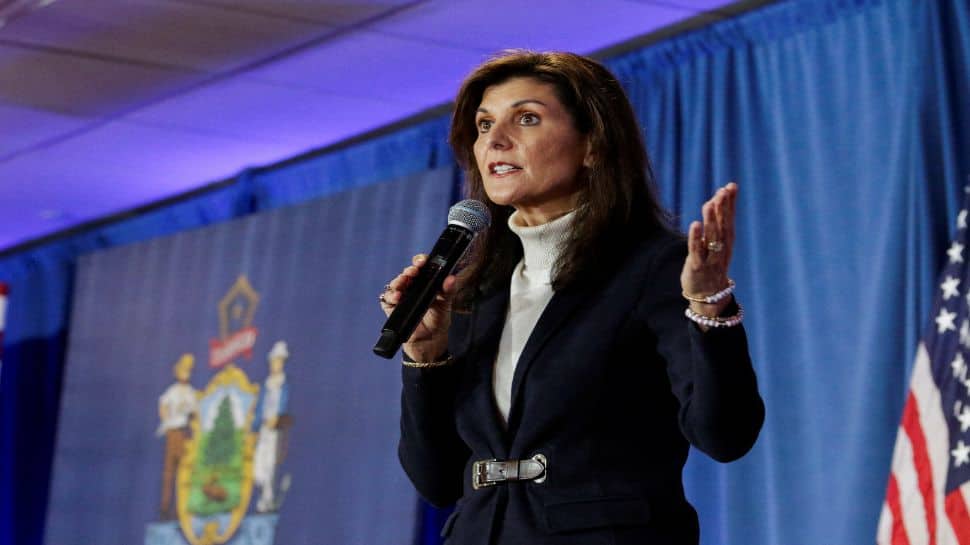
Washington: “To achieve America’s foreign policy goals of outcompeting China, few objectives are more critical than getting relations between Washington and New Delhi back on track,” wrote Nikki Haley, U.S. President Donald Trump’s fellow Republican and former U.N. ambassador, in an op-ed for Newsweek.
She urged that India must be treated “like the prized free and democratic partner that it is, not an adversary like China, which has thus far avoided sanctions for its Russian oil purchases, despite being one of Moscow’s largest customers”. She warned that undoing decades of diplomatic momentum with the only Asian power capable of balancing Beijing would be a “strategic disaster”.
She also highlighted India’s role in shifting supply chains away from China. “While the Trump administration works to bring manufacturing back to our shores, India stands alone in its potential to manufacture at a China-like scale for products that cannot be quickly or efficiently produced here, like textiles, inexpensive phones and solar panels,” she said.
Haley described New Delhi as a “crucial asset to the free world’s security”, stressing that unlike authoritarian China, a rising democratic India strengthens the global order.
Trump, however, has unsettled both allies and critics by threatening to impose an additional 25 per cent tariff on India for importing discounted oil from Russia. The measure comes on top of a similar levy already rolled out this month, taking the total duty to 50 per cent.
Once hailed as Washington’s counterweight to China, New Delhi now finds itself grouped with Brazil, whose President Luiz Inacio Lula da Silva has already threatened retaliation. Beijing, the largest buyer of Russian crude, has been spared from similar penalties.
‘Biggest Mistake’
Geopolitical analyst Fareed Zakaria joined the wave of criticism. Speaking to CNN, he called the tariff push “America’s biggest foreign policy mistake”, warning that even if Trump walks back the decision, “the damage is done”.
According to him, India now views the United States as “unreliable, its willingness to be brutal to those whom it calls its friends” and may deepen its ties with Russia while easing tensions with China.
‘Stupidest Tactical Move’
Economist Jeffrey Sachs struck a similar note. On ‘Breaking Points’ with Krystal Ball and Saagar Enjeti, he said the White House is effectively binding the BRICS bloc closer together.
He branded the tariffs “the stupidest tactical move in U.S. foreign policy” and labelled Trump “the great unifier of BRICS”.
‘Tariff Tantrum’
The pushback has reached Capitol Hill as well. Senior Congressman Gregory Meeks, a Democrat on the House Foreign Affairs Committee, denounced the policy as a “tariff tantrum” that risks dismantling over two decades of strategic, economic and cultural ties.
“We have deep strategic, economic and people-to-people ties. Concerns should be addressed in a mutually respectful way consistent with our democratic values,” he said.