

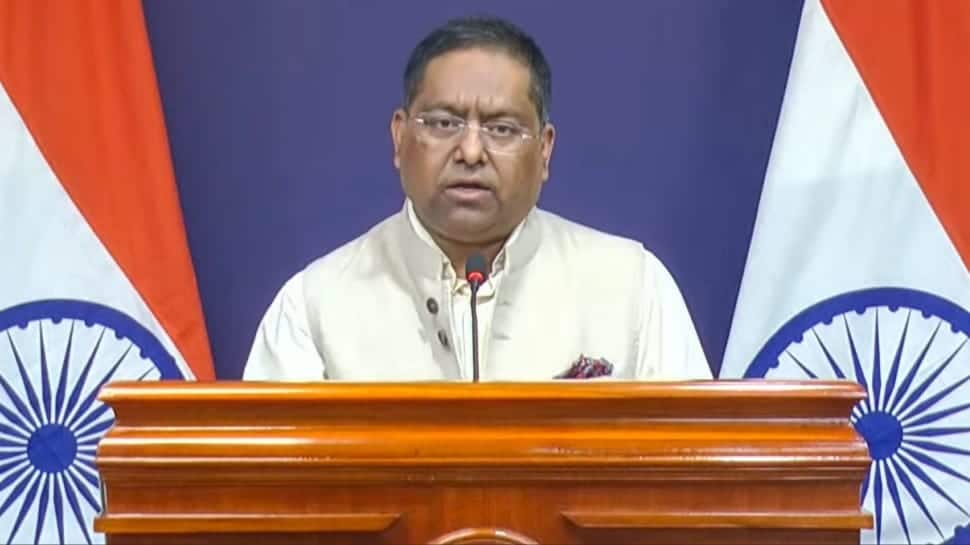
India has expressed strong disapproval of Nepal’s statements regarding the resumption of trade between India and China via the Lipulekh Pass, asserting that Kathmandu’s territorial claims over the route are “untenable,” lack justification, and are not supported by historical facts and evidence
MEA spokesperson Randhir Jaiswal, in an official statement, said that India has conducted trade with China via the Lipulekh Pass since 1954, adding that New Delhi is willing to engage in “constructive interaction” with Nepal through dialogue and diplomacy to address the “boundary issues.”
“Our position in this regard (on Lipulekh Pass) has been consistent and clear. Border trade between India and China through Lipulekh pass had commenced in 1954 and has been going on for decades. This trade had been disrupted in recent years due to COVID and other developments, and both sides have now agreed to resume it,” Randhir Jaiswal said.
The MEA spokesperson added, “As regards territorial claims, our position remains that such claims are neither justified nor based on historical facts and evidence. Any unilateral artificial enlargement of territorial claims is untenable. India remains open to constructive interaction with Nepal on resolving agreed outstanding boundary issues through dialogue and diplomacy.”
Foreign Ministry spokesperson Randhir Jaiswal has given this statement at a time when Nepal has expressed its claim on this land, objecting to the agreement between India and China to open a trade route through Lipulekh.
MEA spokesperson Randhir Jaiswal’s statement comes after Nepal objected to the agreement between India and China to open a trade route via Lipulekh, asserting its claim over the land.
Our response to media queries regarding comments made by Nepal on border issue https://t.co/0I3Es5UUfP pic.twitter.com/nxqFJtudGH — Randhir Jaiswal (@MEAIndia) August 20, 2025
Nepal Objects To India-China Trade Via Lipulekh Pass
Nepal’s Ministry of Foreign Affairs on Wednesday reaffirmed its claims over Limpiyadhura, Lipulekh, and Kalapani, located east of the Mahakali River, describing them as integral parts of Nepal and objecting to the unilateral move by China and India.
“The Nepalese government is clear that the official map of Nepal has been included in the constitution of Nepal and that the map shows Limpiyadhura, Lipulekh and Kalapani east of the Mahakali River as integral parts of Nepal,” the first point of the press statement reads.
Further, the ministry reiterated that Kathmandu has been urging the Indian government not to carry out activities such as road construction, expansion, or border trade in the area.
“It is also known that the Nepalese government has been urging the Indian government not to undertake any activities such as road construction, expansion, or border trade in the area. It is also known that the friendly country, China, has been informed that the area is Nepali territory.”
India-China Reopen Border Trade
India and China have agreed to reopen border trade through the Lipulekh Pass, which Nepal claims lies 56 km inside its western border at Limpiyadhura. The agreement was reached during the visit of Chinese Foreign Minister Wang Yi to India.
The two countries announced the decision following a meeting between Indian Foreign Minister S. Jaishankar and Chinese Foreign Minister Wang Yi. Point nine of the joint communiqué mentions the resumption of border trade.
“Both sides agreed to the reopening of border trade through the three designated trading points, namely Lipulekh Pass, Shipki La Pass, and Nathu La Pass.”
India Claims Lipulekh and Limpiyadhura as Part of Its Territory
India maintains that the Kalapani region, including Lipulekh and Limpiyadhura, is part of its territory. This claim is based on India’s interpretation of the 1816 Treaty of Sugauli, which determined the border with Nepal on the basis of the Kali River.
Nepal Refutes India’s Claims
However, Nepal argues that under the 1816 Treaty of Sugauli, Lipulekh, including Kalapani and Limpiyadhura, falls within its territory.
India claims the Kali River originates from the village of Kalapani, while Nepal contends that it begins further north at Limpiyadhura. This difference in interpretation is the root of the territorial dispute.
China’s Stance
In 2023, China released a new map showing Lipulekh, Kalapani, and Limpiyadhura as part of India.
(With ANI Inputs)
ALSO READ: Nikki Haley Urges Trump To Treat India As ‘Prized Partner’ Amid Tariff Row