

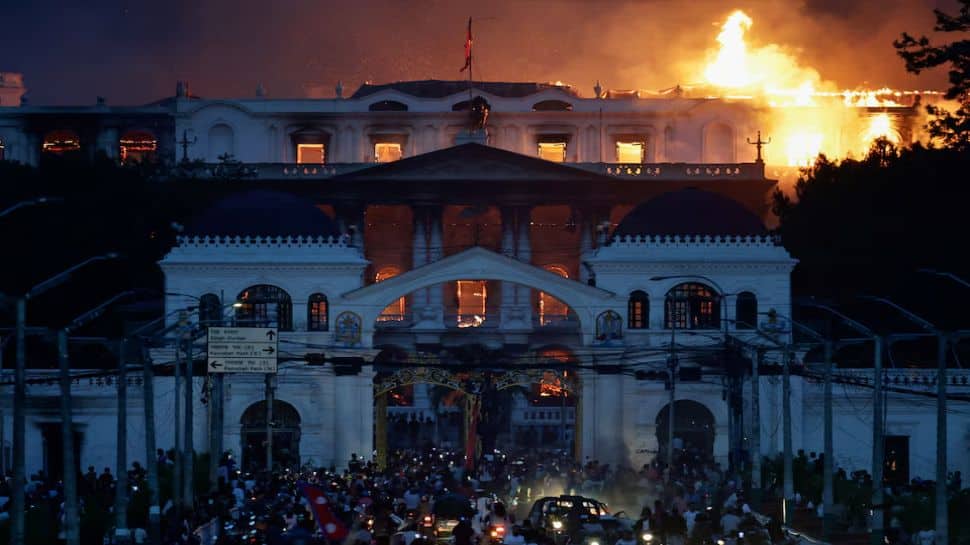
Kathmandu: Nepal burned for two days with youth anger. Corruption, unemployment and social media bans pushed Gen-Z onto the streets. The crowd toppled the government and forced the president, the prime minister and his Cabinet to resign. Most of the political leaders either fled the country or went into hiding. Several ministers were chased and publicly assaulted.
NGOs such as Hami Nepal are said to be driving the mobilization; however, many see the violent agitation as spontaneous. There are others who whisper about involvement of the Deep State. Those who are pushing this conspiracy theory argue that external forces used local anger for global ends. Nepal’s unrest, they allege, suits either the United States or China.
The Trigger – Social Media Ban
On September 4, 2025, the government blocked Facebook, Instagram, YouTube and 26 more social media platforms. The ban was sold as regulation, but people called it an assault on free speech.
The backlash was instant. Hami Nepal rallied students under the banner “Youths Against Corruption”. What began as protests turned into violent street battles. At least 30 people died in the police firing. A curfew gripped Kathmandu. Crowds did not stop at chanting slogans. They stormed offices, dragged politicians into the streets and attacked homes.
Unlike past protests, these were targeted. Parliament’s building was set ablaze. Former PM Madhav Kumar Nepal’s party office was torched. Ministers’ houses were ransacked. It did not feel random.
The Return Of The King?
A striking feature of this wave is nostalgia for monarchy. Demonstrators shouted “Maharaj Lauta, Desh Bachau” (King, return and save the country).
Since 2008, when the monarchy was abolished, Nepal has changed 14 governments in 17 years. Stability has been elusive. For many, democracy feels hollow. Gen-Z now sees the Shah dynasty not as relics, but as potential saviours.
Former King Gyanendra’s portrait resurfaced on banners. The anger was not only against corruption, but against a sense that democracy itself has failed.
Deep State Playbook
The “Deep State” is a term used to describe an alleged hidden web of powerful actors drawn from governments, big business, intelligence agencies and global NGOs. Critics believe this network silently shapes policy and outcomes, often beyond the reach of elected officials.
George Soros’s Open Society Foundation often surfaces in such debates. Across Asia, whispers of its hand follow movements from colour revolutions to abrupt regime shifts.
In Nepal too, many see echoes of the same script, and suspicions grow around familiar patterns:
1. Nepotism (but why only Nepal?)
Nepotism is not unique to Nepal. From India to Europe and the United States, complaints about “Nepo Kids” echo in politics and business. But nowhere else has the anger exploded into this level of unrest.
In Nepal, hashtags such as #Nepokids and #Nepobabies trended social media. NGOs allegedly amplified the outrage. Analysts allege global players chose Nepal’s instability to lit the fire.
2. Selective Violence
Protesters did not loot randomly. They hit Parliament, key party offices and homes belonging to high-profile people. This targeting suggests lists. Leaks show NGOs even told students to wear school uniforms and carry bags to disguise their presence.
This mirrors Bangladesh, where Sheikh Hasina’s fall was preceded by precision attacks and viral guides like “How to Protest”. Experts see a carbon copy of that strategy.
3. Emergence Of New Leaders
People such as Nabaraj Subedi, until recently unknown, now head the United People’s Movement for Monarchy. Months ago, he threatened civil war unless the monarchy returned. Few took him seriously. Today, he rallies thousands.
Once a fringe, Mayor Balen Shah suddenly emerged as a youth icon. Their rise resembles Bangladesh’s Mohammad Yunus, who vaulted from Nobel laureate to interim leader after Hasina’s ouster.
4. The South Asia Pattern
From the unrest in Sri Lanka in 2022, Bangladesh in 2024 and Nepal in 2025, a sequence emerges. Each began with Gen-Z street fury and ended with regime collapse.
In Sri Lanka, protests ousted Gotabaya Rajapaksa. The West-friendly Ranil Wickremesinghe replaced him, followed by an IMF bailout. In Bangladesh, Hasina fled to India after violence killed more than 100. Yunus stepped in. Both cases saw limited economic relief but growing Western influence.
Nepal’s youth see hope. Analysts see déjà vu.
5. Foreign Hands
China is deeply invested in Nepal through Belt and Road projects. Airports, highways and power plants built with Chinese loans have bred resentment. Analysts believe Beijing benefits if instability reduces Indian influence.
America, meanwhile, has channelled money through the USAID (United States Agency for International Development) and the Millennium Challenge Corporation. Many now stalled projects worsened Nepal’s economy in 2025.
American NGOs mirror tactics seen in other uprisings. Hami Nepal’s protest manuals, slogans and digital strategy allegedly align with Deep State fingerprints.
Why India Watches Closely
Nepal is not merely a neighbour. It is a buffer between India and China. An unstable Nepal invites both rivals into Delhi’s backyard.
In Sri Lanka, regime change tilted the island toward Western lenders. In Bangladesh, Hasina’s fall handed the United States a stronger foothold in South Asia. If Nepal follows, India risks losing one more ally to foreign influence.
Four Chinese nationals caught trying to cross illegally into India last month added fuel to suspicion. For India’s security planners, the unrest in Kathmandu does not stop at protests. It touches the Himalayas, the borders and the great game of Asia.
The crowds in Kathmandu chant against corruption. They rage against “Nepo Kids”. They wave royal flags. But in the whispers of diplomats, intelligence officers and analysts, one question grows louder: Was Nepal’s Gen-Z protest truly spontaneous or is the Deep State scripting another regime change in South Asia?