

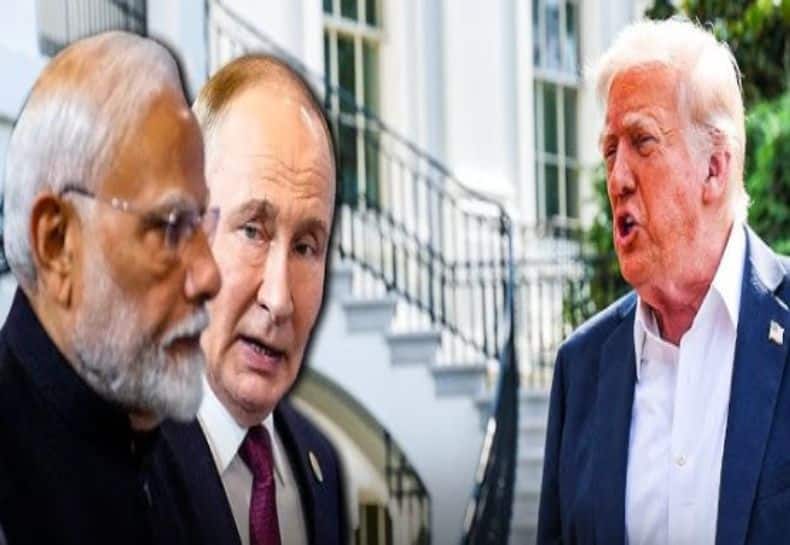
New Delhi: The United States has hit India with steep new tariffs, turning a once-warm trade partnership into a tense standoff. At the centre of the dispute is New Delhi’s decision to keep buying discounted Russian oil, a move that Washington says undermines its sanctions policy. The shift has led to a wider global realignment: allies facing friction and rivals finding common ground. President Donald Trump’s tariff-heavy strategy is blurring the line between friend and competitor.
Signs of a broader geopolitical realignment are also visible. For the first time since the 2020 Galwan Valley clash, Prime Minister Narendra Modi is considering attending the Shanghai Cooperation Organisation (SCO) summit, which China is hosting this year. Russia remains a long-standing ally, but closer ties with Beijing carry strategic and economic risks.
Diplomatic sources suggest that Modi’s potential presence at the SCO would be read in Washington as a signal that India is willing to engage more with blocs where the United States has little sway.
India’s trust deficit with China remains deep. Border disputes, military skirmishes and Beijing’s open support for Pakistan during Operation Sindoor have left a legacy of mistrust. Russia’s growing dependence on China could further reduce India’s influence in the region.
Analysts emphasise that Moscow’s military cooperation with Beijing, including joint patrols in the Sea of Japan and advanced technology transfers, has added to New Delhi’s unease.
The trade imbalance adds another layer of concern. India’s deficit with China has crossed $100 billion in FY 2024-25, up from $85.09 billion the previous year. By contrast, the U.S. relationship brings a surplus of over $35 billion, with bilateral trade valued at $119.71 billion in 2023-24.
Washington has repeatedly highlighted this surplus as proof that it remains a more beneficial trade partner for India, even as it warns that continued Russian oil imports could jeopardise preferential market access.
Analysts warn that closer alignment with Russia and China could strain India’s relations with the West. The United States and its allies view both nations as strategic rivals. India’s engagement with them may invite further economic restrictions and weaken platforms like the Quad, which includes the United States, Japan and Australia.
Conversations in Washington policy circles have questioned India’s reliability as a Quad partner, especially if it moves towards energy and defence agreements that align with Chinese and Russian interests.
While Russia has been a dependable partner for decades, the Ukraine conflict has bound it tightly to China, which is now its largest trading partner. This dynamic could leave India as a secondary priority for Moscow.
India is benefiting in the short run in energy sector by purchasing Russian crude at a discount of up to $8-10 per barrel, but strategists warn that these savings could be erased if Western tariffs expand to cover more sectors.
India’s next moves require careful calculation. Each decision carries significant long-term consequences, not only for its trade but also for its place in the shifting global power structure. A senior Indian diplomat put it privately, “This is no longer just about oil. It is also about choosing which world order we want to belong to, and that choice will define the next two decades.”