

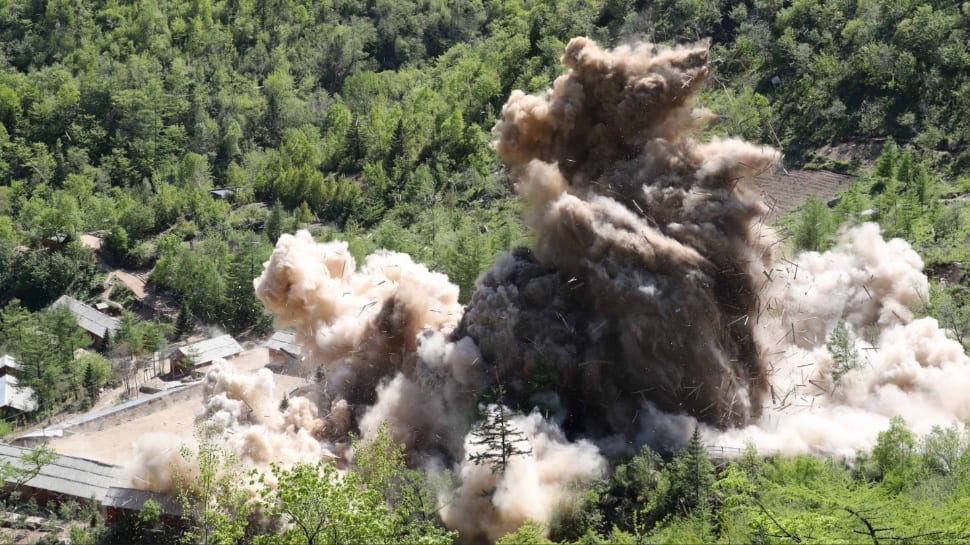
Recent claims by President Donald Trump that Pakistan is covertly conducting nuclear weapons tests have reignited a debate over seismic activity in the volatile region of Balochistan, the site of the country’s previous nuclear detonations.
In an interview with CBS News defending the resumption of US nuclear testing, Trump said Pakistan—along with nuclear powers such as Russia, China, and North Korea—is secretly carrying out bomb tests with no repercussions from the world:
A senior Pakistani official, when questioned by CBS News regarding the charge, firmly stated that Pakistan would not violate any international treaties by conducting nuclear tests. But Trump’s assertions bring renewed scrutiny to Balochistan, an area already prone to geological instability. According to data from the Earthquake List report, Balochistan experiences an average of 29 earthquakes annually, raising the critical question of whether these frequent tremors are a sign of natural geological stress or a cover for clandestine nuclear activity.
The Science: Can Earthquakes Mask Nuclear Tests?
The issue of the relationship between frequent earthquakes in Balochistan and nuclear testing has been widely debated by the scientific community. While a direct, conclusive link remains unproven, new research suggests that differentiating between natural tremors and man-made explosions is extremely difficult.
In fact, according to a recent study by Los Alamos National Laboratory scientists, led by Joshua Carmichael and published in the Bulletin of the Seismological Society of America, some earthquakes are actually masking secret nuclear tests.
Findings Of The Study:
Scientists designed a signal detection device that could identify an underground explosion of 1.7 tons with 97 percent accuracy.
But if a natural earthquake happens within 100 seconds and 250 kilometers of the blast, the accuracy falls to a dismal 37 percent.
This finding indicates that the seismic waves of a nuclear test may be masked in the waves of a nearby natural earthquake, and their correct detection by the global monitoring system would be very difficult to achieve.
Why Balochistan Is Prone To Natural Tremors
Even without the controversial element of nuclear testing, Balochistan is inherently prone to seismic activity due to its unique geological location. The region sits directly on the boundary between the Indian Plate and the Eurasian Plate.
Tectonic Collision: The Indian Plate has been slowly subducting, diving beneath the Eurasian Plate and creating immense underground pressure that has continued unabated. This geological collision is responsible for the formation of the Himalayan mountain range, and Balochistan lies on the extension of this major seismic belt.
Constant Pressure: The convergence rate is about 4 to 5 centimeters per year. Beyond the ground’s limit, the accumulated stress is released as an earthquake. This clarifies that due to constant tectonic movement, this region is an active seismic zone and often receives frequent natural tremors. The attendant controversy over Trump’s claims highlights the global challenge in monitoring nuclear proliferation in regions like Balochistan, which are prone to seismic activity.
Also Read | From ‘Great Smog’ To Clean Air: Five Global Cities That Conquered Pollution—A Lesson for Delhi