

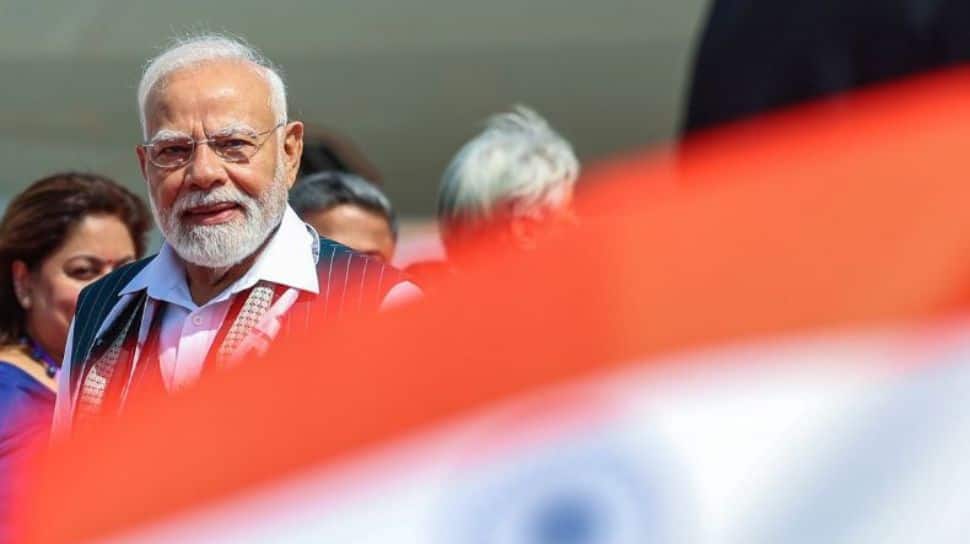
Prime Minister Narendra Modi arrived in Tokyo on Friday for a two-day official visit, marking his eighth trip to Japan as Prime Minister and his first annual summit with Japanese counterpart Shigeru Ishiba. The visit, centred on the 15th India-Japan Annual Summit, focused on strengthening the Special Strategic and Global Partnership amid evolving global challenges, including rising trade tensions and geopolitical uncertainty.
During the summit, Prime Minister Modi and his Japanese counterpart Shigeru Ishiba held wide-ranging discussions on defence, trade, technology, regional stability, and future cooperation in the Indo-Pacific. Here are the eight key outcomes from Day 1 of the visit:
Chandrayaan-5 LUPEX Mission
One of the key highlights of the visit was the announcement of Japan’s technological support for India’s Chandrayaan-5 LUPEX mission, which aims to explore signs that might support human habitation on the Moon. Foreign Secretary Vikram Misri said that the project plans for Indian astronauts to land on the Moon by 2040. He also mentioned that a new agreement signed during the visit will speed up cooperation and create opportunities for future joint space explorations.
Addressing a press conference in Japan, Misri said, “The idea behind the Chandrayaan-5 mission is to look together for signs that might support human habitation on the moon. Our space collaboration is not just limited to this one expedition. It also includes plans to explore other planets together by synergising our strengths. The Chandrayaan-5 LUPEX mission will be a major short-term milestone in India’s lunar exploration odyssey, which also incidentally envisions Indian astronauts landing on the moon by the year 2040. The signing of the implementation arrangement today will fast-track progress on this particular issue in the coming times.”
India-Japan Security Cooperation
In the security domain, both sides signed a joint declaration on security cooperation, creating a framework for India and Japan to respond more effectively to emerging security challenges. Misri said that the agreement covers areas such as cybersecurity, counterterrorism, defence industry collaboration, research and development, and closer coordination in multilateral forums.
“The joint declaration on security cooperation. This is an enabling framework for Indian and Japan to better respond to contemporary security challenges. An important feature of this document is the broad concept of security it embodies, which includes cooperation on cybersecurity, counterterrorism, defence industry, research and development, and closer cooperation on security issues in multilateral groupings. One of the new features of the security engagement between the two countries would be an institutionalised dialogue between the national security advisors of the two countries,” Misri said.
Human Resource Exchange
Misri said the visit also advanced cooperation in human resources between the two countries. A new action plan on people-to-people exchanges was concluded, targeting the movement of 5,00,000 individuals over the next five years, including 50,000 skilled and semi-skilled Indian workers to Japan.
“The two sides concluded an important action plan on human resource exchange today, which sets a headline number of two-way exchange of people of 5,00,000 over the next five years, including 50,000 skilled and semi-skilled personnel from India to Japan,” Misri said.
Japan To Invest $67 billion In India
Misri said that during the meeting, Japan announced a fresh investment target of 10 trillion yen ($67 billion) in India. At a business forum held during the visit, nearly 150 Memoranda of Understanding (MoUs) were signed, with a cumulative value exceeding $13 billion. This reflects growing confidence in India’s economic potential and the private sector’s role in the bilateral partnership.
“Today, it was decided to set a new investment target from Japan of 10 trillion Japanese Yen or $67 billion of private investment into India. At the business forum yesterday, the private sector announced around 150 MoUs. The cumulative value of these MoUs and business partnerships is over $13 billion, which is reflective once again of the confidence that the business pillar has in our relationship,” Misri said.
AI, Data Centres, Semiconductors, Critical Minerals And Pharmaceuticals
Misri said that during today’s meeting, both Prime Ministers launched the Japan-India AI Initiative, designed to strengthen collaboration in artificial intelligence, data centres, large language models, and AI governance. Additionally, they agreed to enhance cooperation in semiconductors, clean energy, critical minerals and pharmaceuticals. To further strengthen grassroots linkages, the India Kansai Business Forum and India Kyushu Business Forum were also launched.
“Both sides launched an economic security initiative, which identifies five priority sectors that will receive concentrated attention from the two sides. These sectors are semiconductors, critical minerals, pharmaceuticals, information and communication technologies, and clean energy. Both Prime Ministers launched the ‘Japan-India AI Initiative’, which will strengthen collaboration on large language models, data centres, and AI governance. PM Modi also invited Prime Minister Ishiba for the AI Impact Summit, which India is hosting in February 2026. Both the Prime Ministers decided to launch the India Kansai Business Forum and the India Kyushu Business Forum to induce more energy into our business linkages at the grassroots level,” Misri said.
Climate Change
Misri said that on climate change, the two sides agreed to establish a joint crediting mechanism to promote decarbonising technologies and sustainable infrastructure, facilitating Japanese investment in India’s clean energy transition while supporting emission reduction goals.
“A joint crediting mechanism has been agreed upon for climate change between the two sides. It is essentially an instrument to facilitate the diffusion of decarbonising technologies and infrastructure, essentially allowing Japanese companies to help us meet our greenhouse gas emission reduction goals and promote Japanese investment in India as well,” Misri said.
US-India trade tensions and ties with China
Asked about US-India trade tensions and ties with China, Foreign Secretary Misri clarified that the summit focused solely on India-Japan cooperation, with no discussions on third-country issues.
“At this point in time, our discussion with Japan was about our bilateral issues. We were not discussing issues between either one of us in any third country. Naturally, what is happening in the rest of the world is discussed. But today’s focus remained squarely on our bilateral cooperation,” Misri said.
Indo-Pacific
Misri said that in today’s meeting, both leaders reaffirmed their commitment to a free, open, and inclusive Indo-Pacific that is peaceful, prosperous, and resilient and issued a joint statement titled ‘A partnership for security and prosperity for our next generation.’
“A joint statement titled ‘A partnership for security and prosperity for our next generation’ has also been issued today. Both leaders reaffirmed their commitment to a free, open, and inclusive Indo-Pacific that is peaceful, prosperous, and resilient. Prime Minister reaffirmed that Japan stands with India on the issue of cross-border terrorism,” Misri said.