

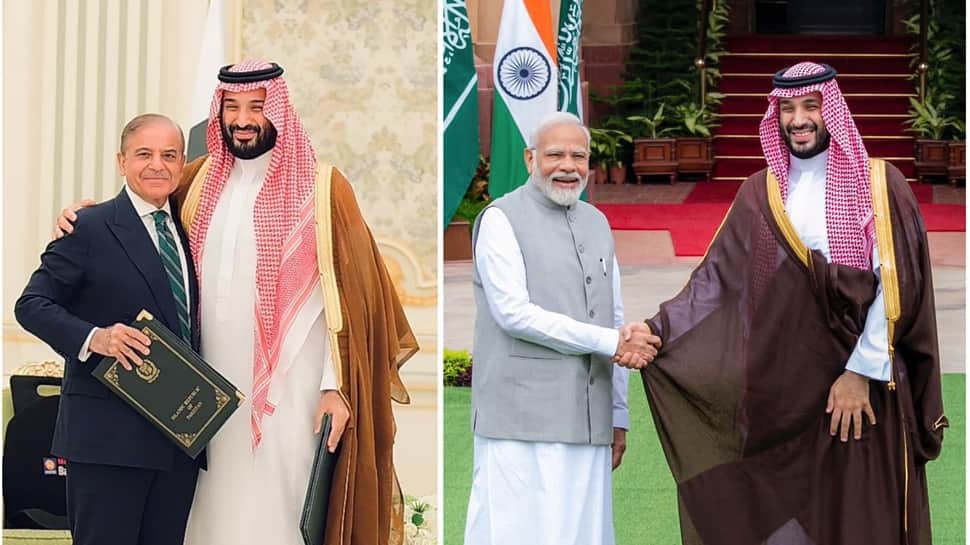
Saudi Arabia-Pakistan Defence Deal: The new defence pact between Pakistan and Saudi Arabia has raised eyebrows not only in India but in the United States and Israel as well. However, the deal appears to be a direct threat to India, given the recent Operation Sindoor conflict between New Delhi and Islamabad. After the pact, there are concerns whether Riyadh will join Pakistan if a war breaks out between India and its arch-rival. India on Thursday said it is closely examining the potential consequences of a new Strategic Mutual Defence Agreement signed between Saudi Arabia and Pakistan, a deal that deepens defence ties between the two long-time partners. In a statement, the Ministry of External Affairs (MEA) acknowledged the development and underlined that New Delhi had been aware of discussions around the pact for some time.
“We have seen reports of the signing of a strategic mutual defence pact between Saudi Arabia and Pakistan. The Government was aware that this development, which formalises a long-standing arrangement between the two countries, had been under consideration,” the MEA said.
The ministry added that India would “study the implications of this development for our national security as well as for regional and global stability,” while reiterating that New Delhi remains committed to safeguarding its interests and ensuring comprehensive security across all domains.
Saudi-Pakistan Defence Pact
The agreement, signed in Riyadh by Pakistani Prime Minister Shehbaz Sharif and Saudi Crown Prince Mohammed bin Salman, is seen as the most formal institutionalisation yet of a defence partnership that has spanned decades. At its core, the pact establishes that an attack on one country would be considered an attack on both—a clause often found in collective defense treaties and a step that elevates the bilateral security relationship to a new level.
The joint communiqué issued after the signing stated that the accord aims to “develop aspects of defence cooperation” and “strengthen joint deterrence against any aggression.”
Saudi Eyes Pak Nukes
For decades, questions have swirled around Saudi Arabia’s interest in Pakistan’s nuclear weapons programme. Many analysts believe that Riyadh may have quietly extended financial support to Islamabad’s nuclear ambitions. Diplomatic chatter over the years has hinted at the possibility of Pakistan extending a “nuclear umbrella” to Saudi Arabia, offering the kingdom a form of strategic protection without it having to build its own arsenal. Reports by the Associated Press note that such discussions have occasionally surfaced in diplomatic circles.
With Israel taking an increasingly aggressive security posture in the region, observers suggest that the timing of deeper Saudi-Pakistani defence cooperation may not be coincidental—and could reflect shared anxieties over regional threats.
Historical Context
The Saudi-Pakistan security relationship dates back to the 1960s, when Pakistan began training Saudi military personnel and supporting the kingdom’s defence preparedness. Over the years, this has expanded into joint military exercises, intelligence cooperation, and arms agreements.
While Riyadh has often looked to Pakistan for military expertise, Islamabad has relied on Saudi Arabia for economic assistance and energy security. The new pact, analysts say, could signal an attempt by both nations to formalise these longstanding ties in the face of shifting regional alignments.
Saudi-Pak Defence Deal Timing
The signing of the pact comes against the backdrop of heightened regional turbulence. Only days earlier, 26 people lost their lives in the Pahalgam attack, carried out by heavily armed militants from The Resistance Front, a Lashkar-e-Taiba affiliate operating out of Pakistan. In response, India launched ‘Operation Sindoor’, striking nine high-value terror facilities across Pakistan and Pakistan-occupied Kashmir (PoK). Islamabad retaliated with its own counter-offensive, further stoking already fragile tensions.
Adding to the volatility, the defence agreement was sealed amid wider upheaval in the Middle East. Just two days before the signing, Arab and Islamic nations convened an emergency joint session of the Arab League and the Organisation of Islamic Cooperation (OIC), following an Israeli airstrike on September 9 in Doha that killed senior Hamas political figures during ceasefire negotiations. The attack triggered sharp condemnations across Arab capitals, underscoring the fragility of the regional security environment.
The agreement also comes at a time of heightened strategic recalibration across West and South Asia—amid the evolving security environment in the Gulf, strained US-Saudi relations in recent years, and Pakistan’s search for stronger partners as it navigates internal economic and political challenges.
For India, which maintains strong energy and trade ties with Saudi Arabia while also viewing Pakistan as a key adversary, the pact introduces a new variable in its regional security calculus. New Delhi’s careful, measured response underscores the importance it places on monitoring how the Riyadh-Islamabad axis evolves in the months ahead.
Also Read: Regional Power Play: Top 5 Takeaways From Pakistan And Saudi Arabia’s Historic Defence Pact
Implications For India, Middle East
Although the pact carries NATO-style language—promising that an attack on one partner will be treated as an attack on both—its symbolism may outweigh its practical impact. For Islamabad, the agreement is already being hailed as a significant diplomatic win. Riyadh, however, is expected to approach the deal more cautiously, treating it primarily as a form of strategic deterrence, particularly with India in mind.
Still, many analysts argue the pact is largely performative, aimed less at India and more at sending a signal to Israel, especially amid the ongoing turbulence in the Middle East.
Conscious of how the optics might play in New Delhi, Saudi Arabia moved quickly to reassure India. A senior Saudi official, speaking to Reuters, stressed that the deal was ‘not directed at any specific country or event’, and emphasized the strength of Saudi-India relations. “Our relationship with India is more robust than it has ever been. We will continue to strengthen these ties,” said the official.
Bilateral trade between India and Saudi Arabia stands at around USD 42 billion, whereas that of Pakistan and Saudi Arabia is around USD 5 billion. Therefore, Riyadh is expected to take a neutral approach in case of a conflict between India and Pakistan.