

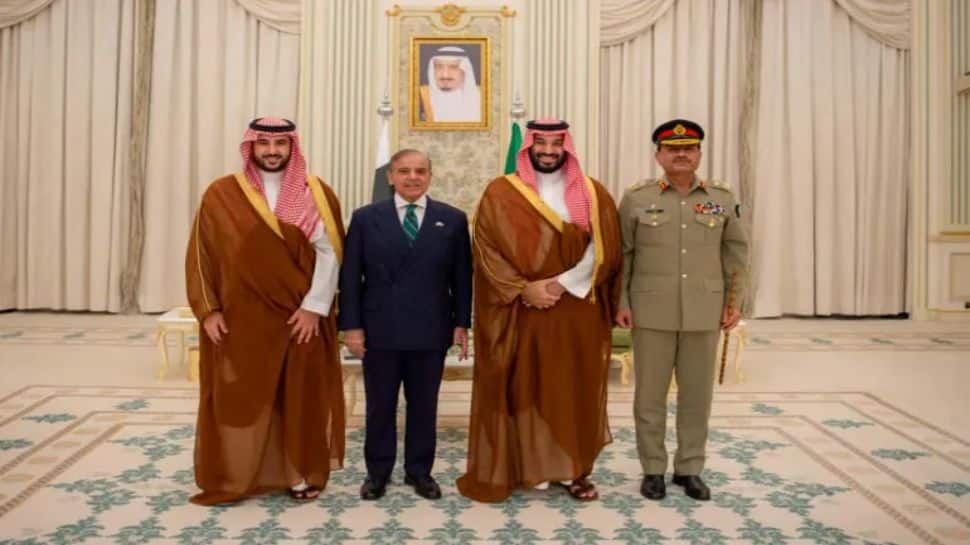
Riyadh: Pakistani Prime Minister Shehbaz Sharif arrived in Riyadh to a full royal welcome, flanked by Saudi F-15 jets and a red carpet. On Wednesday, he joined Saudi Crown Prince Mohammed bin Salman to sign a Strategic Mutual Defence Agreement (SMDA).
The signing at Al-Yamamah Palace included senior officials from both nations. Saudi Arabia, the custodian of Islam’s holiest sites, and Pakistan, the Muslim world’s only nuclear power, reinforced decades of ties that stretch back nearly eighty years.
The agreement comes at a time of heightened regional tension. Israeli attacks on Gaza, strikes on neighbouring states and last week’s assault on Qatar have unsettled Gulf politics. Pakistan and India recently fought a four-day military exchange in May, heightening South Asia’s instability.
Pakistan’s Ministry of Foreign Affairs described the deal as a reflection of “shared commitment” to regional peace and security. It pledged to “strengthen joint deterrence against any aggression”.
“The agreement states that any aggression against either country shall be considered an aggression against both,” the ministry added.
Experts call it a landmark move. Pakistan previously maintained mutual defence treaties with the United States during the Cold War, but they crumbled by the ’70s. Even with China, despite extensive defence cooperation, Pakistan lacks a formal mutual defence pact.
The pact could serve as a blueprint for Pakistan’s engagement with the United Arab Emirates (UAE) and Qatar. This agreement is likely to consolidate and formalise multi-prong defence cooperation already under way. New avenues for joint training, defence production and potential expansion of Pakistani troops in Saudi Arabia are likely to be explored.
Ties, Military Cooperation
Saudi Arabia was among the first nations to recognise Pakistan in 1947. A 1951 Treaty of Friendship established strategic, political and military cooperation.
Pakistani troops have trained in Saudi Arabia and at home, with over 8,000 Saudis trained since 1967. A 1982 agreement reinforced personnel deputation and military instruction.
Today, the Middle East faces new pressures. Gulf states remain uneasy about Israel’s actions and the reliability of US security guarantees.
Attacked on September 9 for hosting Hamas leaders, Qatar hosts US Central Command forward operations. About 40,000-50,000 US troops are stationed across the region, including Prince Sultan Air Base near Riyadh.
The SMDA language is likely to raise eyebrows in Washington. Pakistan already has a credibility problem in the United States. This agreement is not likely to reduce it. The nation is not likely to fight Saudi wars but provide relevant support.
A Region On Edge
Earlier this year, Israel fought a 12-day war with Iran, targetting nuclear facilities. American bombers were involved. Three months later, Israeli forces struck a Doha building hosting embassies, killing five Hamas members and one Qatari security officer.
The incident triggered an emergency GCC meeting. Bahrain, Kuwait, Oman, Qatar, Saudi Arabia and the UAE activated a joint defence mechanism.
The pact reflects Gulf security anxieties and waning confidence in the United States. As Gulf states seek to bolster security, regional partners such as Pakistan, Egypt and Turkiye emerge naturally. The pact likely took months to negotiate despite recent triggers.
The agreement exposes Pakistan and Saudi Arabia to each other’s regional disputes. Pakistan risks entanglement in Saudi rivalries, particularly with Iran. Saudi Arabia has committed itself to Pakistan’s disputes, notably with India, and potentially with Taliban-led Afghanistan.
The Indian Dimension
India watches closely. Relations with Pakistan sank after the April 22 Pahalgam attack and escalated with May’s four-day military clash.
Reacting to the deal between Riyad and Islamabad, Ministry of External Affairs spokesperson Randhir Jaiswal said, “We will study the implications of this development for our national security as well as for regional and global stability. The government remains committed to protecting India’s national interests and ensuring comprehensive national security in all domains.”
The agreements improves Pakistan’s standing, creating space for expanded bilateral defence and regional security cooperation. It ensures Islamabad is not isolated.
Nuclear Questions
Saudi Arabia has expressed interest in nuclear technology for civilian energy. Prince Abdulaziz bin Salman Al Saud emphasised uranium enrichment for power. He has stated Saudi Arabia does not seek nuclear weapons.
Bob Woodward’s 2024 book ‘War’ quotes Crown Prince Mohammed Bin Salman saying he would buy a bomb from Pakistan if needed.
The SMDA does not form a nuclear umbrella or extended deterrence. Robust alliances carry risk, but its political significance remains high. The agreement mainly makes a political statement.