

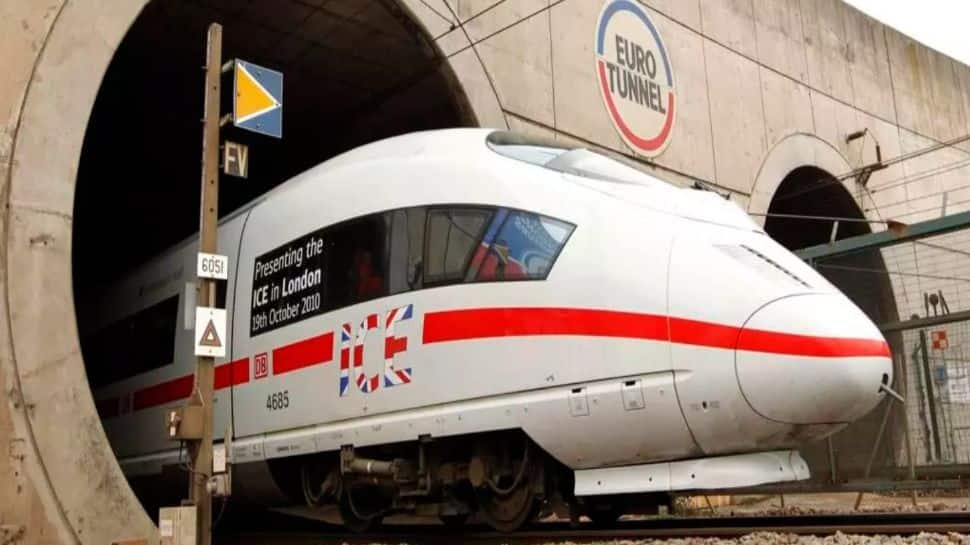
New Delhi: Beneath the calm surface of the English Channel lies a man-made wonder that few can imagine. Trains move swiftly through silence, far below the roaring waves, in a tunnel that connects two nations once separated by the sea.
Often called The Chunnel, the Channel Tunnel stretches 50.45 kilometres, linking Folkestone in England’s Kent to Coquelles in France’s Pas-de-Calais. It runs deep under the English Channel, the water body that joins the North Sea with the Atlantic Ocean. What makes it remarkable is its depth, which is nearly 75 metres below the seabed, equivalent to the height of a 20-story building turned upside down into the earth.
The Longest Undersea Tunnel In The World
This is the longest undersea tunnel ever built. Its construction began in 1988, and the first passenger train rolled through in 1994. Of its total length, about 23.3 kilometres lie directly beneath the sea. Japan’s Seikan Tunnel also runs underwater, but its undersea stretch is shorter at roughly 23 kilometres.
A Network Of Three Tunnels
The Channel Tunnel is not merely a single passage. It includes two main rail tunnels and a smaller service tunnel in between. Passenger and freight trains both use it daily. The most famous among them is the Eurostar, a high-speed passenger train that connects London with Paris and Brussels in just over two hours.
Another service called Le Shuttle ferries cars, buses and trucks through the tunnel. Travellers can drive onto special trains with their vehicles, sit back and emerge on the other side ready to continue their journey.
A Journey Replacing Sea And Air
Before the tunnel existed, travellers relied only on ships or flights between England and France. Ships took longer and flights cost more.
The tunnel changed everything, bringing speed, comfort and a new sense of connection between the two countries.
Each year, millions of passengers cross through this engineering marvel. It has become an essential part of Europe’s transport network, moving people and goods swiftly under the sea.
Today, the Channel Tunnel stands as more than a link between nations. It is a symbol of how human imagination can carve a path beneath the ocean, a route where the rumble of trains replaces the roar of waves.